

More news on this day
Passengers at Dubai’s Al Maktoum International Airport (DWC) faced fresh travel chaos on March 7 as at least 14 flights were delayed and nine canceled, compounding a wider regional shutdown that has disrupted links to Saudi Arabia, Qatar, Bahrain, Oman and other key Gulf and international destinations.
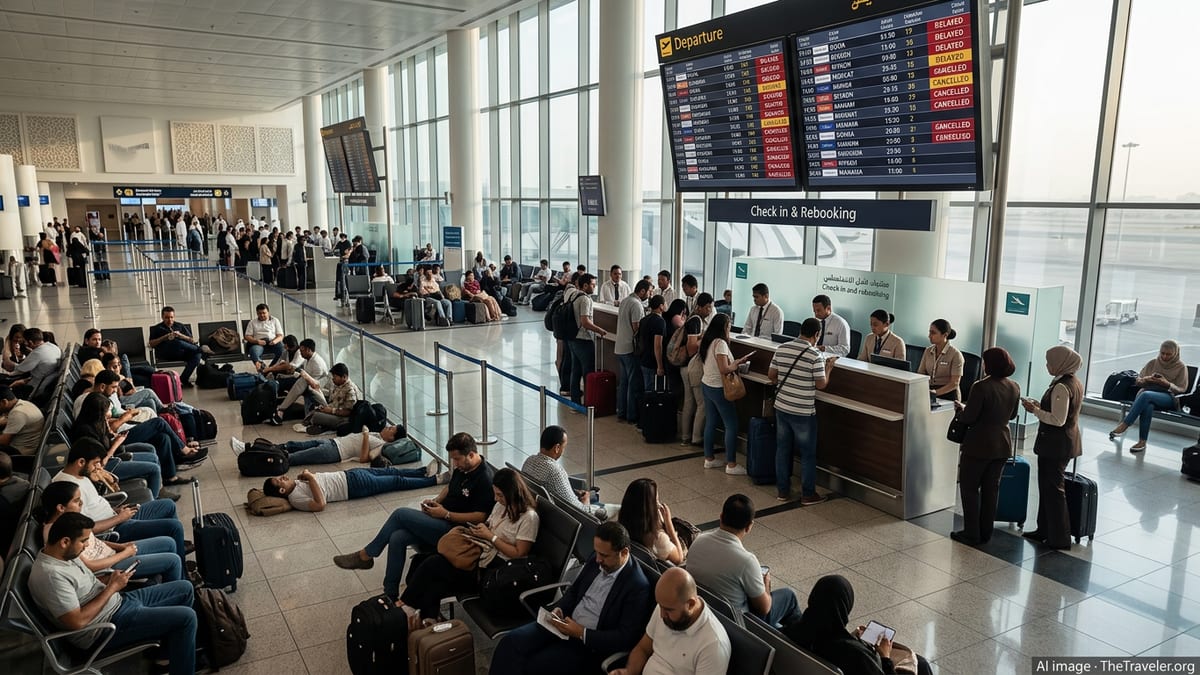
Al Maktoum Airport Feels the Strain as Region Reopens in Patches
The turbulence at Al Maktoum International comes just as authorities in the United Arab Emirates begin cautiously restarting services following days of near-total suspension across Dubai’s airports. Dubai Airports confirmed that limited operations have resumed at both Dubai International (DXB) and Al Maktoum (DWC), but the network remains fragile, with schedules changing by the hour as carriers respond to shifting airspace permissions and operational constraints.
The latest disruption at DWC, involving 14 delayed and nine canceled services, underscores how vulnerable secondary hubs are when regional airspace is restricted. While the airport normally handles a mix of leisure, budget and cargo traffic, it has become an overflow and contingency node during the crisis, absorbing diverted flights and emergency rotations when capacity at DXB is saturated.
Airlines using Al Maktoum, including low-cost carriers and charter operators, have struggled to maintain reliability as flight paths are rerouted around closed skies and as slots at onward hubs tighten. Ground handling teams report intense pressure to turn around aircraft quickly when takeoff windows open, only to see fresh ground stops imposed as conditions change.
Operational planners say that, in effect, DWC has been operating in surge mode for days, with staff juggling last-minute aircraft swaps, crew duty-time limitations and high passenger volumes in a terminal not designed for prolonged mass disruption.
Ripple Effects Across Saudi Arabia, Qatar, Bahrain and Oman
The knock-on impact from Dubai’s secondary hub has been felt across the Gulf. Flights from Al Maktoum feeding into Saudi Arabia’s major cities, as well as to Doha, Manama and Muscat, have been among those delayed or canceled as carriers prioritize core trunk routes and designated relief corridors from primary hubs.
Saudi Arabia, which has reopened some of its airspace and airports to limited commercial operations, is seeing uneven connectivity from the Emirates. While certain long-haul and national-carrier services into Jeddah and Riyadh are resuming on tightly managed schedules, secondary and low-cost links from DWC have been more vulnerable to cancellation when aircraft and crews are redeployed to higher-priority services.
In Qatar, already hard hit by the closure and subsequent partial reopening of Hamad International Airport in Doha, even small disruptions from feeder airports like DWC have outsized effects. Connections to Europe, Asia and Africa rely heavily on banks of inbound flights arriving within narrow time windows. When an Al Maktoum departure misses its slot or is scrapped altogether, passengers can lose not just one leg but an entire onward itinerary.
Oman and Bahrain, which have marketed themselves as alternative gateways during the crisis, are likewise absorbing displaced travelers from canceled Dubai services. Muscat International, in particular, remains one of the more stable corridors in the region, yet authorities there have tightened terminal access and urged only ticketed, confirmed passengers to approach the airport as they balance a surge of transit travelers against finite capacity.
Stranded Passengers Face Long Waits, Patchy Information
For travelers at Al Maktoum, the immediate experience is one of uncertainty. Many passengers arriving at the airport on March 7 reported learning of delays only at check-in, while others discovered that their flights had been canceled after hours in the terminal. With call centers overwhelmed and airline apps and websites struggling to keep pace with rapid schedule changes, accurate, real-time information has been in short supply.
Airport staff have urged travelers not to come to DWC unless they hold a confirmed booking and have received explicit notification that their flight is operating. This mirrors guidance from major Gulf carriers across the region, which are warning that a functioning “relief corridor” is not the same as a full reopening of their hubs and that standby travel or last-minute rebooking at the airport is unlikely to succeed.
Inside the terminal, temporary queuing systems and improvised customer-service points have appeared as airlines attempt to rebook passengers onto scarce seats through Abu Dhabi, Doha or Muscat. However, the tight capacity of those hubs, combined with distance-to-duty limits for flight crews and the need to keep aircraft positioned where they are most effective for evacuations and essential routes, means that many travelers are being told to expect waits of 24 to 72 hours before onward travel is possible.
For some, the only immediate exit has been through costly private charters or overland transfers to airports in Oman or Saudi Arabia where a handful of long-haul services are operating. Travel agents in Dubai report that inquiries about road transfers to Muscat and Riyadh have surged since the weekend as passengers try to bypass the congestion at Dubai’s airports.
Carriers Juggle Relief Flights and Fragile Schedules
The strain at Al Maktoum is closely tied to how airlines are rebuilding their regional networks. Major Gulf carriers, including Emirates, Etihad and Qatar Airways, have begun operating limited schedules focused on relief flights and carefully controlled corridors into and out of their main hubs. These operations are geared toward clearing backlogs of stranded travelers rather than restoring the kind of high-frequency, connection-rich patterns that characterized the Gulf’s pre-crisis aviation landscape.
Industry briefings indicate that carriers are using a mix of wide-body aircraft on short- and medium-haul hops to move the greatest possible number of passengers where airspace is available. In that context, flights in and out of DWC often serve as tactical additions or backup options rather than core services, which partly explains why they are among the first to be cut when circumstances tighten.
Some airlines have redeployed aircraft that would ordinarily operate Dubai World Central rotations to operate evacuation-style services from Muscat, Riyadh or Jeddah to European and Asian cities. Others are consolidating multiple lightly booked services into single flights from Dubai International or Abu Dhabi, leaving DWC-based passengers to be re-accommodated via ground transfers and reissued tickets.
At the same time, carriers must navigate ongoing airspace closures over multiple countries, leading to longer flight times, increased fuel burn and tighter crew rosters. These constraints ripple back into scheduling at Al Maktoum, where a missed crew connection or late-arriving aircraft can cascade into further delays and last-minute cancellations.
What Travelers Using Al Maktoum Should Expect Next
With regional volatility and evolving airspace restrictions, aviation analysts caution that disruptions at Al Maktoum International are likely to continue in the short term, even as more flights are gradually added back to the boards. Airlines have signaled ambitions to restore capacity in the “coming days,” but much depends on the security situation and the ability of air traffic controllers to safely expand available corridors.
Passengers booked to or from DWC in the next week are being encouraged to monitor their airline channels closely and to consider flexible routing options via Muscat, Riyadh or other operational hubs if changes become available. However, experts warn against making speculative journeys to the airport, as seats on relief flights are typically pre-assigned to those already stranded and prioritized for families, older travelers and those with urgent medical or humanitarian needs.
For now, Al Maktoum International remains emblematic of the region’s broader aviation turmoil: technically open, but operating under significant constraint, with every new delay or cancellation sending shockwaves across a delicate web of Gulf connections. Until a more stable pattern of airspace access is restored, even modest disruptions at this secondary Dubai hub are likely to reverberate through Saudi Arabia, Qatar, Bahrain, Oman and beyond, keeping thousands of passengers in limbo.