

More news on this day
Travel chaos has gripped Toronto Pearson International Airport today as a powerful winter storm sweeping across North America forces airlines including Air Canada, Jazz, Endeavor, Republic and WestJet to cancel 151 flights and delay a further 160, disrupting tightly connected routes across Canada, the United States, Mexico and key European cities.
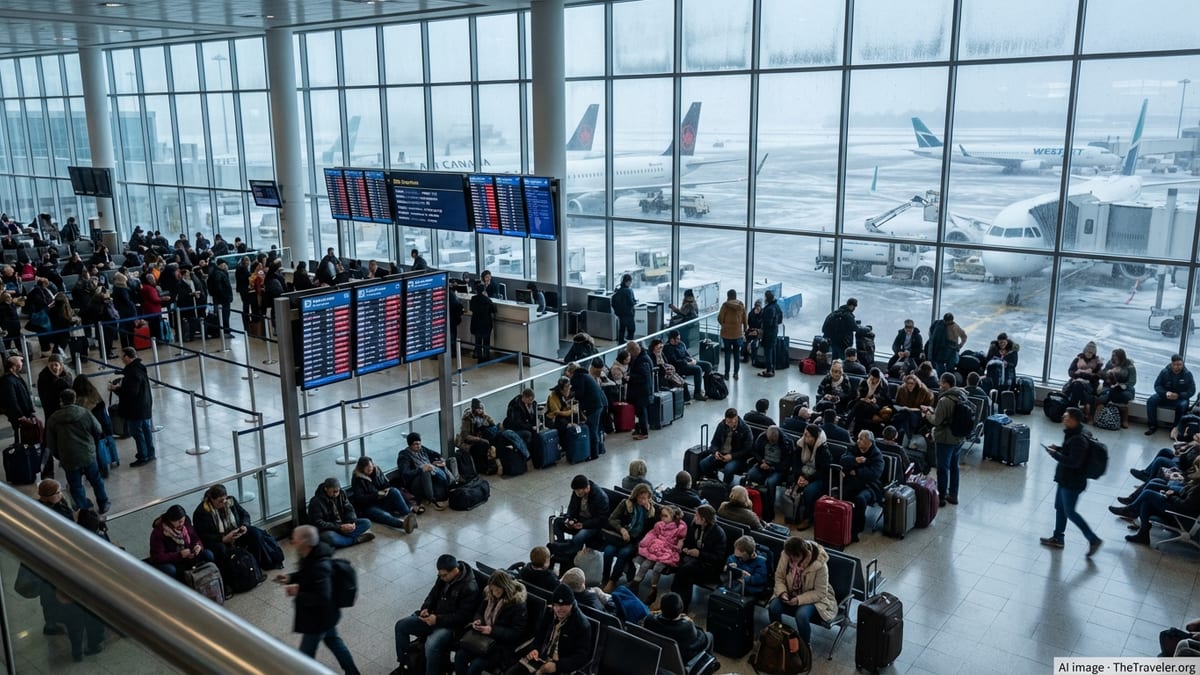
Storm-Stricken Hub Struggles to Keep Operations Moving
Toronto Pearson, Canada’s busiest airport, spent Monday battling high winds, blowing snow and deteriorating runway conditions as the latest winter system pushed across Southern Ontario. Airport plows, deicing trucks and ramp crews worked continuously to keep critical surfaces clear, but fast-changing weather and poor visibility repeatedly slowed the flow of aircraft in and out of the hub.
The airport’s central role in linking Canadian cities with the United States, Mexico and Europe amplified the impact of every cancelled or delayed departure. With 151 cancellations and 160 significant delays logged by midday, according to operational data reviewed by aviation analysts, Pearson quickly climbed to the top tier of global disruption tables, with ripple effects visible across multiple time zones.
Airport officials urged travelers to arrive early, monitor their airline apps and be prepared for last-minute gate changes as air traffic controllers imposed spacing restrictions on takeoffs and landings for safety. Inside the terminal, departure boards cycled through rolling updates, with growing clusters of red "cancelled" and "delayed" notices on flights operated by Canadian and U.S. carriers alike.
While the runways remained technically open for much of the day, ground operations were constrained by the rate at which aircraft could be deiced and maneuvered safely. The result was a patchwork of departures punctuated by long pauses as crews paused to let squalls pass and visibility improve.
Air Canada, Jazz and Regional Partners Bear the Brunt
As Pearson’s dominant carrier, Air Canada absorbed a substantial share of the disruption. The airline and its regional affiliates, including Jazz and U.S. partners such as Endeavor Air and Republic Airways operating codeshare services, collectively accounted for a large portion of the 151 cancellations and 160 delays recorded at the airport.
Domestic routes linking Toronto with major Canadian cities such as Vancouver, Calgary, Montreal, Ottawa and Halifax were particularly affected, as were cross-border flights to busy U.S. hubs like New York, Chicago, Boston and Washington. With aircraft and crew rotations thrown into disarray, some cancellations were driven not only by weather in Toronto but also by storm-battered airports further south and east.
Regional jets serving secondary markets faced acute challenges. These aircraft typically cycle through multiple cities over a single day, so an early-morning cancellation can strand a plane and crew in one location and strip capacity from several later legs. Jazz and other regional operators scrambled to reposition aircraft where possible, but the widespread nature of the storm limited options for quick recovery.
Air Canada customer service teams were inundated with rebooking requests, as passengers tried to salvage business trips, family visits and long-planned vacations. The carrier issued waivers allowing customers on affected routes to change their travel dates without standard penalties, but limited remaining seat availability meant many travelers faced waits of 24 to 48 hours before alternative flights became available.
WestJet and U.S. Carriers Caught in a North American Gridlock
WestJet, Canada’s second-largest airline, also felt the strain as the weather system intersected with its network of domestic and transborder services. Cancellations were concentrated on flights linking Toronto with Western Canadian cities and sun destinations in the United States and Mexico, where aircraft arriving late from storm-affected regions could not be turned around quickly enough to maintain schedules.
U.S. partner airlines operating to and from Pearson, including regional affiliates of major American carriers, faced the twin challenges of weather at Toronto and near-blizzard conditions across parts of the northeastern United States. Airports such as Newark, LaGuardia, Boston Logan and Philadelphia were simultaneously grappling with their own ground stops and deicing queues, forcing operators to scrub some Toronto-bound flights in advance.
In many cases, cancellations at U.S. hubs cascaded directly into Pearson’s totals. When an inbound aircraft from a U.S. city never left the gate because of local conditions there, its corresponding outbound leg from Toronto disappeared from the schedule as well. This dynamic contributed to the growing number of Pearson cancellations that were technically recorded as Toronto-originating, even when the root cause lay hundreds of kilometers away.
The combined effect was a continent-wide gridlock that left crews and aircraft out of position from Minneapolis to Mexico City, making it harder for airlines to restore normal patterns even when brief weather windows opened over Toronto.
Transatlantic and Mexico Routes Hit as Long-Haul Plans Unravel
While the bulk of cancellations and delays involved short- and medium-haul routes, long-haul passengers also saw carefully timed itineraries fall apart. Several transatlantic departures to major European gateways were delayed for hours as carriers waited for connecting passengers and inbound aircraft trapped in weather elsewhere on the continent or in the United States.
Routes linking Toronto with European cities such as London, Frankfurt, Paris and Dublin reported significant boarding delays as ground handlers navigated icy aprons and mandatory deicing procedures. Any additional snowfall or wind shifts forced temporary suspensions of ramp activity, further complicating attempts to keep widebody operations on track.
Mexico services, traditionally popular during the winter months with Canadian holidaymakers, also suffered. Flights to resort destinations and major hubs alike encountered a mixture of outright cancellations and lengthy delays as aircraft were shuffled among routes and crew duty-time limits approached. Some passengers who had already experienced earlier disruptions at connecting airports in the United States found themselves facing a second wave of cancellations at Toronto.
Because many long-haul journeys involve tight connections through Pearson, the knock-on effects extended well beyond the airport’s immediate catchment area. Travelers originating in mid-sized Canadian cities and relying on Toronto as an intercontinental springboard often discovered that a delayed feeder flight meant missed transatlantic or Mexico departures, triggering complex rebooking challenges.
Inside the Terminal: Crowded Gates, Long Queues and Frayed Nerves
Inside Pearson’s terminals, the human cost of the disruptions was immediately visible. Gate areas filled with stranded travelers stretched out on carry-on bags, occupying any available power outlet and refreshing airline apps in search of updates. Families tried to keep children entertained against a backdrop of repeated public address announcements advising patience and apologizing for "weather-related operational constraints."
Customer service desks and airline transfer counters developed long queues as passengers sought hotel vouchers, meal credits and rebooked itineraries. Many travelers reported waiting over an hour to speak to an agent in person, prompting others to turn to call centers or online chat tools that were themselves overwhelmed by demand.
Nearby concession stands, coffee bars and airport lounges saw a surge in traffic as delayed passengers set up makeshift offices and waiting rooms. While some travelers took the disruptions in stride, describing them as an unfortunate but familiar feature of winter flying, others expressed frustration at what they saw as a lack of clear communication about realistic departure times.
Volunteer assistance teams and airport staff moved through the halls offering directions, distributing basic information and helping vulnerable travelers, including seniors and those with mobility challenges, navigate between rebooked gates or overnight accommodations. Hotels near the airport reported high occupancy levels as evening approached and it became clear that many flights would not depart until at least the following day.
How the Blizzard and Regional Weather Patterns Fueled the Disruption
The disruption at Toronto Pearson did not occur in isolation. The storm hitting Southern Ontario was part of a larger winter system affecting wide swaths of the northeastern United States and parts of Atlantic Canada, intensifying a pattern of repeated storms that has plagued airlines throughout the 2025–26 winter season.
Forecasters noted a blend of heavy snow, freezing rain and gusty winds moving through the Great Lakes region, reducing visibility on approaches and making runway surfaces more difficult to maintain. In the United States, near-blizzard conditions along the Interstate 95 corridor and at major hubs such as New York and Boston triggered thousands of cancellations, which in turn knocked out numerous aircraft rotations feeding into Toronto-bound schedules.
Because modern airline networks rely heavily on aircraft and crew circulating through multiple cities in tightly coordinated patterns, weather issues in one region can quickly propagate elsewhere. At Pearson, that meant that even when local visibility improved temporarily, airlines sometimes lacked an aircraft or rested crew to operate the next scheduled departure, forcing managers to prioritize certain routes and cancel others.
Operational planners also had to factor in strict duty-time regulations designed to prevent crew fatigue. Extended delays earlier in the day nudged some pilots and cabin crews toward their legal limits, leading airlines to cancel or consolidate flights rather than risk last-minute crew shortages after boarding.
Airlines Respond With Waivers, Flexible Policies and Recovery Plans
In response to the mounting disruption, major carriers serving Toronto Pearson rolled out a range of protective measures aimed at giving customers more flexibility. Change-fee waivers were introduced on many affected routes, allowing passengers booked on the most heavily impacted days to shift travel to later in the week without incurring standard penalties, subject to seat availability.
Some airlines temporarily relaxed fare rules for nonrefundable tickets, permitted changes to alternate nearby airports, or allowed travelers to move their trips forward or backward by several days. These policies were particularly important for those connecting to long-haul flights to Europe or Mexico, where missed departures could otherwise mean multi-day delays.
Behind the scenes, airline operations centers initiated recovery plans focused on rebalancing aircraft and crew across the network as weather conditions gradually improved. This process typically involves prioritizing aircraft for long-haul and high-demand domestic routes, then rebuilding regional schedules as resources become available.
Even with these efforts, experts cautioned that the effects of the storm would likely linger for at least another 24 to 48 hours. Passengers whose flights were not cancelled outright still faced the possibility of rolling delays while airlines worked through backlogs and positioned aircraft back to their intended bases.
What Travelers Can Expect in the Coming Days
With forecasts calling for lingering snow showers and another potential system tracking toward Ontario later in the week, travelers through Toronto Pearson were advised to build extra time and flexibility into their plans. Airlines and airport officials recommended that passengers avoid arriving at the airport until their flight status showed "on time" within a few hours of departure, as early arrivals only added to congestion inside the terminals.
Experts also stressed the importance of monitoring both origin and destination weather conditions, not just the forecast for Toronto. Because Pearson acts as a central link in a wider web of North American and transatlantic routes, issues at outstations can quickly ripple back into the Toronto schedule, even if local skies appear to be clearing.
For those whose trips are not urgent, travel advisers suggested considering voluntary rebooking to later dates in order to avoid the worst of the recovery period. Flexible work arrangements and remote connectivity make it easier for some travelers to postpone nonessential journeys, potentially freeing capacity for those with more pressing reasons to fly.
Looking ahead, the latest disruption at Toronto Pearson has renewed debate among travelers and industry observers about winter preparedness, schedule resilience and the limits of operating complex global networks in an era of increasingly volatile weather. For the thousands of passengers still waiting in terminals across Canada, the United States, Mexico and Europe, however, the priority remained far simpler: a safe departure and a long-delayed arrival at their intended destination.