

More news on this day
Chicago O’Hare International Airport is experiencing another punishing spell of disruption, with publicly available tracking data showing 640 flight delays and 87 cancellations, snarling Easter-period travel for passengers across the United States and overseas.
Get the latest news straight to your inbox!
Storm Systems and Holiday Crowds Converge
The disruption comes as a fresh round of spring storm systems sweeps across northern Illinois and the Great Lakes region, producing heavy rain, thunderstorms and localized flooding that have repeatedly interfered with flight operations at O’Hare. Aviation and weather trackers indicate that the latest wave of delays coincides with unstable conditions that have reduced visibility, slowed arrivals and forced spacing between departures.
The timing of the latest problems has compounded the impact. The early April Easter travel window has already pushed airlines to operate dense schedules through Chicago, one of the country’s busiest hubs. Higher passenger loads have left fewer open seats to absorb missed connections, meaning a single delay in the morning can ripple throughout the day and across the national network.
Operational data compiled from flight-tracking platforms show that when ground delay programs are activated at O’Hare because of storms or congestion, average departure waits can quickly stretch well beyond published schedules. Once that happens, both domestic and international routes feel the shockwaves.
Major Airlines Face Widespread Disruption
Current figures on delays and cancellations at O’Hare point to a broad-based problem rather than one confined to a single carrier. Published coverage of the disruption highlights that American Airlines, United Airlines, Delta Air Lines, Southwest Airlines and Spirit Airlines all have flights affected, along with several regional affiliates that connect smaller cities to the Chicago hub.
Industry trackers show that on comparable recent days of severe disruption, some network carriers at O’Hare have seen well over one third of their schedules arrive late, alongside clusters of cancellations concentrated in late afternoon and evening banks. Low-cost and regional operators have sometimes fared worse, with higher percentages of their relatively smaller schedules being scrubbed entirely when aircraft and crew cannot be repositioned in time.
The latest count of 640 delayed flights and 87 cancellations at O’Hare underscores the way a single hub can become a choke point for much of the country. With Chicago serving as a central connecting point between coasts, the Midwest and international destinations, any loss of operational capacity quickly translates into missed onward connections and longer recovery times for airline schedules.
Ripple Effects Across the United States and Beyond
The problems in Chicago are not confined to Illinois. Flight information summaries indicate that disruption at O’Hare is radiating outward to airports across the United States and in several international markets. Delayed departures from Chicago are arriving late into cities such as New York, Washington, Dallas, Denver and Phoenix, often forcing crews to bump back return segments or cancel individual flights outright.
Published reports focused on the current crisis note that connections to Canada and Europe are also affected, with knock-on delays for passengers who planned to transfer through O’Hare onto transatlantic services. In earlier episodes of severe disruption this season, travel media documented cancellations or heavy delays on routes linking Chicago to hubs in Germany and Switzerland, illustrating the vulnerability of long-haul itineraries when a major U.S. hub becomes constrained.
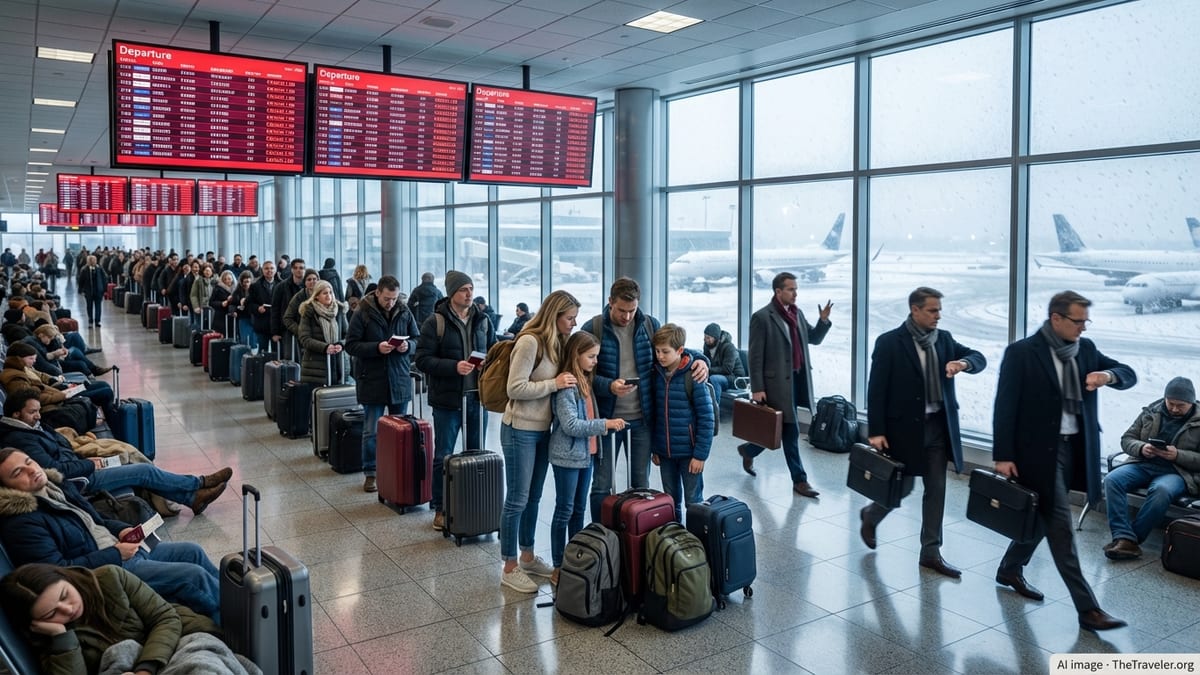
For travelers, the practical effects are highly visible: crowded gate areas, long queues at customer service desks and rapidly changing departure boards dominated by orange and red status alerts. Even when flights eventually depart, extended taxi times and airborne holding patterns around Chicago can push already-late services deeper into the night.
Infrastructure Strain and Staffing Pressures
The latest day of travel chaos is unfolding against a backdrop of longer-running structural challenges at O’Hare. Passenger accounts shared across public forums over recent months describe protracted waits for arrival gates, lengthy taxi times and aircraft holding on the tarmac as they queue for available stands. These experiences line up with the reality that several carriers have added capacity at O’Hare while construction and modernization projects continue across parts of the airfield.
Commentary from aviation observers has also drawn attention to staffing pressures in the wider Chicago airspace system. Publicly accessible advisory notices for recent weeks have pointed to ground delay programs linked not only to weather but also to air traffic control staffing constraints. When fewer controllers are available to safely handle peak volumes into and out of Chicago, the Federal Aviation Administration’s traffic management initiatives can force airlines to trim or retime flights, adding another layer to weather-related disruption.
At the same time, security and landside operations are under strain. National passenger-screening data show that O’Hare is handling high throughput this spring, and social media posts from travelers have described long check-in and security lines during peak morning and evening waves. Even when flights operate close to on time, congestion in terminal areas can add stress for passengers racing to make connections.
What Travelers Can Expect in the Coming Days
With storms still active in the broader Midwest region and airlines working through significant backlogs, travel analysts warn that disruption linked to the current spike in delays and cancellations at O’Hare may not resolve immediately. Experience from previous severe-weather events indicates that it can take 24 to 72 hours for schedules to stabilize once hundreds of aircraft and crew rotations have been thrown off balance.
Public guidance from airlines and aviation agencies generally emphasizes flexible planning in such periods. Same-day rebooking options are often constrained when planes are already full for the Easter travel rush, and passengers may find that the most reliable alternative is to travel at off-peak times or accept routing through secondary hubs if seats are available. Those with nonessential travel in or out of Chicago in the short term may also choose to delay trips until operations visibly normalize.
For now, the headline figures of 640 delays and 87 cancellations at Chicago O’Hare capture only part of the disruption’s real-world impact. Behind each statistic is a disrupted itinerary, a missed family gathering or a business trip cut short. With the busy summer season still ahead, the latest episode of chaos at O’Hare is likely to renew scrutiny of how the airport and the wider U.S. aviation system manage the growing combination of extreme weather, crowded skies and limited operational slack.