

More news on this day
International travel across the Gulf and Mediterranean is facing a fresh wave of turmoil, as new operational disruptions in the United Arab Emirates, Saudi Arabia, Qatar and Greece leave passengers stranded, schedules shredded and confidence in key global hubs under renewed strain.
Multiple Hubs, One Bad Week for International Flyers
The latest bout of disruption spans some of the world’s most important aviation crossroads: Dubai and Abu Dhabi in the UAE, Doha in Qatar, and Jeddah in Saudi Arabia, along with key airports in Greece already buckling under surging traffic and infrastructure pressures. In aggregate, at least 31 flights have been fully grounded and a further 62 services have suffered major operational setbacks across these networks in recent days, according to airline statements and schedule analyses, with knock on delays stretching far beyond the region.
The immediate triggers vary by country, ranging from weather related ripple effects tied to a powerful United States East Coast winter storm to systemic congestion on Europe Mediterranean corridors and tight staffing at overstretched airports. Yet for passengers, the lived experience is the same: long queues at transfer desks, rolling gate changes, blown connections and last minute SMS alerts advising that carefully planned itineraries are suddenly in ruins.
Because Dubai, Abu Dhabi, Doha and Jeddah function as global transit superhubs rather than purely origin and destination gateways, one cancelled or severely delayed widebody departure can strand hundreds of people at a time. When similar patterns emerge simultaneously at Athens and other Greek airports, the cumulative effect is a web of missed onward flights that can stretch from North America to Southeast Asia.
Emirates and Etihad Wrestle With Knock On Storm Impacts
For Emirates and Etihad, the week’s challenges have been compounded by the fallout from a fast moving Nor’easter that has hammered the United States East Coast with blizzard conditions, forcing widespread cancellations at New York, Newark and Boston. The storm, which intensified on February 22 and 23, prompted both Gulf carriers to proactively ground and retime a cluster of transatlantic services, including flagship Dubai New York and Abu Dhabi New York rotations, as well as Athens to Newark tag flights used heavily by Europe and Middle East travelers.
Data from airline advisories and independent trackers indicate that across the latest 48 hour window alone, Emirates and Etihad together have fully cancelled more than a dozen long haul departures tied directly to the storm, with approximately twice that number experiencing long delays, aircraft swaps or significant schedule changes. Those figures sit within a broader tally of at least 31 grounded flights and 62 heavily disrupted services across the wider UAE, Saudi, Qatari and Greek networks, as weather and congestion effects reverberate through already tight winter timetables.
At Dubai International and Abu Dhabi International, the operational focus has shifted to keeping the rest of the system flowing. Airlines have been consolidating lightly booked services, turning aircraft around more quickly where possible and leaning on spare crews to recover punctuality. Airport authorities have meanwhile advised connecting passengers to allow extra time for security and transfer formalities, warning that immigration and rebooking desks could see surges whenever a major long haul cancellation is announced.
With the Nor’easter expected to lose strength over the coming days, carriers hope to restore near normal schedules on the North America corridor. But the disruptions have exposed just how vulnerable even well resourced Gulf hubs remain to severe weather a continent away, especially when winter storms collide with peak weekend travel demand.
Qatar Airways and Saudia Face Network Wide Pressure
In Doha and Jeddah, operations have been under parallel strain, albeit for slightly different reasons. Qatar Airways, which relies heavily on coordinated banks of arrivals and departures to feed its global network, has seen a series of cascading delays after aircraft and crew were displaced by weather events and air traffic control restrictions on long range sectors. When one arrival lands outside its allocated slot, tightly wound connection banks can unravel quickly, forcing the airline to hold onward flights for late connecting passengers or offload and rebook those who miss the cut.
Saudia, which has been growing its international network aggressively from Jeddah and Riyadh, is confronting similar schedule fragility. High winter demand on religious and labor corridors, combined with lingering crew rostering challenges and occasional ground handling bottlenecks at regional airports, has led to a higher incidence of late running flights. When those services feed into long haul departures to Europe or Asia, any delay can push aircraft beyond legal crew duty limits, obliging the airline to cancel or significantly retime departures at short notice.
Recent data from passenger rights platforms tracking Middle East operations point to several hundred delays and dozens of cancellations across Dubai, Jeddah, Dammam and Doha in the final quarter of 2025, underlining how narrow the margin for error has become at these fast growing hubs. While not every disruption in the current episode can be attributed to systemic issues, the confluence of weather, tight networks and infrastructure strain has pushed many routes past the tipping point where minor operational hiccups turn into major passenger headaches.
For travelers passing through Doha, Jeddah or Dammam over the coming days, the picture is one of intermittent but sometimes severe disruption. Flights may still depart the same day, but often hours behind schedule, and in some cases overnight holds are necessary when inbound aircraft arrive too late to turn around legally or when curfews at destination airports close the window for safe operations.
Greece’s Overstretched Airports Amplify the Shockwaves
The troubles in the Gulf are being amplified by conditions in Greece, where airports are grappling with an extraordinary surge in traffic early in 2026. Analysis of operational data for the first seven weeks of the year shows an 85 percent jump in air traffic compared with the same period in 2025, with more than 74,000 flights operating between January 1 and February 17 alone. That rapid growth has left airport infrastructure and air traffic management playing catch up, with knock on effects for flights linking Greece to the Middle East and beyond.
One of the most heavily affected corridors has been Athens to Dubai, which has ranked as the single most disrupted route in recent monitoring, with more than a third of flights experiencing delays of at least 60 minutes. Other key European links, including Athens to Paris Charles de Gaulle and Athens to Istanbul, have also faced elevated levels of disruption, with a combination of weather, congestion and operational bottlenecks leading to a sharp rise in both delays and cancellations.
For passengers connecting between Gulf hubs and Europe via Greece, the result is a fragile travel chain in which any delay on an inbound flight can easily cause a missed onward departure. When those onward flights are already operating near capacity, rebooking options become limited, forcing some travelers into overnight stays or extended layovers. Airlines have been offering hotel accommodation and meal vouchers in many cases, but hotel capacity around Athens, particularly near the airport, is itself under pressure during peak travel days.
Greek authorities and aviation analysts have warned that without rapid improvements in airport capacity, staffing and flow management, the current pattern of disruption could persist or worsen as the peak summer tourist season approaches. For now, international travelers with itineraries touching Athens or popular island gateways are being urged to build in more generous connection times and to monitor their flights closely in the days before departure.
Passengers Stranded in Dubai, Doha, Jeddah and Abu Dhabi
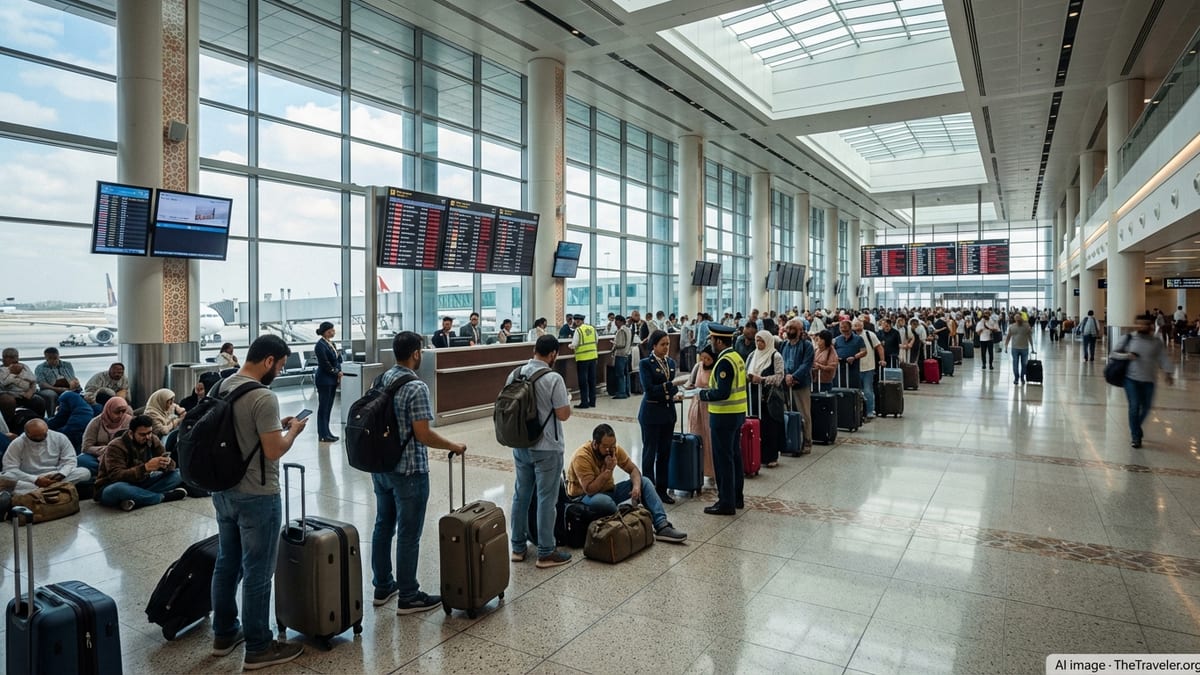
On the ground, the statistics translate into scenes of weary passengers lining up at transfer counters in Dubai, Doha, Jeddah and Abu Dhabi, many of them uncertain when they will next board an aircraft. Social media feeds over the weekend have filled with images of crowded terminals, children sleeping across rows of seats and departure boards flickering between “delayed” and “cancelled” notices as staff race to re accommodate disrupted travelers.
At Dubai International, Emirates has set up additional customer service desks near key transfer points to process rebookings and issue new boarding passes for those who missed connections. In Abu Dhabi, Etihad has been deploying extra staff at gates and arrivals halls, with managers moving between queues to prioritize families with young children, elderly passengers and those with urgent medical or visa constraints.
In Doha, Qatar Airways has leaned on its established disruption playbook, arranging hotel rooms and ground transportation for long haul passengers facing overnight waits and issuing digital meal vouchers that can be redeemed at airport restaurants. Jeddah’s King Abdulaziz International Airport, which serves heavy religious and labor traffic, has seen particularly intense pressure around prayer times and peak evening banks, when crowds swell and available seating quickly disappears.
Despite these measures, many passengers report receiving limited advance warning that their flights were at risk. In several instances, travelers only learned of cancellations or long delays after arriving at the airport or during a layover, leaving them with few practical alternatives. Industry observers note that while airlines have improved disruption communications in recent years, messaging can still lag reality when fast moving weather systems or cascading operational issues take hold across multiple regions at once.
What International Travelers Must Do Right Now
For anyone scheduled to travel through the UAE, Saudi Arabia, Qatar or Greece in the coming days, aviation experts recommend shifting from a set and forget mindset to a more actively managed approach. That begins with checking flight status directly with the operating carrier rather than relying solely on booking platforms or third party apps, and doing so repeatedly in the 24 hours before departure. Where possible, travelers should also register for airline SMS and app notifications, which tend to be the fastest channels for last minute updates.
Building more generous buffers into itineraries is equally critical. With Athens to Dubai and other high traffic routes seeing elevated disruption rates, travelers connecting between the Gulf and Europe are advised to avoid tight connections of less than two hours and to consider overnight stays at hub cities if schedules allow. While longer layovers may be inconvenient, they can substantially reduce the risk of a missed onward flight turning into a lengthy unplanned stopover.
Travelers should also review their ticket type and rights under applicable passenger protection rules. Depending on the route and operating carrier, those whose flights are significantly delayed or cancelled may be entitled to rebooking at no extra cost, meal vouchers, hotel accommodation and, in some cases, financial compensation. Keeping all boarding passes, receipts and written confirmations can help if a compensation claim is pursued later.
Finally, packing essential medications, a change of clothes, chargers and basic toiletries in carry on bags rather than checked luggage can make unanticipated overnight stays or long terminal waits more bearable. With disruption risks elevated, especially on routes connecting North America, the Gulf and southern Europe, a small amount of preparation can go a long way toward reducing stress when plans suddenly change.
Operational Outlook: Recovery Possible, But Fragility Remains
Looking ahead, airline planners expect some stabilization once the current US winter storm system moves offshore and airspace restrictions ease. Emirates and Etihad are already preparing to restore normal frequencies on several transatlantic routes as conditions improve, while Qatar Airways and Saudia are working to reposition aircraft and crews to close the gaps opened up by recent disruptions.
However, structural vulnerabilities remain. Rapid traffic growth at Greek airports without commensurate infrastructure upgrades suggests that elevated disruption levels on routes linking Athens to major hubs, including in the Gulf, may become a recurring feature rather than a brief anomaly. In the Gulf itself, continued expansion at Dubai, Abu Dhabi, Doha and Jeddah means that even small operational shocks can cascade quickly during peak travel banks.
For international travelers, the message is not to avoid these hubs, which remain among the most efficient and best connected in the world, but to approach future trips with a more resilient mindset. That may mean favoring slightly longer connection times, considering flexible ticket options, and staying attuned to early warning signs such as storms in distant regions or reports of congestion at key transfer points.
As the aviation industry balances robust demand with tight capacity and complex global weather and geopolitical risks, episodes like this week’s turmoil across the UAE, Saudi Arabia, Qatar and Greece are likely to recur. For now, the priority for both airlines and passengers is to navigate the immediate disruption, restore confidence in schedules and apply the hard learned lessons to make the next shockwave less damaging when it inevitably arrives.