

More news on this day
Rhode Island T.F. Green International Airport is struggling through one of its most disruptive days on record, as a powerful blizzard and widespread airline cancellations leave travelers facing hours-long delays, stranded overnight stays and a patchwork of rebooked itineraries affecting Providence, New York, Boston and major cities across the United States.
Blizzard Shuts Down a Key New England Gateway
The travel turmoil peaks as the February 2026 North American blizzard, known locally as Winter Storm Hernando, dumps record snowfall and fierce winds across Rhode Island and southeastern Massachusetts. T.F. Green, which serves the Providence and Warwick region and acts as an important relief gateway for Boston and the wider New England corridor, has seen runway operations repeatedly suspended while crews battle whiteout conditions and drifting snow.
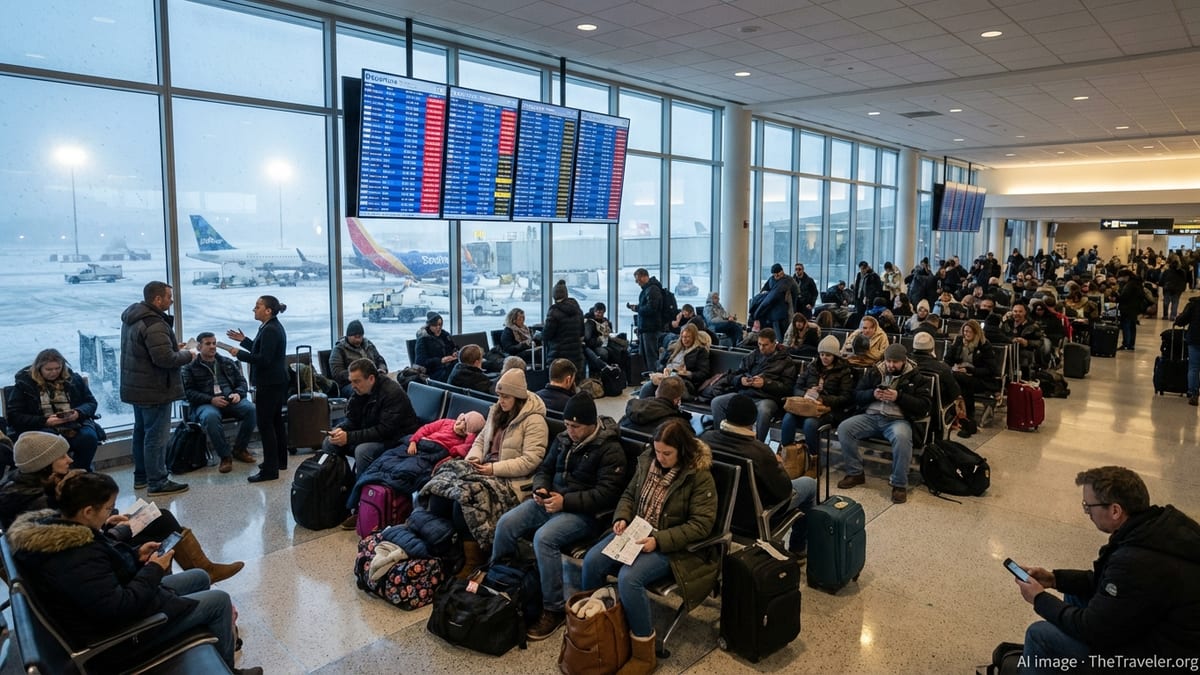
Airport officials reported dozens of cancellations and a growing wave of delays on Tuesday morning, with flight boards dominated by red alerts as plows worked to keep a single usable runway open. Snow totals at the airfield have climbed to historic levels, with more than three feet recorded, complicating efforts to clear taxiways and ramp areas and forcing airlines to extend ground stops well into the day.
Inside the terminal, passengers crowd around departure screens and agent desks, many wrapped in winter coats and clutching carry-on bags after spending the night in concourses and gate areas. Families bound for school vacations, business travelers heading to New York and Washington, and students trying to return to campuses in the Midwest have all been caught up in the disruption.
Authorities are urging would-be fliers not to head to the airport without confirmed rebooked seats, warning that same-day standby options are nearly nonexistent as airlines consolidate their schedules and aircraft remain out of position across the Northeast.
JetBlue, Southwest and American Bear the Brunt
Among the hardest-hit carriers at T.F. Green are JetBlue, Southwest Airlines and American Airlines, all of which rely on the airport for dense schedules to New York, Washington, Florida and Midwest hubs. JetBlue, a major player on routes to New York’s JFK and LaGuardia as well as Boston and Florida, has canceled many of its early bank of flights, triggering a knock-on effect for connecting passengers across its network.
Southwest, which links Providence with Baltimore, Chicago Midway and several Florida destinations, has likewise scrubbed multiple departures and arrivals as crews confront low visibility and high crosswinds on already snow-choked runways. Ground staff are juggling aircraft de-icing with gate changes and rolling delays, as aircraft and crews struggle to reach Rhode Island from less affected parts of the country.
American Airlines is reporting significant disruptions on its shuttle-style services to New York and Washington, as well as on flights feeding into major hubs such as Charlotte and Dallas Fort Worth. With those hubs also working through weather-related congestion and aircraft rotations, passengers are finding that even once T.F. Green reopens to a fuller schedule, available connecting seats may remain limited for much of the week.
Airline representatives on site say rebooking is being prioritized for travelers with urgent needs, while others are encouraged to explore options later in the week or accept travel credits. Many customers are choosing to postpone trips altogether, citing uncertainty over when normal schedules will resume.
Providence, New York and Boston Routes Severely Disrupted
The fallout from T.F. Green’s shutdown extends far beyond Rhode Island, with core routes to New York and Boston among the worst affected. Flights to and from New York’s three major airports have seen widespread cancellations, sharply reducing connectivity from Providence to one of the nation’s busiest air corridors.
In Boston, Logan International Airport is working through its own backlog of cancellations and delays after the storm forced the suspension of most operations on Monday. Thousands of travelers who had rerouted via Providence to avoid Boston’s storm exposure now find that option closed off, as Rhode Island’s airport grapples with its own recovery. With Amtrak and regional roadways also affected by snow and reduced visibility, overland alternatives are under intense pressure.
For many New England residents, T.F. Green normally serves as a lower-stress alternative to Logan, offering shorter lines and easier access from southern New England. The blizzard has turned that convenience into a vulnerability, however, as the airport’s smaller scale leaves fewer options for rerouting aircraft, bolstering staffing or absorbing large numbers of diverted flights.
Travel analysts note that the concentration of cancellations on a relatively small number of critical corridors New York, Boston, Washington and key Midwest hubs means the ripple effects are likely to linger for days, with aircraft and crews needing to be repositioned before full schedules can be restored.
Nationwide Ripple Effects to Major U.S. Cities
Though the storm’s epicenter lies in New England, its aviation impact is radiating nationwide. Flight tracking data show knock-on disruptions reaching major cities including Chicago, Atlanta, Miami, Orlando and Dallas, as aircraft that would ordinarily cycle through Providence and Boston remain stranded on snowy tarmacs or are reassigned to less affected routes.
Carriers are consolidating lightly booked flights and deploying larger aircraft where possible, aiming to move the highest number of disrupted passengers with each available departure. This strategy, while efficient in the long run, can mean additional cancellations in the short term as airlines merge multiple scheduled flights into a single operation.
Travelers as far away as Los Angeles and Denver are reporting unexpected last minute schedule changes as their connecting legs into the Northeast vanish from timetables. Cruise passengers heading for Florida sailings, families bound for school break trips to Orlando, and international travelers with onward connections through New York and Boston are all facing complex rebookings or forced overnight stops in intermediate hubs.
Industry observers say the current episode highlights the fragility of tightly wound domestic schedules, particularly at a time of strong demand and limited spare aircraft capacity. With so many flights interconnected, a complete or near complete shutdown at even a mid sized airport like T.F. Green can create a domino effect stretching from coast to coast.
What Stranded Passengers Are Being Told to Do
Amid the ongoing disruption, airport officials and airlines are stressing a few consistent messages for travelers. First and foremost, passengers are being urged to check flight status and rebooking options online or via airline apps before leaving home, and to avoid showing up at the terminal without a confirmed itinerary.
For those already at T.F. Green, announcements are directing travelers to work directly with their airline for hotel and meal vouchers where applicable, and to keep boarding passes, receipts and documentation that may be needed for future claims. Lines at customer service desks remain long, but many carriers are offering virtual assistance through call centers and messaging platforms.
Officials also warn that recovery will not be instantaneous, even once the storm moves offshore and snowplows reclaim runways and taxiways. Aircraft will have to be repositioned, crews must comply with strict duty time limits, and cleared runways can quickly re-freeze if temperatures remain low. Travelers are being advised to build flexibility into their plans, consider alternative dates or routes and prepare for the possibility of further last minute changes.
As New England begins digging out from one of its most intense winter storms in years, the scene at Rhode Island T.F. Green International Airport has become a vivid snapshot of how a single weather system can paralyze modern air travel, with consequences felt from Providence and Boston to major cities across the United States.