

More news on this day
Air passengers traveling to and from Canada this week faced mounting frustration as 152 flights were reported delayed and 12 cancelled across multiple carriers, disrupting key routes into Toronto, Vancouver and other major hubs and stranding or rerouting hundreds of travelers.
Get the latest news straight to your inbox!
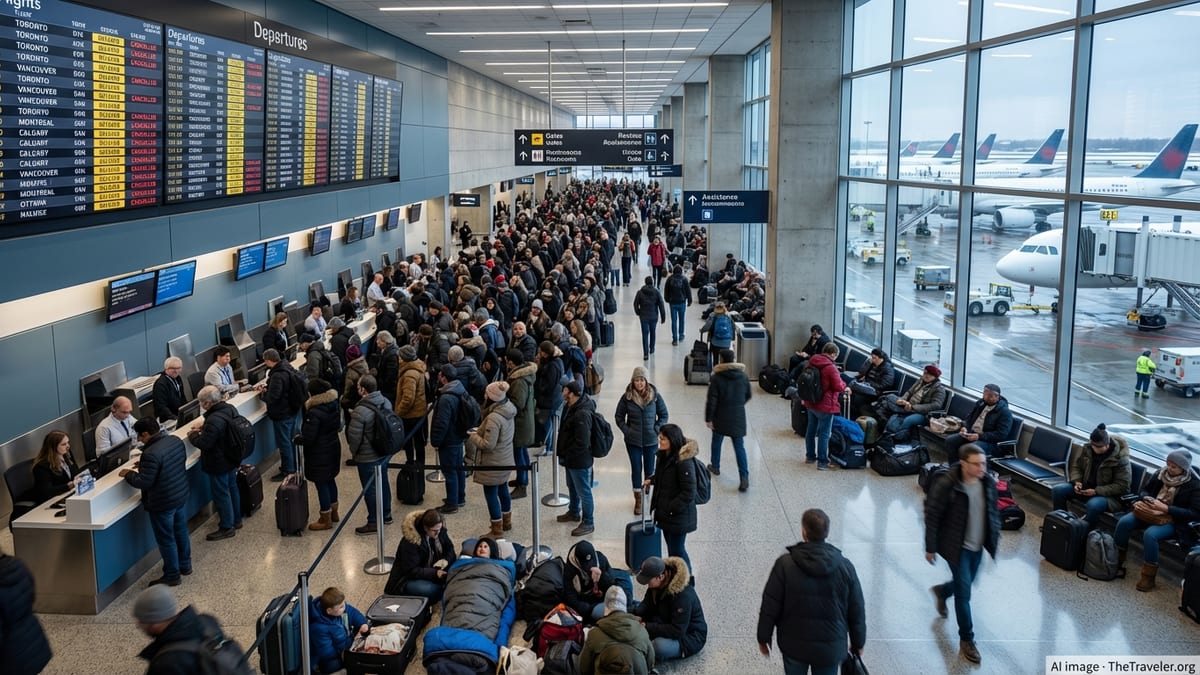
Widespread Disruptions Hit Major Canadian Gateways
The latest wave of disruption unfolded as an already strained North American aviation network continued to grapple with residual weather impacts, tight aircraft rotations and crew-scheduling challenges. Publicly available flight-tracking data and airport dashboards showed knock-on effects at major Canadian gateways, most notably Toronto Pearson and Vancouver International, where delays stacked up throughout the day.
While the scale of the problem was smaller than the mass cancellations seen during recent severe winter storms that shut down parts of the network, the pattern was familiar to Canadian travelers. Reports indicate that a mix of domestic and transborder services were affected, with late-arriving aircraft and shifting weather systems combining to push departure times back and, in some cases, scrub flights entirely from the schedule.
The disruption came on the heels of an exceptionally turbulent winter for Canadian aviation, marked by powerful storm systems that repeatedly disrupted operations across the country and into the northern United States. According to published coverage of recent weather events, thousands of flights across North America have been cancelled or delayed in recent weeks as airlines worked to reposition aircraft and crews after blizzards and heavy snowfalls.
For travelers, the effect on the ground was immediate. Long lines formed at check-in counters and service desks as passengers sought new itineraries, hotel vouchers or clarification on when, or if, their flights would depart. Many of the delays extended into several hours, compressing connection windows and forcing rebookings through alternative hubs.
SkyWest, PAL Airlines and Regional Partners Feel the Strain
Among the carriers touched by the latest disruption were regional operators including SkyWest and PAL Airlines, whose flights often feed larger hubs or connect smaller communities to Toronto, Vancouver and other cities. These regional services play a critical role in Canada’s aviation system, linking remote or mid-sized markets with the country’s primary international gateways.
Publicly available operational data for North American regional airlines shows that carriers such as SkyWest routinely operate dense schedules with limited slack in aircraft and crew availability. When weather, air traffic control restrictions or maintenance issues occur earlier in the day, subsequent flights can quickly fall behind schedule, particularly on cross-border routes that must also navigate security and customs constraints.
PAL Airlines, which operates a network of services in Eastern and Atlantic Canada and also participates in regional flying for larger brands, can face similar cascading effects. When a single aircraft experiences a delay on an early leg, subsequent rotations into busier hubs can be pushed back, eroding on-time performance even if weather at the destination appears stable.
According to aviation analysts cited in recent industry coverage, these regional disruptions can be especially painful for passengers because alternatives are limited. With fewer daily frequencies on many smaller-city routes, a single cancellation may mean an unplanned overnight stay or a lengthy re-routing through multiple hubs in order to reach Toronto or Vancouver.
Toronto and Vancouver Routes Under Particular Pressure
Toronto Pearson and Vancouver International are central to Canada’s domestic and international connectivity, and services into these hubs have been under recurring pressure throughout the winter. Published reporting on recent storms shows that heavy snow, low visibility and high winds in southern Ontario and coastal British Columbia have repeatedly forced ground stops, runway clearing operations and schedule reductions.
Even on days without headline-grabbing storms, these hubs can experience lingering operational stress. When aircraft and crews are out of position from prior disruptions, airlines must adjust rotations, sometimes consolidating flights or downgrading aircraft types. This can leave certain departures overbooked or vulnerable to last-minute changes if a technical issue arises.
Routes between Toronto and Vancouver, two of the busiest city pairs in the country, are particularly sensitive to such constraints. Travel forums and passenger reports have frequently highlighted recurring delays on this corridor, with late inbound aircraft, maintenance checks and afternoon thunderstorm activity in the Toronto area cited as common factors. When regional partners feeding these hubs also run behind schedule, missed connections can ripple across the network.
The latest set of 152 delays and 12 cancellations echoed those patterns. Travelers reported missed meetings, forced overnight stays and tight rebookings onto already crowded flights. Some passengers opted to reroute through alternate hubs or to switch to other carriers where seats were available, often at higher last-minute fares.
Passenger Rights and Compensation Questions Resurface
The renewed wave of disruption has once again drawn attention to Canada’s Air Passenger Protection Regulations, which set out minimum standards of treatment and, in some circumstances, compensation for travelers affected by delays and cancellations. Recent decisions by the Canadian Transportation Agency and publicly available enforcement summaries have underscored that airlines can face penalties when they fail to provide food, accommodation or rebooking assistance in situations deemed within their control.
In practice, however, passengers often face uncertainty about whether a particular delay qualifies for compensation. Airlines may classify disruptions as caused by weather, air traffic control or safety-related operational constraints, which in many cases limits their financial obligations while still requiring them to provide basic care such as meals and hotel rooms in the event of overnight delays.
Consumer advocates quoted in recent coverage argue that the complexity of the rules, coupled with differences between Canadian and international regimes, leaves many travelers unsure of their rights. Passengers who experience significant delays or cancellations are frequently advised by advocacy groups and online resources to document all communications, keep receipts for additional expenses and, if necessary, file a claim with both the airline and the regulator.
For those caught up in the latest spate of delays and cancellations, that process is likely to take days or weeks, long after their immediate travel headaches have subsided. In the meantime, airlines continue to balance schedule recovery with crew-rest requirements and aircraft maintenance checks, working to stabilize operations as demand remains robust on key routes into Toronto, Vancouver and other Canadian hubs.
What Travelers Can Expect in the Days Ahead
As airlines work through the backlog from the most recent operational snags, publicly available schedule data suggests that carriers are attempting to normalize their timetables while building in additional recovery time where possible. That may translate into slightly longer planned connection windows and selective trimming of marginal flights in favor of protecting core routes.
Travel experts cited across recent industry and consumer reporting advise passengers flying to or through Canadian hubs to monitor their flights closely in the 24 hours before departure, use airline apps for real-time updates and consider booking longer layovers when making tight domestic-to-international connections. For travelers dependent on regional links operated by carriers such as SkyWest and PAL Airlines, flexibility and contingency planning remain important, given the limited number of daily frequencies on many routes.
In the short term, some residual delays are likely to persist as crews and aircraft return to scheduled positions and as weather remains variable at this time of year. However, barring another major storm system or unforeseen operational shock, airlines are expected to gradually restore more reliable on-time performance into Toronto, Vancouver and other key Canadian gateways.
For now, the 152 delayed flights and 12 cancellations serve as another reminder of the fragility of modern airline networks and the outsized impact that even a modest wave of disruptions can have on travelers across Canada and beyond.