

More news on this day
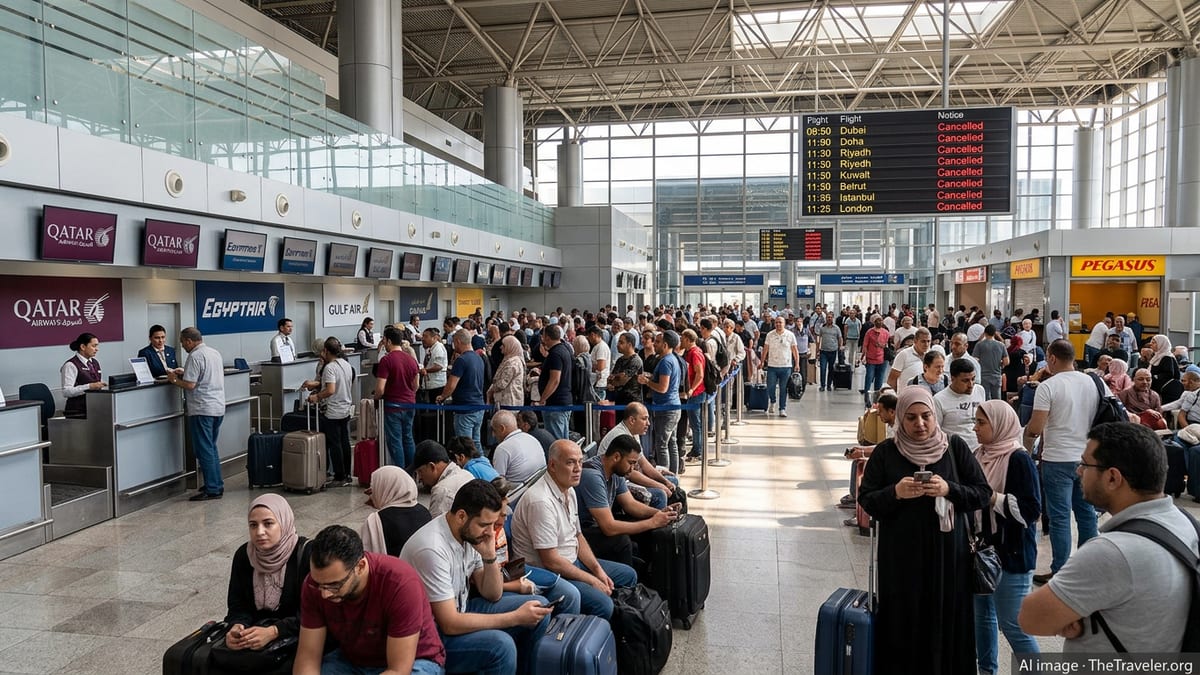
Air travel to and from Egypt was plunged into fresh turmoil this week as more than 130 flights were cancelled or heavily disrupted, with services operated by Qatar Airways, EgyptAir, Gulf Air, Pegasus and other carriers curtailed on key routes linking Cairo and other Egyptian airports to Dubai, Doha, Riyadh, Kuwait, Beirut, Istanbul, London and beyond.
Get the latest news straight to your inbox!
Regional Airspace Restrictions Hit Egyptian Gateways
The latest wave of cancellations follows sweeping airspace restrictions across parts of the Middle East, imposed after a sharp escalation in regional tensions and missile activity that has forced airlines to divert or suspend services on some of their busiest corridors. While Egyptian airspace remains officially open, its carriers and foreign airlines serving the country are being forced into rapid operational changes, with short-notice cancellations and complex rerouting.
Industry briefings seen by travel agents and corporate travel managers indicate that more than 130 flights touching Egypt over the past several days have been scrapped or significantly delayed, as carriers recalculate flight paths to avoid closed or restricted skies over neighboring states. This includes point-to-point services linking Cairo and coastal resorts to Gulf hubs, as well as wide-body long haul services that typically overfly the region en route between Europe, Asia and Africa.
Egypt, which relies heavily on air connectivity for both tourism and labor flows to the Gulf, is experiencing the knock-on effects of decisions being taken in Doha, Dubai, Riyadh and other key aviation centers. With regional hubs cutting capacity and reducing frequencies, the schedules of airlines serving Egypt have had to be redrawn, pushing disruption down the line to passengers who may never actually cross the closed airspace.
Qatar Airways and EgyptAir Scale Back Key Gulf Links
Qatar Airways, one of the region’s largest long haul carriers and a major connector for Egyptian travelers heading to Asia, Europe and the Americas via Doha, has shifted to a pared-back operation after authorities in Qatar introduced tight controls on available air corridors. The airline has published a rolling list of limited services to and from Doha, while confirming that dozens of flights that would normally transit Egyptian gateways have been cancelled or consolidated.
Flights between Doha and Cairo, as well as onward connections from Doha to London, Istanbul and other European cities frequently used by Egyptian passengers, have been particularly affected. Travel industry sources describe a pattern in which some departures operate at short notice under revised timings and routings, while others disappear from departure boards altogether, leaving passengers scrambling for alternative options or waiting days for the next available seat.
Egypt’s flag carrier EgyptAir has also been forced to suspend or reduce a swathe of regional services, especially to Gulf destinations that lie within or near restricted airspace. Recent advisories from the airline highlight temporary suspensions on routes to Doha, Kuwait and certain Saudi cities, alongside frequency cuts on others. Although domestic operations inside Egypt remain largely stable, the loss of high-yield Gulf routes is being keenly felt by both the airline and travelers who rely on these flights for work and family travel.
Gulf Air, Pegasus and Other Carriers Pull Back
The ripple effect extends well beyond the two flagship carriers. Gulf Air has cancelled multiple services linking Bahrain with Cairo and other Middle Eastern destinations as Bahrain aligns with regional restrictions, further shrinking the pool of available connections for travelers trying to move between Egypt and the wider Gulf. In some cases, entire rotations over several days have been scrapped, contributing to the running tally of more than 130 cancellations impacting Egyptian-bound itineraries.
Turkish low cost carrier Pegasus, which serves Egypt via Istanbul and is popular with budget-conscious travelers heading to Europe, has also cut flights to several Middle Eastern cities following directives from Turkish authorities to halt operations to high-risk destinations. While Istanbul itself remains open, the reduction in Pegasus services across the region means fewer seats and less flexibility for those trying to route between Egypt, Turkey and onward European cities such as London and Berlin.
Other regional and international airlines, including carriers based in the United Arab Emirates and Saudi Arabia, have reduced frequencies or temporarily suspended flights that normally link their hubs to Cairo, Hurghada, Sharm el Sheikh and Alexandria. Collectively, these adjustments have slashed capacity on what is typically one of the densest networks of short and medium haul routes in the Middle East, leaving Egypt’s airports facing quieter terminals but more distressed passengers.
Passengers Stranded Between Cairo, Gulf Hubs and Europe
For travelers, the numbers translate into thousands of disrupted journeys. At Cairo International Airport, tour operators report groups of holidaymakers left waiting in departure halls for news of replacement flights after their original Qatar Airways or Gulf Air services were cancelled. Some have been offered rerouting via alternative hubs such as Istanbul or European capitals, often involving overnight stays and significant detours to avoid closed skies.
Routes connecting Egypt to Dubai, Doha, Riyadh, Kuwait and Beirut are proving especially problematic, as these cities sit at the heart of the affected airspace. Workers commuting between Egypt and Gulf states are facing missed contract start dates and delayed home visits, while students and medical travelers with time-sensitive commitments report particular anxiety over mounting uncertainty. Capacity on the remaining operating flights is tight, driving up fares on last minute inventory.
Disruption is also spilling into long haul markets. Travelers bound for London and other European destinations from Egypt, especially those booked on itineraries involving a Gulf or Turkish connection, are seeing their trips rebooked on more circuitous routings. In some cases, airlines are advising passengers not to travel to the airport until they have received explicit confirmation that their flight will operate, a significant shift in guidance that underscores the fluidity of the situation.
Airlines Move to Limited Schedules and Flexible Policies
In response to the fast-changing picture, airlines are increasingly publishing short-window, limited schedules that indicate which flights are expected to operate over the coming days. Qatar Airways has outlined a slimmed-down timetable of departures from Doha that still includes Cairo, Istanbul and London, but at a fraction of normal frequencies. EgyptAir, meanwhile, is emphasizing that any gradual resumption of suspended Gulf routes will depend on coordination with regional civil aviation authorities and ongoing security assessments.
Carriers across the region are also expanding flexibility policies for affected passengers. Many travelers holding tickets for flights between late February and late March are being offered fee-free rebooking or vouchers, with airlines urging customers to use digital channels and mobile apps to manage changes rather than queueing at airport counters. Travel agents in Egypt say this has eased some of the immediate pressure, but note that the lack of clear timelines for a full return to normal operations continues to weigh on both leisure and corporate demand.
For now, aviation analysts expect a stop-start recovery, with pockets of limited service gradually restored as airspace restrictions are adjusted, but the threat of renewed cancellations never far away. With Egypt’s tourism sector entering what is typically a busy spring season for visitors from Europe and the Gulf, the industry will be closely watching how quickly stable, predictable flight schedules can be reestablished on the critical corridors that link Cairo and the Red Sea resorts to Dubai, Doha, Riyadh, Kuwait, Beirut, Istanbul, London and other key markets.