

More news on this day
Europe’s already stretched aviation network is facing fresh turbulence as a cluster of cancellations and severe delays on Lufthansa, easyJet and SAS routes has disrupted at least 79 flights, snarling connections at major hubs and stranding passengers across multiple countries.
Get the latest news straight to your inbox!
Simultaneous disruptions hit key airline networks
Recent operational data and industry reports indicate that Europe’s latest wave of travel chaos is being driven by a combination of staffing shortages, industrial action and air traffic control constraints, with Lufthansa, easyJet and SAS among the most exposed carriers. While hundreds of flights across the continent have been affected in recent days, at least 79 services involving these three airlines alone have been cancelled outright or suffered multi-hour delays, effectively removing them from their intended schedules.
The failures have clustered around some of Europe’s busiest hubs, including Frankfurt, London, Amsterdam, Copenhagen and key Spanish and French gateways. Publicly available disruption tallies show Germany, England, the Netherlands, Portugal and Denmark recording more than 200 cancellations and over 1,400 delays in a single recent 24-hour period, with Lufthansa, easyJet and SAS all facing significant knock-on effects as aircraft and crews fell out of position.
Network maps for the affected airlines suggest that the most severely hit routes are short and medium-haul European links, where tight turnarounds and high utilisation leave little slack in the system. Once a wave of cancellations is triggered at one hub, subsequent rotations are often unable to depart on time, creating a rolling pattern of missed connections that can take days to unwind.
Aviation analysts note that while Europe’s traffic levels are close to or above pre-pandemic volumes, staffing levels in critical areas such as crew planning, ground handling and air traffic control have not fully recovered. As a result, simultaneous disruptions at several airlines quickly spill over into the wider network, particularly when they occur at the same time of day and on overlapping routes.
Strikes, staffing gaps and air traffic control limits
According to recent coverage from European travel and aviation outlets, labour disputes and chronic staffing shortages remain central to the latest bouts of disruption. In Germany, repeated industrial action involving Lufthansa staff in early April, including cabin crew walkouts, has forced large-scale schedule reductions and last-minute cancellations, with knock-on delays rippling through the group’s Frankfurt and Munich hubs.
Similar operational strains are evident in northern Europe, where Scandinavian carrier SAS has been listed among airlines hit by waves of delays and cancellations linked to crew availability and air traffic flow constraints. At several major airports, late-arriving aircraft have been unable to turn around on time, further compressing schedules already under pressure from high passenger demand.
In the south, recent disruption in Italy and Spain has been compounded by air traffic control issues and localized strikes. Travel industry reports show Italian hubs such as Rome and Milan recording hundreds of cancellations and delays in a single day, with easyJet among the airlines affected on key domestic and cross-border routes. In Spain, separate tallies for Barcelona, Madrid and other major airports point to dozens of cancellations and more than 200 delays across multiple carriers, including Lufthansa and easyJet, feeding additional stress into shared European corridors.
Capacity limits in French and Portuguese airspace have also played a role, with network performance summaries highlighting repeated bottlenecks over France in particular. When sectors are constrained, aircraft are rerouted or slowed, with the resulting airborne queues feeding back into airport departure and arrival banks. Carriers such as Lufthansa, easyJet and SAS, which operate dense schedules through these regions, are especially vulnerable when several such factors converge.
Passengers face missed connections and crowded terminals
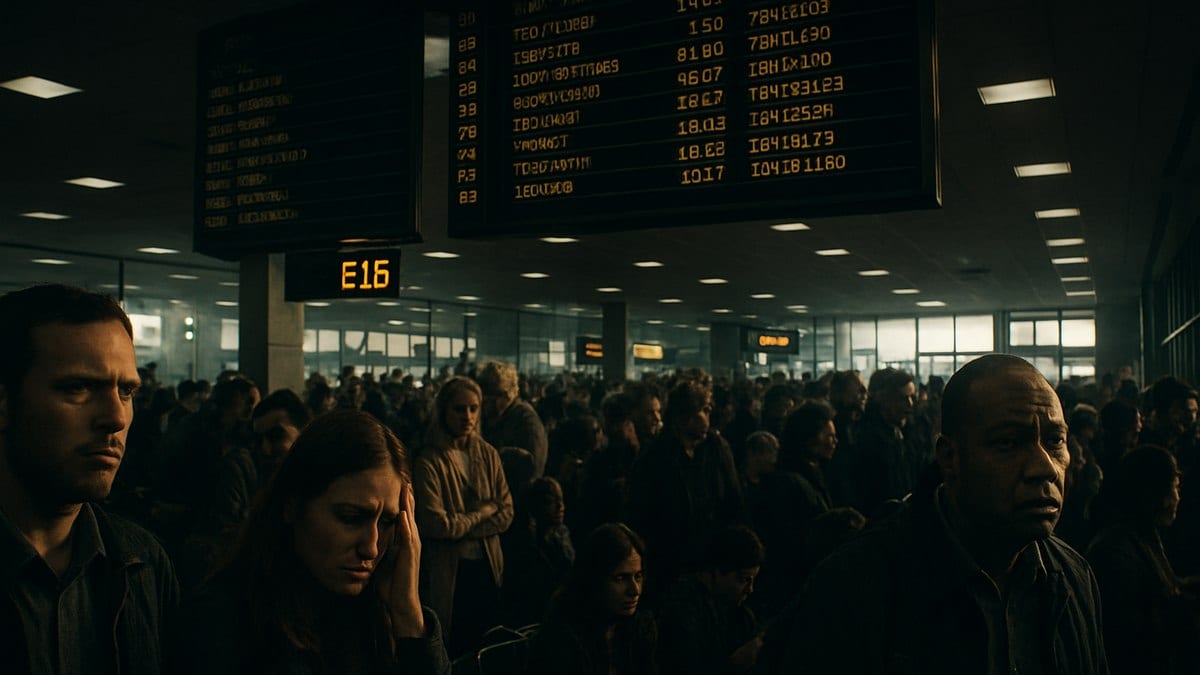
For travellers, the practical impact of the latest failures has been felt in long queues, crowded gate areas and missed onward journeys. From London Heathrow and Gatwick to Frankfurt, Amsterdam and Copenhagen, disruption trackers have recorded large numbers of passengers stuck in terminals after cancellations or facing departures pushed back by several hours.
European consumer sites monitoring flight status across the region report that on some days more than a thousand departures have been delayed and over two hundred cancelled, with significant portions of the Lufthansa, easyJet and SAS networks affected. At times, nearly a quarter of all flights at certain airports have operated late, eroding connection buffers and increasing the likelihood that transfer passengers will misconnect and require rebooking.
The situation has been particularly difficult for travellers relying on tight layovers or early-morning departures. When a first rotation of the day is cancelled or substantially delayed, subsequent flights using the same aircraft or crew can be disrupted well into the afternoon or evening. Public data from major hubs show persistent backlogs that can linger even after the original trigger, such as a strike or localized storm, has passed.
Observers note that the concentration of affected flights among a handful of large network carriers and low-cost operators multiplies the impact. Lufthansa’s central role in German and wider European connectivity, easyJet’s dense point-to-point schedule across primary and secondary airports, and SAS’s presence in Nordic markets mean that even a relatively small number of simultaneous route failures can leave thousands of passengers without straightforward alternatives.
What travellers can expect under European passenger rules
Under the European Union’s air passenger rights framework, travellers whose flights are cancelled or heavily delayed on eligible routes may be entitled to care, rerouting or refunds, and in some circumstances financial compensation. Legal overviews of the regulation note that entitlement depends on several factors, including the cause of the disruption, the length of the delay at arrival and the distance of the journey.
In practice, passengers caught up in the current disruption on Lufthansa, easyJet and SAS routes can generally expect airlines to provide assistance such as meals, refreshments and hotel accommodation when long waits or overnight stays become necessary. Rebooking on the next available service or issuing refunds for unused segments is standard practice, although the speed and ease of securing new arrangements can vary significantly between airports and carriers.
Where staff shortages, internal scheduling problems or industrial action at the airline are identified as primary causes, travellers may have stronger grounds to seek additional compensation under European rules. However, when disruption is mainly attributed to factors such as air traffic control restrictions or severe weather, available analyses suggest that compensation may be limited, even though carriers are still expected to provide basic care and support.
Consumer advocates recommend that passengers retain boarding passes, written notices of disruption and any receipts for extra expenses, as these documents can be important when submitting claims. They also advise checking directly with the operating airline, rather than only relying on third-party booking platforms, to ensure that rebooking options and rights under European regulations are fully understood.
Fragile recovery raises concerns for peak summer season
The concentration of failures across 79 Lufthansa, easyJet and SAS routes comes as industry forecasts point to another year of robust demand for European air travel. Recent assessments by aviation consultancies and financial analysts warn that, without significant investment in staffing and infrastructure, Europe’s aviation system will remain vulnerable to exactly the type of cascading disruption now unfolding.
Studies of 2025 performance data already highlighted persistent punctuality issues at several major European airports, with some hubs seeing barely half of departures leave on time. Early snapshots for 2026 indicate that while punctuality has improved slightly in some markets, the network remains highly sensitive to shocks, whether from industrial action, localized storms or structural staffing gaps.
For airlines such as Lufthansa, easyJet and SAS, the challenge will be to rebuild resilience in their schedules while keeping costs under control in a competitive market. Measures reported in recent months include trimming marginal routes, increasing turnaround buffers on congested sectors and revising crew patterns to provide more operational flexibility. However, these adjustments can only partially offset external constraints such as airspace capacity limits and air traffic controller shortages.
With the peak summer season approaching, travel specialists caution that the recent cluster of cancellations and delays may be an early warning of wider strains to come. Unless the underlying issues behind Europe’s current wave of flight disruptions are addressed, passengers could face further episodes of travel chaos, with even more simultaneous route failures across the continent’s busiest airlines.