

More news on this day
A fresh burst of disruption is sweeping across Europe’s transport network this spring, with aviation and rail data pointing to dozens of delays and cancellations that are unsettling holiday plans and testing the resilience of key travel hubs.
Get the latest news straight to your inbox!
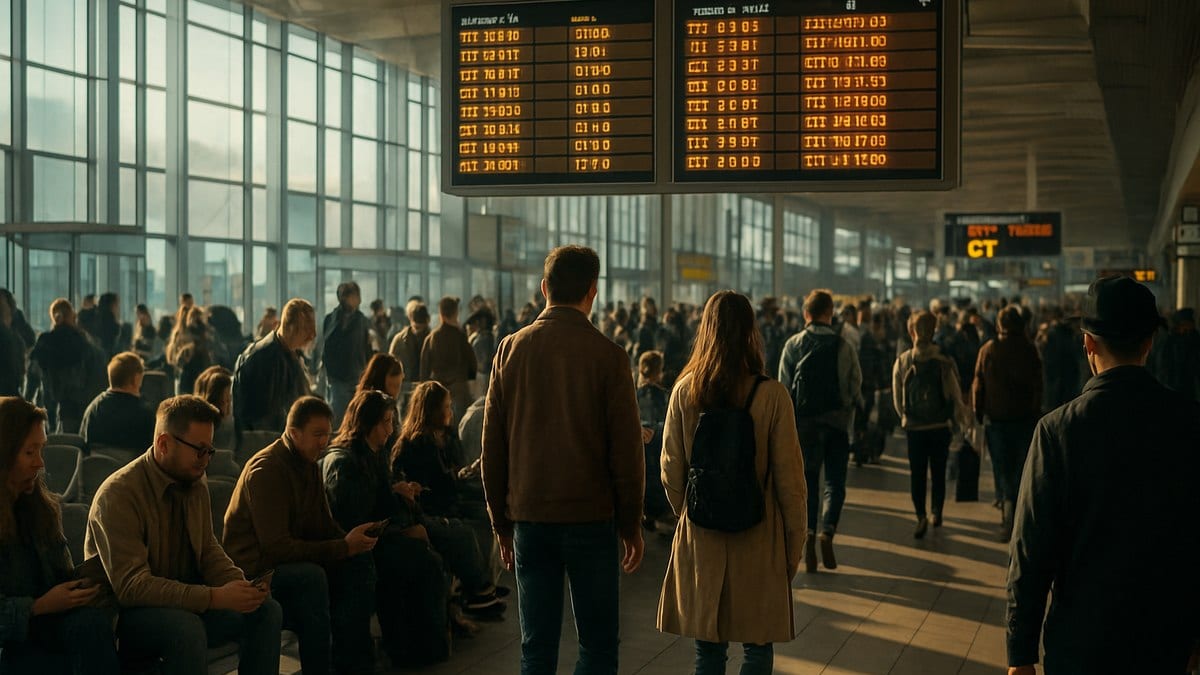
Patchy Skies and Persistent Bottlenecks Drive New Disruptions
Operational data from early April 2026 shows that Europe has entered the spring travel season with infrastructure already under strain, as a mix of unsettled weather, lingering air traffic control constraints, and isolated technical issues ripples across the continent’s airspace. Reports from industry trackers indicate that on some recent days, clusters of airports across Western and Southern Europe jointly recorded around 79 significant delays and at least 9 outright cancellations, a snapshot that illustrates how even moderate disruption can quickly spread through the network.
Recent accounts of travel disruption highlight that spring weather remains a central trigger, particularly in northern and western Europe, where strong winds, low visibility, and intermittent heavy showers have complicated operations at major hubs. Aviation analytics providers report that these localized weather systems have interacted with already busy schedules to push departure times back and force carriers to trim frequencies on the margins rather than risk extended knock-on delays later in the day.
Publicly available information also underscores that these issues are landing on an aviation system that has little spare capacity after a difficult winter. Air traffic management updates describe an environment in which modest spikes in demand or short-lived weather cells can rapidly translate into queues for takeoff slots, longer taxi times, and aircraft arriving out of rotation, all of which erode schedule reliability as the day progresses.
Industry commentary suggests that, while headline cancellation numbers remain relatively low compared with past crises, the accumulation of moderate delays is increasingly shaping the passenger experience. Travelers report missed connections, tight transfers, and late-night arrivals that fall outside ground transport operating hours, creating disruption that goes beyond the raw count of canceled flights.
Airports From Amsterdam to Athens Feel the Strain
The latest wave of travel problems has not been limited to a single country or airline. Passenger-rights organizations and travel publications tracking daily performance point to a pattern in which multiple hubs experience simultaneous disruption, turning what might otherwise be a local problem into a regionwide challenge for carriers and travelers alike.
Coverage from Europe-focused travel outlets notes repeated days in early April where airports such as Amsterdam Schiphol, Rome Fiumicino, Lisbon, Dublin, and Paris Charles de Gaulle have each reported clusters of delayed departures and a handful of cancellations. When tallied across the network, these individual trouble spots can easily add up to several dozen late flights, with a smaller subset of services canceled preemptively to create breathing room in schedules.
Southern European gateways are also facing their own seasonal pressures. Reports focused on Mediterranean tourism markets describe how early spring holiday traffic is already building into Greece, Italy, Portugal, and Spain, narrowing the margin for operational error. Even where the official count for a given day might show only one or two cancellations, the number of delayed departures can be high enough to strain airport resources, from ground handling to security and border control.
In parallel, rail operations in parts of northwestern Europe have seen targeted disruption linked to technical investigations on busy intercity corridors. While these events are typically short in duration, any suspension of frequent commuter and regional services adds further complexity for travelers trying to piece together multi-leg journeys that combine air and rail segments.
Structural Weak Points Exposed Ahead of Peak Season
The pattern emerging in April is renewing debate about the structural vulnerabilities of Europe’s transport system ahead of the main summer peak. Analyses from aviation regulators and air traffic management bodies over the past year have repeatedly warned that congestion, staffing shortages, and airspace constraints could leave the continent exposed to fresh waves of disruption if underlying issues are not addressed.
Eurocontrol data and punctuality reports for previous seasons already indicated that reactionary delays, where one late flight leads to subsequent late departures on the same aircraft, remain the dominant cause of schedule slippage across the network. With overall traffic volumes now back to or slightly above pre-pandemic levels, these recurring inefficiencies are again becoming visible in daily performance statistics.
Recent industry outlooks for 2026 add another layer of concern, highlighting that even modest levels of industrial action or localized technical incidents can quickly translate into notable cancellation spikes. Passenger advocacy groups point to past episodes in which strikes, radar problems, or airspace restrictions produced multiples of the normal number of cancellations in affected states, reinforcing the sense that the system still lacks resilience.
Analysts also note that emerging pressures on jet fuel supply, as discussed in recent European and international coverage, could become a complicating factor later in the season if geopolitical tensions persist. While current travel chaos is driven primarily by operational and weather factors, airlines and airports are openly modeling scenarios in which fuel availability constraints might require additional schedule adjustments or capacity reductions.
Passengers Confront Growing Risk of Missed Connections
For travelers on the ground, the practical impact of 79 delayed flights and 9 cancellations on a busy spring day can be far greater than the raw numbers suggest. Publicly available flight-tracking data and on-the-ground accounts show how a single late inbound aircraft can trigger a cascade of challenges, especially for passengers relying on tight connections through busy hubs.
Intra-European itineraries are particularly vulnerable, as many rely on short turnaround times and complex banked schedules at major connecting airports. When early wave flights run late, passengers risk missing onward services to secondary cities and leisure destinations, forcing them to accept rebookings that may not depart until late in the day or even the following morning.
Long-haul travelers transiting through Europe are also affected. Industry commentary notes that when regional feeders into key hubs arrive behind schedule, airlines sometimes opt to hold widebody departures for connecting passengers, pushing back departure times and compressing turnaround windows at destination airports. This, in turn, can leave crews approaching duty limits and limit flexibility to recover from additional delays later in the rotation.
Travel advocates emphasize that Europe’s passenger-protection rules, including the framework commonly referred to as EU261, provide important safeguards in cases of significant delay or cancellation. However, they also point out that practical outcomes can vary depending on the cause of disruption, the carrier involved, and the availability of alternative flights, making it essential for passengers to understand both their rights and the operational realities shaping airline decisions.
What the Spring Turbulence Signals for Summer
Looking ahead, the early spring chaos across European skies and rail corridors is being interpreted by analysts as an important stress test for the months to come. Published forecasts for 2026 anticipate higher passenger volumes than last year, with demand particularly strong in the peak summer holiday window and around major events that are expected to draw visitors from within Europe and beyond.
Aviation consultancies and travel research organizations argue that the pattern of moderate but repeated disruption in March and April should be seen as an early warning. If similar weather events, staffing gaps, and technical issues arise during the peak traffic weeks of July and August, the number of delayed and canceled flights could climb much higher, especially if compounded by industrial action or additional constraints on fuel supply.
Some airlines are already adjusting their strategies in response. Public schedule data and network announcements show that several carriers are selectively trimming frequencies on congested routes, shifting capacity to more resilient hubs, and increasing block times to create more margin for day-of-operations challenges. Airport operators, in turn, are emphasizing investments in staffing, technology, and airside infrastructure designed to handle higher volumes more smoothly.
For travelers, the spring experience across Europe serves as a reminder that flexibility, longer connection times, and awareness of passenger rights will remain crucial tools as the continent moves toward the busy summer season. While the specific figures of 79 delays and 9 cancellations may represent only one day in a volatile calendar, they capture a broader story of a transport system still working to find stability in an era of persistent shocks.