

More news on this day
Hours-long airport security lines, missed departures and scenes of confusion at checkpoints are confronting U.S. travelers this spring, as staffing shortages at Transportation Security Administration checkpoints collide with record passenger volumes and an ongoing Department of Homeland Security funding shutdown.
Get the latest news straight to your inbox!
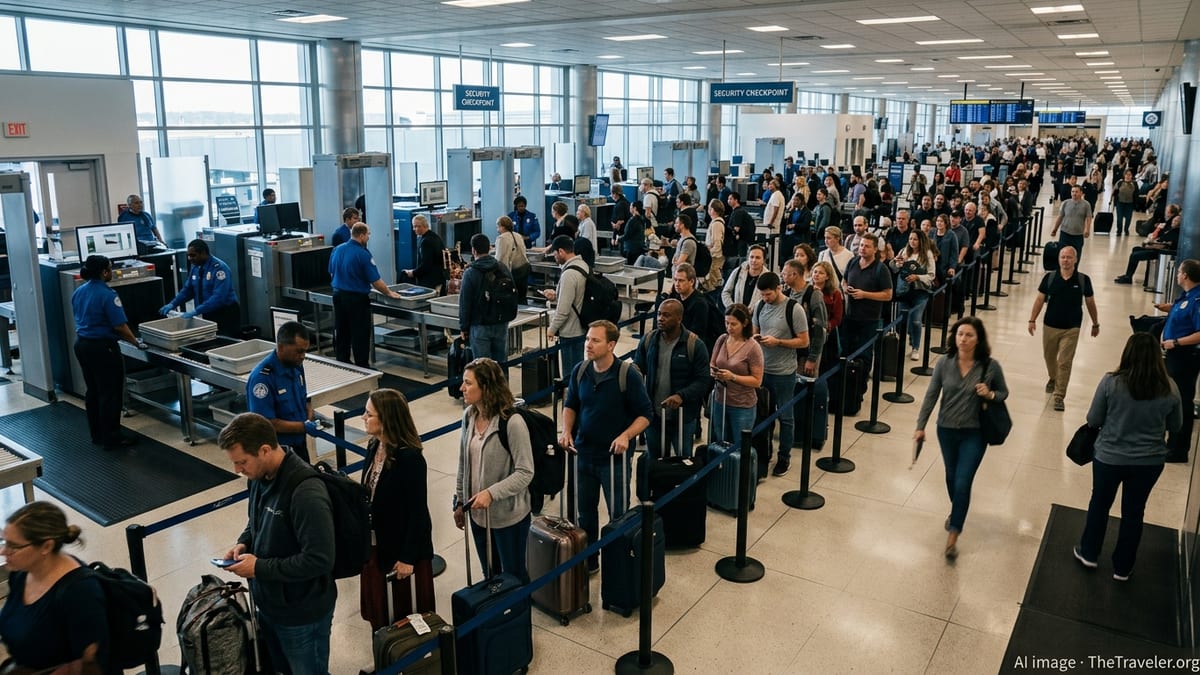
Shutdown Fallout Pushes TSA To Breaking Point
The current wave of security delays began after funding for the Department of Homeland Security lapsed on February 14, 2026, triggering a partial shutdown that left tens of thousands of TSA officers working without pay. Publicly available information shows that these workers are required to report for duty as essential personnel even as paychecks are frozen, a dynamic that has historically led to higher rates of sick calls, resignations and overtime fatigue.
Recent coverage of the shutdown describes airport security as one of the most visible pressure points. Travel reports indicate that domestic checkpoints in major hubs have been operating with fewer open lanes during peak periods, forcing passengers into serpentine lines that snake through terminal corridors and in some cases out toward ticketing halls and parking structures. In this environment, even minor disruptions such as a bag recheck, a secondary screening or a misrouted queue can quickly cascade into systemwide delays.
Analysts who track federal workforce trends note that the shutdown is landing on top of years of attrition on the TSA front line. Public data from earlier periods showed elevated turnover among officers, driven by relatively low starting pay, unpredictable shifts and the stressful nature of checkpoint work. Those structural issues have made it more difficult for the agency to surge staffing when a crisis hits, particularly during high-demand travel periods.
Eyewitness Accounts From Overwhelmed Hubs
Across social media platforms and in local news coverage, passengers have shared accounts and images of crowded security halls that capture the scale of the disruption. In Houston, reports from George Bush Intercontinental and Hobby airports since late 2025 describe security queues stretching well beyond stanchions, wrapping around terminal interiors and doubling back toward baggage claim as officers attempt to process full flights with reduced staffing.
New Orleans has seen similar scenes, according to regional reporting that highlights travelers waiting in line for multiple hours during morning departure banks. Some passengers have described arriving the recommended two hours before a domestic flight only to watch boarding times come and go while still outside the main checkpoint area. Airline agents have reported a rise in same-day rebooking requests tied specifically to TSA delays rather than weather or mechanical issues.
Atlanta, one of the country’s busiest connecting hubs, experienced warning signs of the current crunch as early as the 2025 government shutdown, when the airport publicly urged travelers to expect longer-than-usual waits and to arrive earlier than normal due to staffing shortages. More recent accounts indicate those warnings have returned, with early-morning lines spilling into atriums as unpaid officers rotate through extended shifts.
Eyewitness descriptions have also emerged from Denver, Boston and airports around the Washington, D.C. region, where passengers report that standard wait time estimates posted on airport displays can lag behind the reality on the ground. Travelers recount moving only a few yards over the course of 20 or 30 minutes, with families, business travelers and airline crews all intermingled in the same slowed queues.
Missed Flights, Frayed Tempers And Uneven Impacts
The human toll of the staffing crunch is increasingly evident in traveler testimonies. Reports from Houston, New Orleans and other affected airports describe families missing long-planned vacations, students stranded between connecting flights and business travelers scrambling to salvage meetings after being forced onto later departures. In many cases, airlines have waived some change fees or attempted to place delayed passengers on standby lists, but seats during peak periods remain limited.
Travelers caught in these bottlenecks often describe a sense of powerlessness, with little clear information about how long the wait will last or whether additional lanes will open in time. Some recount checkpoint staff attempting to pull passengers with imminent departure times into expedited lines, a triage approach that can itself spark tension as others fear being left behind. Local media in several cities have carried accounts of frayed tempers, raised voices and heated exchanges as the delays wear on.
The impacts are also uneven across the traveling public. Passengers enrolled in trusted traveler programs traditionally receive access to shorter, dedicated lanes, but the current shutdown has already led to the suspension of Global Entry, and public statements indicate that TSA has been reviewing operations for its expedited screening programs on an airport-by-airport basis as staffing fluctuates. For travelers who rely on these programs for mobility, abrupt changes can magnify uncertainty.
Behind the scenes, airport operators and concessionaires face knock-on effects. Studies and industry briefings have long noted that extended security waits can reduce the time travelers spend past security, leading to lower sales at restaurants and shops. At the same time, terminals outside the checkpoints grow increasingly congested as delayed passengers crowd ticket counters and seating areas, adding strain to local operations and customer service teams.
Structural Staffing Gaps And Growing Passenger Demand
The immediate crisis is unfolding against a backdrop of continued growth in air travel demand. Federal forecasts had already projected passenger volumes to climb steadily through the mid-2020s, returning well above pre-pandemic levels. TSA year-in-review reports from prior years documented record screening days around holidays and peak weekends, underscoring how little slack exists in the system when staffing thins or traffic spikes unexpectedly.
Analysts who specialize in aviation operations point to a mismatch between these rising passenger loads and the pace at which new officers can be recruited, vetted and trained. Hiring pipelines for security screeners involve background checks, classroom instruction and on-the-job mentoring before an officer can independently staff a lane. Even with expedited hiring authorities, that process can take months, limiting the agency’s ability to offset sudden losses from resignations or high unscheduled absences during a shutdown.
Research on airport queuing underscores how sensitive checkpoint performance is to small changes in staffing levels. Academic work on security queues has shown that when a lane closes or an officer is pulled to deal with a secondary inspection, the resulting slowdown can multiply wait times far beyond the initial disruption. Applied to today’s environment, these models help explain why losing even a modest percentage of the workforce to financial stress, burnout or alternative employment can produce hours-long delays in front of X-ray machines.
Industry observers also highlight technology gaps that limit how much automation can compensate for fewer people on the floor. While larger airports have invested in computed tomography scanners and automated screening lanes that can help process bags more efficiently, many facilities still rely on older equipment and manual bin handling. Without enough trained officers to guide travelers and respond to alarms, the theoretical capacity of these systems cannot be fully realized.
How Travelers And Airports Are Adapting On The Ground
As the staffing crisis stretches on, airports, airlines and travelers are adjusting their behavior in real time. Several airports highlighted in recent coverage have advised passengers on their public channels to arrive substantially earlier, in some cases four to five hours before departure during peak holiday or spring break periods. These warnings reflect both the known staffing issues and the difficulty of predicting precisely when queues will spike.
Travel advisories from consumer groups and travel publications now commonly recommend that passengers book earlier flights in the day, when cumulative delays are lower, and consider itineraries with longer connection times through the most congested hubs. Some guidance suggests packing lighter and wearing easily removable shoes to minimize the need for secondary screening, while also emphasizing respectful interactions with checkpoint staff who are navigating their own financial and emotional strain.
Inside the terminals, airport managers are experimenting with crowd-control tactics and communication strategies to keep travelers informed. Overhead announcements and display boards at some facilities now flag estimated wait times and encourage passengers to use less congested checkpoints when possible. In other locations, staff are being redeployed from noncritical functions to manage lines, answer questions and separate passengers with imminent departure times.
Yet even with these workarounds, observers note that the core challenge remains a shortage of paid, rested officers at the checkpoint. Publicly available planning documents from prior budget cycles warned that additional staffing resources would be needed to maintain security standards without driving up wait times as travel rebounded. The current travel chaos has made those warnings tangible, turning abstract appropriations debates in Washington into missed flights, crowded terminals and a growing sense of uncertainty for millions of travelers trying to move through the nation’s airports.