

More news on this day
Travelers at Hartsfield-Jackson Atlanta International Airport faced another day of disruption as major U.S. airlines reported 204 delays and 12 cancellations, creating a ripple effect that reached airports in New York, Los Angeles, London, Tokyo and other global hubs.
Get the latest news straight to your inbox!
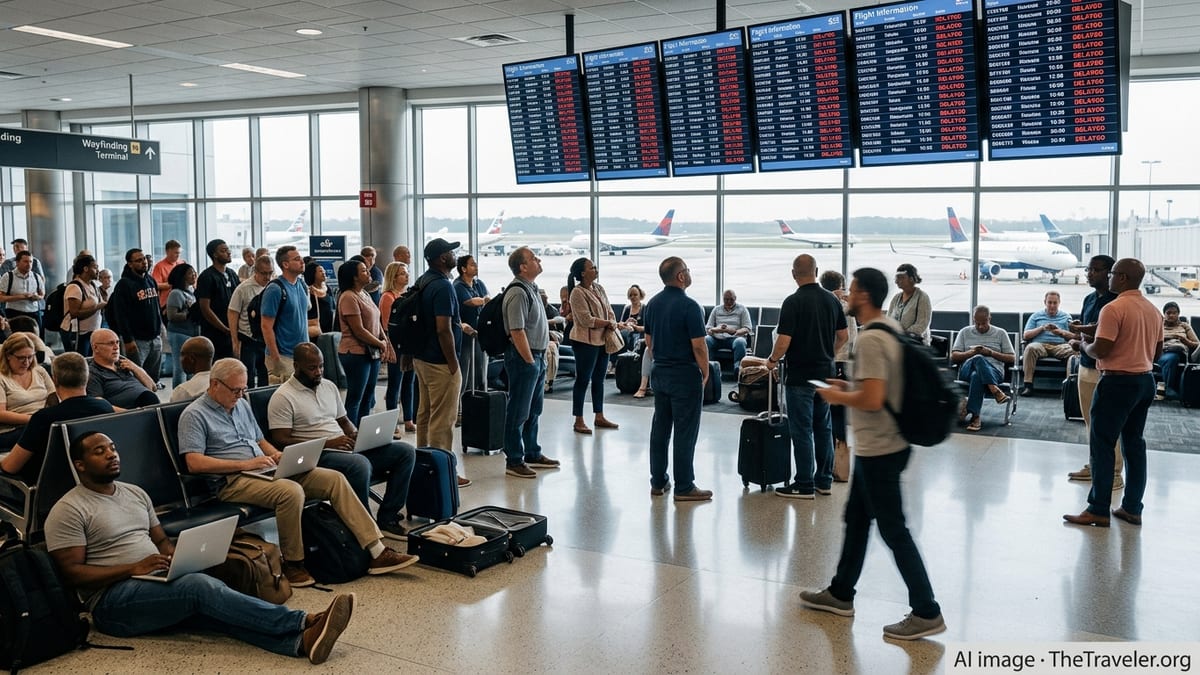
Delays at the World’s Busiest Hub Spread Across Networks
Publicly available flight-tracking data on Wednesday indicated that operations at Hartsfield-Jackson remained under strain, with Delta Air Lines, Southwest Airlines, American Airlines and several smaller carriers accounting for the majority of the 204 delayed departures and arrivals. While the 12 cancellations represented a small fraction of the total schedule, the timing and concentration of delays at the Atlanta hub amplified disruptions across domestic and international routes.
Reports from airline operational dashboards and independent tracking platforms show that aircraft and crews scheduled to pass through Atlanta encountered rolling delays during the morning and early afternoon peak. Because Hartsfield-Jackson functions as a primary connector for Delta and an important node for Southwest and American, even moderate disruption at the airport can quickly affect flights to and from dozens of cities.
Connections to major U.S. gateways, including New York and Los Angeles, as well as key long-haul routes serving Canada, the United Kingdom and Japan, were among those affected. Passengers traveling between regional airports and international hubs often experienced missed connections, longer layovers and rebooked itineraries as airlines attempted to re-balance their networks.
The latest issues come after several weeks in which Atlanta traffic has periodically been slowed by weather, staffing pressures and broader system strain linked to a recent U.S. government shutdown and strong late-winter storms. Industry data published in recent months has highlighted how quickly delays at a high-throughput airport such as Hartsfield-Jackson can cascade into nationwide disruption.
Impact on Key U.S. Gateways: New York and Los Angeles
The operational challenges in Atlanta translated into schedule turbulence for some of the busiest airports in North America. In New York, flights connecting through Atlanta to John F. Kennedy International, LaGuardia and Newark Liberty saw a mix of late arrivals and pushed-back departures, according to same-day tracking boards and airline status pages. Even when local weather around New York improved, delayed inbound aircraft from the Southeast constrained on-time performance.
Los Angeles International Airport, another high-volume coastal gateway, also felt the effects. Publicly available data on recent performance trends already show that LAX handles tens of millions of departing passengers each year, with roughly one in five flights arriving or departing behind schedule. Against that backdrop, additional late-running services from Atlanta further tightened aircraft utilization and increased the risk of missed connections for travelers heading to Asia-Pacific or onward to Latin America.
For many passengers, the impact was most visible in extended waits at gates, crowded departure areas and reprinted boarding passes rather than dramatic large-scale cancellations. Airlines tended to favor holding flights where possible to protect connections, especially on routes linking Atlanta with New York, Los Angeles, Chicago, Dallas and other major hubs. While that strategy can limit outright cancellations, it also increases the likelihood of rolling knock-on delays throughout the day.
Travel industry analysts note that congestion at major coastal gateways is particularly sensitive to upstream delays. With aircraft and crews moving along tightly timed rotations, a late departure from Atlanta early in the day can still be affecting schedules in New York or Los Angeles by evening, even if local conditions at those airports remain relatively stable.
International Repercussions in London, Tokyo and Beyond
The wave of delays out of Atlanta also rippled through transatlantic and transpacific networks. London and Tokyo, consistently ranked among the world’s busiest international gateways, saw disruptions mainly in the form of late-arriving connecting traffic and schedule adjustments by U.S. carriers and their alliance partners. Long-haul departures to and from these hubs often rely on feeder flights from Atlanta and other U.S. cities to assemble full loads.
Recent air transport statistics from government and industry bodies underscore the significance of these global connections. London remains the leading foreign gateway for U.S. international passengers, and Tokyo’s Haneda and Narita airports sit near the top of global rankings by passenger volume. Even limited delays or equipment changes on a handful of U.S.-originating flights can mean missed onward links for travelers heading deeper into Europe or Asia.
According to published coverage and operational summaries, airlines responded by adjusting departure times, swapping aircraft types and, in some cases, consolidating lightly booked services. Passengers connecting through London or Tokyo from Canadian cities and secondary U.S. markets often encountered longer than planned layovers or were rerouted through alternative hubs such as Chicago, Dallas or Seattle.
The situation highlighted the interdependence of North American and international networks. When a core hub like Atlanta experiences hours of disruption, the ripple can eventually reach airport displays thousands of miles away, even if conditions locally in London or Tokyo remain routine. This effect is especially visible on overnight banked departures designed to connect multiple inbound flows from the United States, Canada and the Caribbean.
Airlines Juggle Recovery While Passengers Seek Options
As the day progressed, airlines focused on recovery operations, seeking to realign aircraft and crews while keeping further cancellations to a minimum. Public dashboards showed some improvement in on-time performance at Hartsfield-Jackson by mid-afternoon, yet residual delays continued to affect both domestic and international routes. Recovery typically involves a combination of minor schedule compression, shifting aircraft between routes and using reserve crews where available.
Passengers facing missed connections or significantly delayed arrivals turned to rebooking tools, same-day change options and, in some cases, voluntary travel waivers that remained in place after earlier weather and airspace disruptions this month. Recent weeks have seen multiple carriers, including large U.S. airlines, issue flexibility policies for flights touching New York, Atlanta and other weather-prone hubs, allowing travelers to move trips within a limited date range without additional fees.
Consumer advocates note that, in the current operating environment, even a relatively modest number of cancellations can create an outsized impact when load factors are high and many flights are already near capacity. Seats for same-day reaccommodation are limited, particularly on long-haul services linking the United States to Europe and Asia. Travelers caught up in the Atlanta delays often reported being rerouted through less direct paths or being moved to flights the following day.
Operational reports also indicate that airlines continued to emphasize compliance with federal consumer protection rules on lengthy tarmac delays and involuntary bumping. While the day’s disruption did not approach the scale of major weather events earlier in the year, it served as a reminder of how quickly schedules can unravel when a primary connection point slows down.
What Travelers Can Expect in the Coming Days
Looking ahead, industry observers expect airlines to restore more normal operations at Hartsfield-Jackson and its key partner airports over the next 24 to 48 hours, provided there are no additional weather or airspace surprises. However, publicly available performance data from recent months suggests that isolated pockets of delay may persist as carriers work through displaced aircraft and crews.
For passengers booked through Atlanta, New York, Los Angeles, London or Tokyo, the latest disruptions underscore the importance of monitoring flight status closely, building extra time into connections and being prepared to adjust plans when operational conditions tighten. Travel planners often recommend avoiding very short connection windows at large hubs and considering earlier departures on days when storms, staffing issues or system strain are anticipated.
Broader aviation data compiled over the past year shows that even top-tier global hubs operate with narrow margins for error. As travel demand remains strong across North America, Europe and Asia, days like this one at Hartsfield-Jackson illustrate how quickly a few hundred delayed flights and a small set of cancellations can reverberate through the world’s interconnected air travel system.
For now, the latest round of interruptions at Atlanta appears to be a mid-level operational challenge rather than a full-scale meltdown. But for individual travelers navigating missed meetings, lost vacation time or unexpected overnight stays, the distinction offers limited comfort, reinforcing the reality that flying through the world’s busiest hubs still carries a heightened risk of delay.