

More news on this day
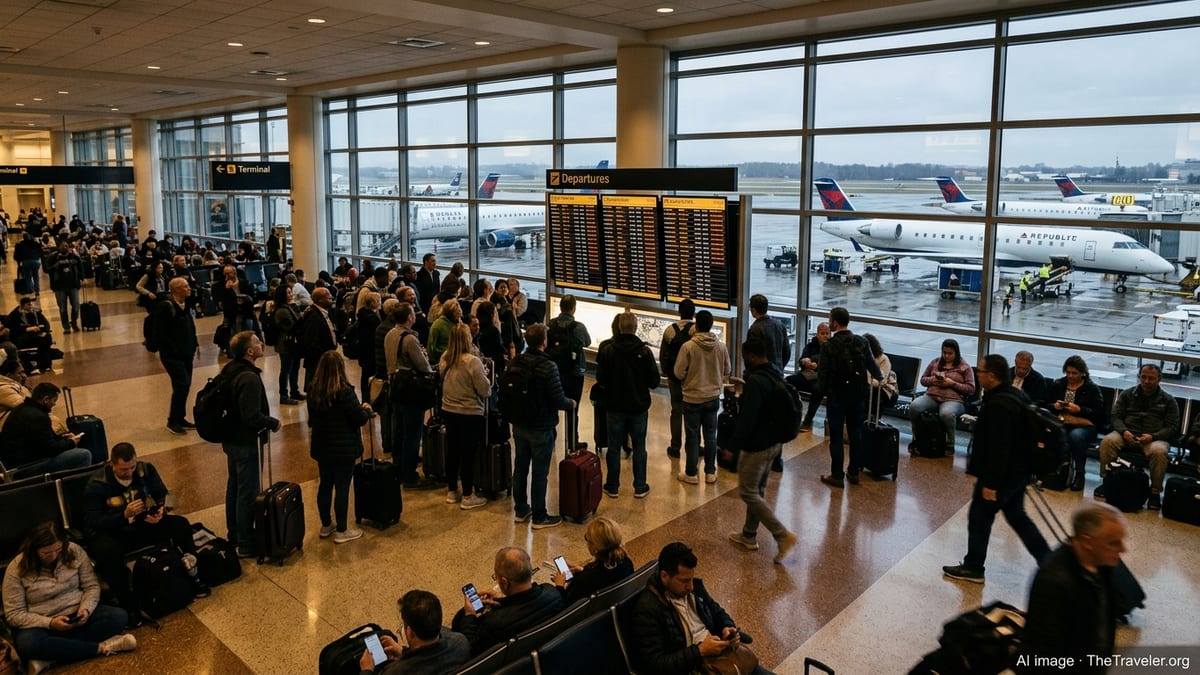
Travelers moving through Ronald Reagan Washington National Airport are facing a fresh wave of disruption as regional carrier Republic, which operates flights for several major U.S. airlines, suspends at least 11 departures and records more than 100 delays, rippling across routes that connect Washington with New York, Columbus, Albany, Atlanta and several other cities.
Get the latest news straight to your inbox!
Disruptions Ripple Across a Crowded Washington Airspace
Reports from aviation tracking services and airport status boards indicate that Reagan National is again confronting significant schedule strain at the height of the spring travel period. Dozens of delayed departures and arrivals tied to Republic-operated flights for major network airlines are backing up gates and crew rotations, adding to congestion at one of the country’s most tightly controlled airports. The pattern follows a month in which the broader Washington region has already seen weather-related slowdowns, air traffic control constraints and intermittent ground stops.
Publicly available flight-status data show that the latest operational snarl includes the suspension of at least 11 Republic-operated flights in and out of Reagan National, alongside more than 100 delays extending throughout the day. The impact is magnified by the hub-and-spoke nature of regional flying, in which a missed or late turn on an early-morning leg can cascade into hours of disruptions for travelers booked on subsequent segments.
Reagan National’s constrained runway layout and restricted airspace have long kept it near the top of national rankings for delay minutes per passenger. Recent federal analyses of on-time performance highlight how even relatively small operational shocks can ripple quickly through the airport’s dense schedule, particularly during peak business travel periods when departure slots are tightly packed and recovery options are limited.
The current bout of disruptions comes as airlines and regulators continue to balance high demand for short-haul connectivity into the U.S. capital with ongoing air traffic control staffing pressures and weather volatility that have affected many East Coast hubs during the late winter and early spring period.
Major Cities Feeling the Impact Beyond Washington
The latest schedule data show that the effects of Republic’s disruptions are not confined to Washington. Routes linking Reagan National with New York area airports, Columbus, Albany and Atlanta are seeing elevated delay levels and scattered cancellations as aircraft and crews fall out of position. Regional operations often serve as crucial feeders into larger airline networks at these cities, meaning that missed connections can quickly strand travelers far from their final destinations.
Columbus and Albany, where regional jets play an outsized role in linking local passengers to national and international networks, appear particularly vulnerable when a carrier such as Republic encounters operational strain. Delays on Washington-bound flights can disrupt onward journeys to the Midwest, the Southeast and the West Coast as passengers miss connecting departures on mainline aircraft.
Atlanta, one of the nation’s busiest hubs, is also experiencing knock-on effects from the Reagan National disruptions. Even when the airport itself is operating normally, irregular operations involving regional partners can create imbalances in aircraft availability and require last-minute schedule adjustments, including rebookings onto later flights or different routings through other hubs.
New York routes add an additional layer of complexity. High traffic density, chronic congestion and weather-sensitive approach paths into the New York metropolitan area mean that delayed departures from Washington can easily translate into holding patterns or further ground delays at arrival airports, compounding the disruption for passengers on both ends of the route.
Republic’s Outsized Role in U.S. Regional Connectivity
Republic, which in recent years has expanded through mergers to become one of the largest regional carriers in the United States, operates flights on behalf of multiple major airlines under their respective brand names. Public corporate filings and industry analyses describe a fleet dominated by Embraer 170 and 175 regional jets, serving more than a thousand daily departures across the country. That scale means that operational turbulence at one of its focal airports can quickly reverberate throughout the broader network.
Because Republic-branded aircraft typically do not appear on consumer tickets, many passengers experiencing disruptions at Reagan National and other affected airports may not immediately recognize that a single regional operator connects many of the delayed flights. Instead, they see the logos of the major carriers whose flight numbers Republic operates under contract, even when the underlying crew, maintenance and day-of-operation decisions sit with the regional partner.
Industry observers note that this structure can complicate recovery efforts during disruption events. When weather, air traffic control constraints or technical issues reduce capacity, regional partners often shoulder a significant share of schedule adjustments, including proactive cancellations of lower-priority flights. With Republic now handling large portions of short-haul flying for several mainline carriers, any concentrated set of suspensions or delays at an airport such as Reagan National can leave limited alternatives for travelers hoping to switch to another carrier or routing on short notice.
Republic’s own publicly filed customer-service plans for lengthy tarmac delays emphasize coordination with its mainline partners and adherence to federal time limits on ground holds. However, those documents also underscore that exceptions can occur when air traffic control, safety or security considerations reduce the options available to dispatchers and crews during rapidly evolving disruption scenarios.
Weather, Infrastructure and System Strain Behind the Delays
While no single cause fully explains the current round of disruptions, recent weather systems across the eastern United States have combined with infrastructure and staffing constraints to create challenging conditions for airlines. A series of strong storm systems in March has prompted travel waivers from several major carriers, particularly for flights touching the Northeast and Mid-Atlantic. Those waivers acknowledge the heightened risk of delays, reroutes and cancellations as airlines attempt to balance safety with schedule reliability.
Air traffic control capacity in the Washington region has also come under pressure. The terminal radar facility managing approaches to Reagan National, Dulles and Baltimore/Washington has reported isolated operational issues in recent weeks, including a temporary hazmat-related closure that brought departures to a halt for several hours. Although that specific incident has been resolved, it illustrates how sensitive the regional airspace can be to unexpected constraints at key control nodes.
Longer-term analyses from federal transportation agencies and congressional committees have repeatedly flagged Reagan National as an airport where demand often presses against physical and regulatory limits. The combination of a compact airfield, riverine approach paths and strict security-related airspace rules restricts options for rapid recovery when operations fall behind schedule. Any reduction in arrival or departure rates, whether due to weather, traffic management initiatives or localized technical issues, can therefore translate into visible queues of aircraft waiting for takeoff slots.
Industry data on passenger delay minutes underline the cumulative impact of these constraints. Even on days without headline-grabbing disruptions, incremental delays at Reagan National add up over time, contributing to a nationwide pattern in which regional hubs and slot-controlled airports account for a disproportionate share of missed connections and extended travel days.
Travelers Face Crowded Gates and Tight Rebooking Windows
For passengers caught in the current disruption, the practical effects are most visible at the gate and in the rebooking process. With more than 100 Republic-linked delays reported in connection with Reagan National operations, same-day seat availability on alternative flights is limited, particularly on peak business routes such as Washington to New York and Washington to Atlanta. Many affected travelers are being shifted to later departures or rerouted through other hubs, extending overall journey times.
Airline customer-service advisories encourage passengers to monitor mobile apps and airport display boards closely for gate changes and rolling departure estimates. When widespread delays or cancellations occur, self-service rebooking tools and proactive notifications have become critical for keeping travelers informed, but those tools can be strained when irregular operations affect multiple carriers and airports simultaneously.
Airport terminal operations are also feeling the strain. Crowded holding areas near heavily impacted gates, longer lines at customer-service desks and increased competition for power outlets and seating have become common scenes during the disruption period. Travelers with tight onward connections at downline airports are especially vulnerable, as even modest delays out of Reagan National can push itineraries beyond legally mandated crew duty limits or narrow connection windows.
Travel industry analysts suggest that, given the underlying capacity and infrastructure challenges in the Washington region, passengers planning near-term trips through Reagan National should allow extra time, build flexibility into connections and consider earlier departures where possible. As regional carriers such as Republic continue to play a central role in linking the capital to cities like New York, Columbus, Albany and Atlanta, operational resilience at DCA remains a critical factor in the reliability of air travel along the eastern seaboard.