

More news on this day
Germany’s already fragile winter air travel network faced fresh disruption this weekend after regional carrier Cityjet suspended three of its scheduled services, tightening capacity on key routes serving Frankfurt and Hamburg and leaving passengers scrambling for alternatives at two of the country’s most important airports.
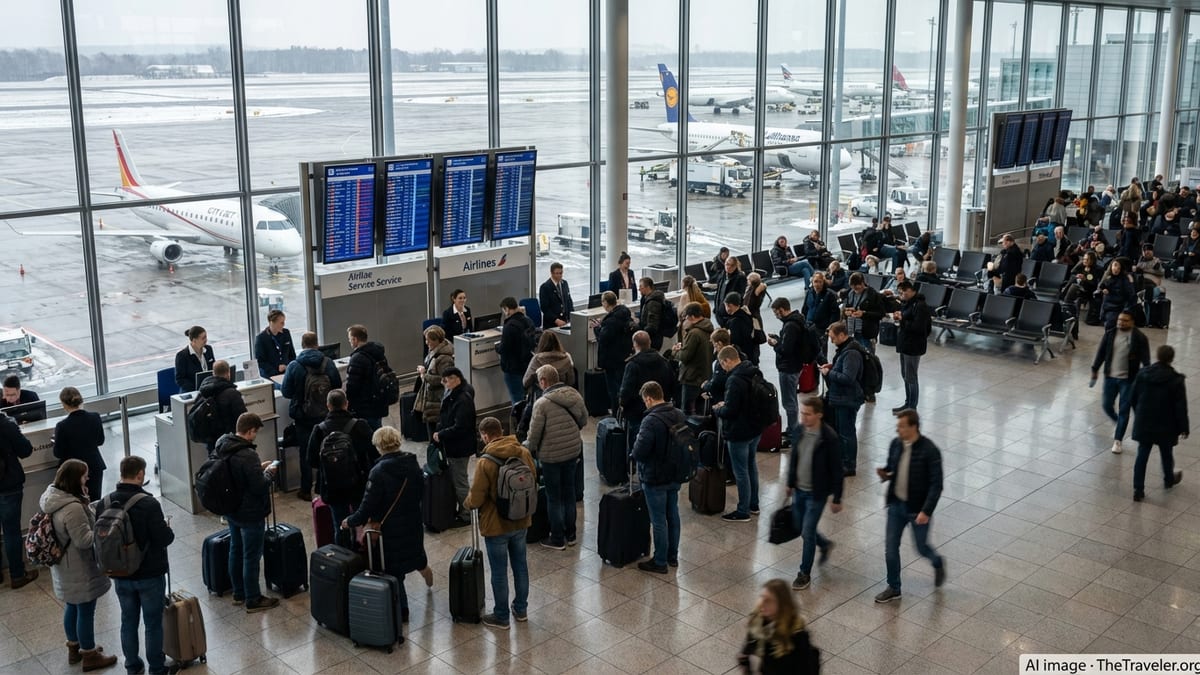
Cityjet Pulls Three Services Amid Wider German Disruptions
Cityjet’s decision to suspend three flights touching Frankfurt and Hamburg has added another layer of complexity to a German aviation system already grappling with weather, congestion and knock-on delays across Europe. While the carrier operates a relatively small share of overall movements compared with Lufthansa or Eurowings, its sudden absence on select regional services is being acutely felt on routes where capacity was already tight at the height of winter travel.
The move comes against a backdrop of recurring disruption at German hubs, where waves of delays and cancellations have become a familiar feature of the early 2026 season. Flight-tracking and industry data show that Frankfurt, Munich, Berlin and Hamburg have all seen repeated bouts of operational stress so far this month, driven by a combination of winter storms, runway de-icing requirements and congested airspace across central Europe.
Industry analysts note that even small schedule changes at secondary airlines can have outsized effects when airports are already running close to their limits. With Cityjet withdrawing three services that connected into Germany’s main hubs, the pressure has intensified on other carriers to absorb displaced passengers, often at short notice and on already busy departures.
For travelers, the suspension has translated into longer queues at rebooking desks, crowded departure halls and a fresh wave of uncertainty over connections, particularly for those linking from regional European cities into long-haul flights departing Frankfurt.
Frankfurt: Germany’s Largest Hub Under Strain
Frankfurt Airport, Germany’s busiest international gateway, has been at the center of the latest turbulence. In recent days, the hub has been forced to manage a broad mix of disruption, from severe winter weather that triggered dozens of cancellations and delays to rolling schedule adjustments by multiple airlines seeking to stabilize operations. Each new irregularity, including the removal of Cityjet capacity, has added friction to an already delicate system.
Snow and icy conditions earlier this week slowed runway operations and increased the need for de-icing, reducing throughput and compressing takeoff and landing slots. Ground crews have been working extended shifts to clear taxiways and stands, yet the combination of weather-sensitive procedures and a dense schedule has created recurring bottlenecks. Airlines have been asked to trim peak-hour flights where possible to help regain punctuality.
Cityjet’s suspended services intersect with Frankfurt’s role as a crucial transfer platform. Many passengers affected by the changes were using the airline’s regional flights to connect into long-haul departures operated by larger network carriers. When those feeder flights disappear, travelers can find themselves rerouted on more circuitous itineraries, often via Munich, Berlin or overseas hubs such as Amsterdam and Zurich.
Airport officials and airline liaison teams have emphasized that safety considerations, particularly around de-icing and runway conditions, must take precedence over schedule integrity. Nevertheless, they acknowledge that the cumulative effect of weather-related constraints, previous waves of cancellations and Cityjet’s latest cuts has pushed Frankfurt’s operational resilience to its limits during peak travel periods.
Hamburg Faces Knock-On Effects from Regional Cuts
Hamburg Airport, a key gateway for northern Germany and Scandinavia, has also been dealing with sustained turbulence. The city has already been affected this winter by strong winds, snow and the lingering impact of earlier storms that snarled road and rail links across the region. Against that backdrop, Cityjet’s decision to remove services touching Hamburg has reduced the options for both business and leisure travelers relying on short-haul connectivity.
Unlike Frankfurt, which serves as a massive intercontinental hub, Hamburg’s traffic base is more heavily weighted toward European point-to-point routes. This means even a small number of suspended flights can significantly narrow choices on specific city pairs. Travelers who once had the option of a direct Cityjet service are now being pushed onto multi-stop routings or are forced to travel at less convenient times with competing airlines.
Local travel agents report a rise in inquiries from passengers seeking help to reshuffle itineraries around the suspended flights. In many cases, alternatives exist, but they may involve longer layovers, overnight stays or higher fares. Passengers who booked well in advance at promotional prices are finding that rebooking into the current market can be considerably more costly, especially if they need to travel on fixed dates for business meetings, cruise departures or major events in Hamburg and the surrounding region.
Hamburg’s airport management has been working closely with carriers to keep essential routes open and minimize connection gaps. However, with broader European airspace still dealing with periodic delays and weather systems sweeping across the North Sea and Baltic, the loss of even a handful of regional flights contributes to a sense of instability for travelers in northern Germany.
Passengers Confront Cancellations, Confusion and Crowded Halls
For travelers caught up in the latest wave of disruption, the reality on the ground has been crowded terminals, anxious waits at departure boards and frequent schedule updates. At both Frankfurt and Hamburg, passengers affected by Cityjet’s suspended services joined queues of others whose flights were delayed or altered for unrelated reasons, creating a picture of generalized uncertainty across the departure halls.
Some passengers have reported receiving notification of schedule changes only hours before departure, leaving limited time to evaluate alternatives. Others learned of cancellations only on arrival at the airport, forcing them to make decisions quickly while contending with language barriers, unfamiliar booking systems and limited availability on nearby departures. For families and older travelers in particular, navigating these changes has proved stressful.
Airport staff and ground handlers have been trying to manage expectations and provide clear information, but they acknowledge that real-time updates can lag when multiple airlines are making rolling adjustments to their schedules. Digital signage and mobile apps do not always refresh as quickly as passengers would like, especially when weather or air traffic control interventions require last-minute slot changes.
Compounding the frustration is a sense among some travelers that disruption has become a regular feature of air travel in Germany this season. The latest Cityjet cancellations are perceived less as isolated events and more as another chapter in a month-long run of irregular operations that have already tested the patience of frequent flyers and occasional holidaymakers alike.
How Cityjet’s Suspension Ripples Across Europe
While the immediate impact of Cityjet’s suspended flights is most visible at Frankfurt and Hamburg, the repercussions are being felt across a wider European network. The airline has historically focused on regional services that plug into major hubs, often operating on behalf of or in close coordination with larger carriers. When those links are temporarily removed, the result is a chain reaction affecting schedules in other countries as well.
In some cases, aircraft and crew that would have been based around German rotations must be reassigned, creating fresh complexities for operations teams. Timetables in neighboring countries can be indirectly affected as airlines attempt to rebalance aircraft usage and protect the most commercially critical routes. This can lead to subtle but widespread impacts, such as slightly retimed departures, swapped aircraft types or reduced frequencies on secondary city pairs.
Competing airlines have moved quickly to market remaining seats on overlapping routes, especially during high-demand periods. However, aviation experts caution that short-notice capacity increases are rarely possible in winter, when fleets are already heavily committed. The net effect is a tightening of available inventory, particularly on popular business corridors linking Germany with major financial centers in Western and Northern Europe.
For travelers planning itineraries weeks or months in advance, this shifting landscape can be difficult to read. Fares can fluctuate more sharply than usual as yield management systems respond to the sudden loss of capacity. Travelers who wait too long to rebook may find that the most convenient options have already sold out to others displaced by the initial cancellations.
Airlines and Airports Race to Manage Winter Operations
The latest turmoil underscores how vulnerable European aviation remains to a combination of seasonal weather and structural constraints. German airports have repeatedly highlighted the challenge of running dense schedules in winter, when snow, ice and reduced visibility can quickly erode the margins built into daily operations. Even when the total number of cancellations appears modest, the concentration of disruptions around peak waves of departures and arrivals can create significant knock-on effects.
Airlines operating into Frankfurt and Hamburg have been forced to balance reliability against commercial pressures. Proactively canceling or suspending a limited number of flights, as Cityjet has done, can sometimes help stabilize the broader schedule by freeing up resources and allowing more time for de-icing, maintenance checks and crew changes. Yet from a passenger perspective, any cancellation is disruptive, particularly when it affects a flight with few direct substitutes.
Ground handling companies and airport service providers have also been under pressure. They must maintain sufficient staffing and equipment levels to cope with peaks in demand while dealing with the unpredictability of winter storms and freezing conditions. Crew duty-time regulations, union agreements and safety standards all limit the flexibility to extend shifts or redeploy staff at short notice when a new weather front or operational issue emerges.
In the longer term, German aviation stakeholders are once again debating whether more slack needs to be built into winter timetables, especially on regional routes that connect to major hubs. But such changes take planning cycles and may not offer immediate relief to passengers facing today’s disruptions.
What Travelers Can Do if Their Flight Is Affected
With the situation in flux, travel experts advise passengers flying to or from Germany in the coming days to take a more proactive approach to their trips. First, travelers are encouraged to monitor their booking directly through the airline’s app or website and to enable notifications, as these channels typically receive updates before airport departure boards. Checking flight status the evening before departure and again several hours ahead of leaving for the airport can help avoid unnecessary journeys.
Passengers whose Cityjet flight has been suspended are generally entitled to a choice between rebooking and reimbursement, depending on fare conditions and the circumstances surrounding the cancellation. Those with onward connections should coordinate any changes for the entire itinerary, not just the affected leg, to avoid ending up with misaligned flights that jeopardize later segments on different tickets.
Travel agents recommend arriving earlier than usual at Frankfurt and Hamburg, particularly in bad weather, to account for longer lines at security, check-in and customer service desks. Where possible, carrying hand luggage only can provide more flexibility to switch onto alternative flights at short notice, as bags do not need to be transferred or re-tagged.
For future bookings, seasoned travelers are increasingly opting for slightly longer connection times through major hubs during the winter months. While a tight transfer can be tempting when schedules run smoothly, the recent disruptions in Germany highlight the value of a buffer when snow, ice or last-minute cancellations intervene.