

More news on this day
Thailand has become the latest Southeast Asian destination to confront mounting travel disruption, joining Indonesia, Malaysia and Vietnam in a volatile mix of extreme weather, overcrowded airports, rising fuel costs and tightening entry rules that is testing the resilience of the region’s tourism recovery.
Get the latest news straight to your inbox!
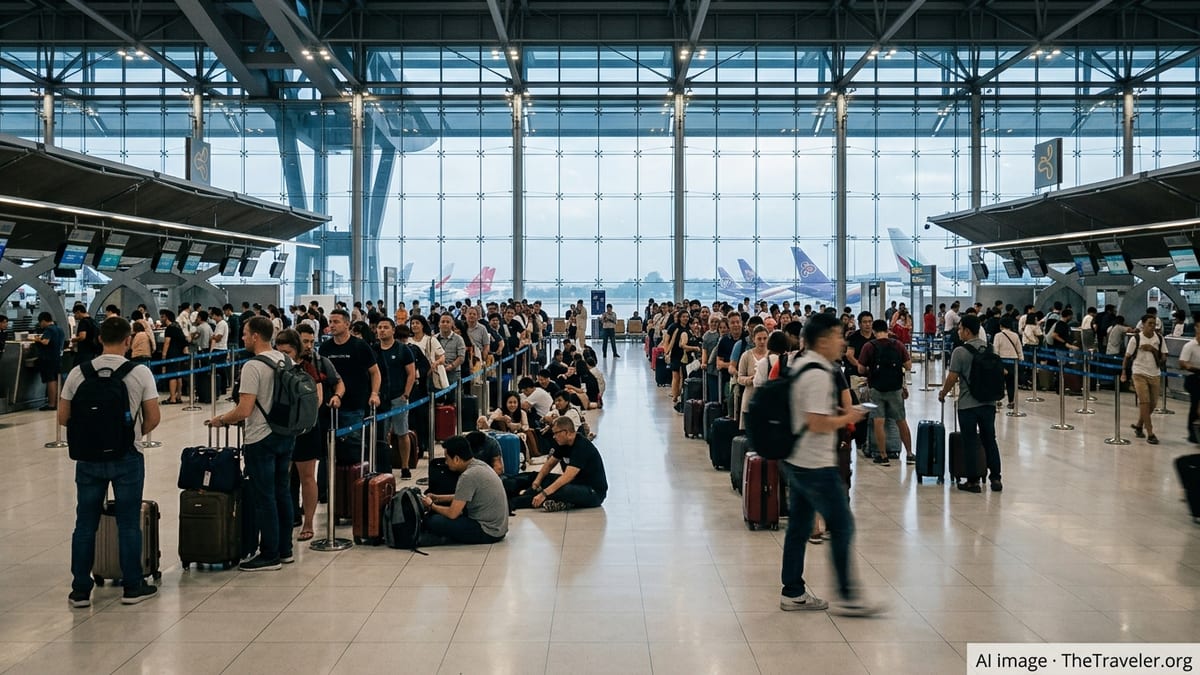
Thailand’s Tourism Engine Strains Under Surging Arrivals
Publicly available data indicate that Thailand’s airport traffic has rebounded to near or above pre-pandemic levels, with Airports of Thailand reporting more than 119 million passengers across its key gateways in the 2024 fiscal year and daily international arrivals climbing sharply through late 2025 and early 2026. Suvarnabhumi and Don Mueang airports now handle tens of thousands of passengers per day, magnifying long-standing issues of congestion, queues and transport bottlenecks around Bangkok.
Reports from local outlets describe heavy vehicle traffic at Suvarnabhumi, crowded parking, and long immigration lines during peak hours as airlines restore capacity and new routes are added to capture resurgent demand. Research focusing on passenger experience at Suvarnabhumi notes that volumes approaching 60 million or more passengers a year are again testing the main terminal, where processing and baggage systems were already under pressure before the pandemic.
Recent crises have revealed how quickly this system can tip into chaos. Bangkok’s recurring smog episodes have affected visibility at Suvarnabhumi and Don Mueang, leading to diversions and delays, while flooding and storms have periodically disrupted regional links to popular southern beach destinations. In early March 2026, Thai immigration authorities announced an overstay amnesty for travelers stranded by Middle East flight disruptions, while simultaneously rolling out stricter screening measures to manage security risks and ease congestion in airport halls.
At the same time, Thailand is confronting a more fragile demand mix than headline numbers suggest. Reporting on airport concession revenues indicates that spending by key markets such as Chinese travelers has softened, even as passenger totals climb. This combination of high volume, lower per-capita spending and operational stress is fueling debate over whether the sector is chasing quantity at the expense of quality and long-term resilience.
Indonesia’s Bali Battles Overtourism, Natural Hazards and New Rules
Indonesia’s flagship destination, Bali, encapsulates the paradox at the heart of Southeast Asia’s tourism boom. Visitor numbers on the island have surpassed pre-pandemic peaks, with more than six million international arrivals in recent years and provincial targets that continue to edge higher. Tourism accounts for a major share of local economic activity, yet the island’s infrastructure, water resources and waste systems are struggling to keep pace with crowds concentrated in a handful of hotspots.
Associations representing hotels and tourism businesses have publicly raised concerns about overtourism, highlighting chronic traffic jams in southern Bali, mounting rubbish, and rising local frustration over noise and behavior in areas such as Canggu and Kuta. Analyses by regional and international media describe a widening gap between government ambitions to keep growing arrival numbers and the capacity of roads, utilities and public services to absorb them without degrading the visitor experience and residents’ quality of life.
Against this backdrop, policymakers are pivoting toward what they describe as “quality tourism.” Published coverage indicates that Bali’s provincial government is considering tighter entry conditions, including requirements for bank statements, proof of return flights and detailed itineraries for some travelers. The island has also discussed or implemented measures such as tourist levies, stricter enforcement of local conduct rules, and curbs on new hotel construction in overbuilt areas.
Indonesia’s travel system is also exposed to natural hazards that cause sudden, severe disruption. Volcanic eruptions, including recent activity at Mount Lewotobi Laki Laki, have repeatedly forced evacuations and led to flight cancellations affecting routes to and from Bali and other hubs. When ash clouds close airspace or damage runways, thousands of holidaymakers can be stranded for days, underscoring how concentrated the country’s tourism model has become around a small number of vulnerable resort gateways.
Floods and Climate Extremes Hit Malaysia and Vietnam
Malaysia and Vietnam are facing their own forms of travel chaos, much of it driven by climate shocks. A series of severe floods from late 2024 into 2025 inundated large areas of Malaysia, repeatedly disrupting road and rail links and forcing temporary closures of smaller airports. Government statements and media reporting describe billions of dollars in damage to infrastructure, with bridges, highways and rural roads requiring emergency repairs that have slowed cross-country journeys and complicated access to coastal resorts.
Tourism-reliant communities on Malaysia’s east coast and on islands in both Peninsular and East Malaysia have seen visitor numbers swing sharply as heavy rains and storm surges damage beaches, dive sites and basic services. Local accommodation providers have had to cancel bookings or relocate guests when floodwaters cut off access roads or overwhelmed drainage networks. Recovery often takes months, compressing peak seasons and raising costs for both travelers and operators.
Vietnam, meanwhile, has been hit by destructive flooding and landslides in multiple regions, including the north and central provinces that are home to major cultural and nature tourism destinations. Recent disasters have washed out mountain passes, damaged heritage sites, and forced the suspension of rail and bus services that serve as lifelines for domestic and regional tourists. Reports indicate that authorities have warned of possible jet fuel constraints during periods of energy-market volatility, adding another layer of uncertainty for airlines and passengers.
These shocks are part of a broader pattern. Climate scientists and regional organizations have linked the increase in extreme rainfall and storms affecting Southeast Asia to recurring La Niña conditions and a warming ocean. For travelers, the result is a more unpredictable environment in which once-reliable “dry seasons” are frequently interrupted by torrential downpours, while heatwaves and haze events create new health and safety considerations for trips that were previously marketed as straightforward beach or city breaks.
Energy, Airfares and Policy Shifts Cloud Regional Outlook
Beyond weather and infrastructure, economic and geopolitical forces are amplifying travel disruption across Southeast Asia. Recent coverage of global energy markets notes that higher fuel and freight costs are rippling through Vietnam’s export sectors and transport system, and similar pressures are affecting airlines serving Thailand, Malaysia and Indonesia. Carriers in the region have raised fares on international routes to offset more expensive jet fuel, while some budget operators have scaled back frequencies or reconfigured schedules.
Warnings about potential jet fuel shortages in Vietnam, and concerns about liquefied natural gas supplies in Thailand, have heightened worries that sudden supply shocks could trigger last-minute flight cancellations or broader power constraints at key airports. For a region that promotes itself on seamless connectivity and competitive fares, the prospect of more expensive and less reliable air travel is a serious challenge.
At the same time, governments are recalibrating tourism policies with a stronger emphasis on security and control. Thailand’s recent ten-point package to tighten screening of foreign nationals, Bali’s exploration of stricter financial and documentation checks at entry, and ongoing discussions about visitor caps or moratoriums on new hotels in the most saturated districts all reflect a shift away from unfettered growth. Public messaging increasingly stresses safety, cultural respect and environmental protection, even as national tourism agencies continue to set ambitious arrival targets.
This combination of higher prices, stricter rules and recurring operational shocks could reshape travel flows within Asia. Travelers may opt for shorter trips, alternative secondary cities or different regions entirely if they perceive Southeast Asia’s main gateways as too unpredictable. The risk for destination countries is that mismanaging this transition could erode the goodwill built up over decades of branding the region as a welcoming, affordable and hassle-free escape.
Can Southeast Asia Stabilize Its Tourism Future?
Analysts of regional tourism trends argue that the current wave of travel chaos is both a stress test and an inflection point. Thailand’s overloaded airports, Bali’s overtourism debate, Malaysia’s and Vietnam’s flood damage, and wider energy-market turbulence are exposing structural weaknesses that were masked by years of steady growth before the pandemic. Crowds, queues and periodic crises are no longer isolated incidents but recurring features of the travel landscape.
In response, governments and industry bodies are stepping up investment in technology and infrastructure, from collaborative decision-making systems at Thai airports to new terminal projects and digital border controls across the region. There is growing recognition that resilience planning for floods, volcanic ash and haze must be integrated into tourism strategies, rather than treated as ad hoc emergency responses when events occur.
Whether these efforts will be enough to secure Asia’s tourism future remains uncertain. The region continues to benefit from strong underlying demand, a young population, and a powerful global reputation for hospitality and value. Yet the balance between volume, sustainability and reliability is becoming harder to manage as climate risks intensify and travelers grow less tolerant of disruption.
For now, Thailand’s experience illustrates the broader crossroads facing Southeast Asia. The same rapid rebound that has filled planes and revived local economies has also magnified vulnerabilities at airports, on roads and in fragile coastal and mountain environments. How Thailand, Indonesia, Malaysia and Vietnam navigate this period of volatility will help determine whether the region’s tourism boom evolves into a more resilient model, or remains hostage to the next wave of chaos.