

More news on this day
Governments have issued heightened travel warnings covering at least 33 countries as the expanding conflict centred on Iran and the wider Middle East disrupts global flight operations, forcing airlines to reroute or cancel services and prompting travellers to rethink international plans for 2026.
Get the latest news straight to your inbox!
Expanded Advisories Sweep Across Middle East and Beyond
Publicly available government advisories show that countries across North America, Europe and Asia have updated guidance in recent weeks for destinations in and around the Middle East. The United States has urged its citizens to depart immediately from a broad list of regional states and to avoid nonessential travel across much of the Gulf, Levant and parts of North Africa, while similar cautions have been issued by European partners and other allied governments.
Coverage from major travel outlets indicates that Israel, the Palestinian territories, Lebanon, Syria, Iraq, Iran and Yemen remain among the highest risk destinations, with widespread recommendations not to travel. Gulf states such as the United Arab Emirates, Qatar, Bahrain, Kuwait, Oman and Saudi Arabia have seen advisories raised to stricter levels, often telling visitors to reconsider travel or to exercise extreme caution due to the risk of missile and drone attacks, airspace closures and rapidly shifting security conditions.
Additional warnings now extend to countries that serve as key transit points or lie on the periphery of the conflict zone, including Turkey, Egypt, Jordan, Cyprus and Pakistan. When combined with overlapping advisories from multiple governments, the network of warnings touches at least 33 countries, creating a patchwork of restrictions that complicates planning for long haul journeys linking Europe, Asia, Africa and the Americas.
Travel industry analysts note that the breadth of the advisories effectively redraws the risk map for international tourism in 2026. Tour operators and corporate travel managers are being pushed to reassess itineraries that rely on Middle Eastern hubs or overflight corridors that pass near active military activity, even when final destinations are located far from the front lines.
Airspace Closures and Rerouting Snarl Global Flight Networks
The sharp escalation in hostilities following late February strikes involving Iran, Israel and the United States has triggered a series of airspace restrictions that ripple through global aviation. Reports from aviation trackers and regional media show that Israel, Qatar and the United Arab Emirates have each temporarily curtailed or closed parts of their airspace since the start of the conflict, following missile and drone attacks near major airports and energy facilities.
Analyses by airline industry publications estimate that tens of thousands of flights to and from the Middle East have been cancelled since the conflict began, with still more operating on significantly altered routings. Carriers across Europe and Asia have shifted services away from key transit corridors over Iran, Iraq and the Gulf, adding hundreds or even thousands of extra kilometres to flights that connect major markets such as London to Mumbai or Frankfurt to Bangkok.
These detours can extend flight times by two to three hours on some routes, according to estimates shared by aviation consultants, substantially increasing fuel burn, crew costs and scheduling complexity. Even modest routing changes are creating knock on effects for airport slot availability, aircraft rotations and onward connections, resulting in missed links and longer layovers for passengers on multi segment journeys.
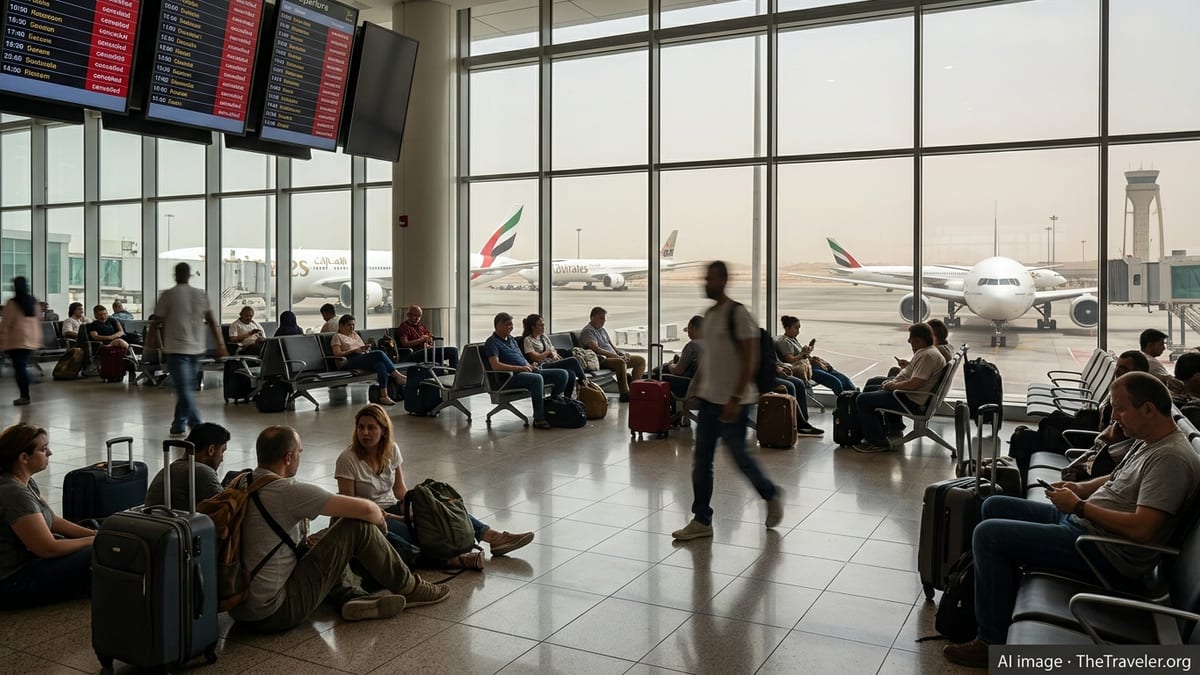
Major Gulf hubs such as Dubai, Abu Dhabi and Doha, previously marketed as efficient crossroads between continents, are experiencing unprecedented disruption. Coverage from regional and international media describes reduced schedules, temporary suspensions on selected routes and a visible slowdown in connecting passenger flows, with ripple effects reaching airports as far afield as Southeast Asia, Australia and Western Europe.
Tourism Flows Shift as Travellers Seek Alternative Gateways
The combined impact of travel warnings and disrupted air services is already reshaping global tourism patterns for 2026. Industry commentary suggests that international arrivals to the Middle East are likely to fall sharply this year, as leisure travellers defer trips to Gulf metropolises, religious sites and resort destinations that previously drew millions of visitors annually.
Travel trade reports highlight a marked pivot toward alternative hubs and itineraries that avoid the conflict zone. European and Asian carriers operating northern routes over Central Asia, the Caucasus and Russia have reported strong demand from travellers who would previously have connected through the Gulf. In Asia, tourism officials describe a renewed focus on routes via Singapore, Bangkok and other Southeast Asian gateways for journeys linking East Asia with Europe and Africa.
At the same time, destinations perceived as stable and easily reachable without crossing affected airspace, including parts of Southern Europe, the Indian Ocean and the Americas, appear to be absorbing demand from cancelled or postponed Middle Eastern trips. Tour operators in regions such as the Mediterranean, East Africa and the Caribbean are adjusting marketing campaigns to target travellers who have abandoned itineraries requiring a Gulf stopover.
For business travel, the disruption is particularly acute. Corporate travel managers are reported to be relocating meetings and trade events away from the region, shifting conferences to cities with more reliable flight options and fewer security related constraints. This shift could have lasting consequences for the positioning of Gulf cities as global business and events hubs, depending on the duration and intensity of the current crisis.
Rising Fuel Costs and Airline Finances Under Pressure
The conflict’s impact on energy markets is adding further strain to the aviation sector. Publicly available economic data show that oil prices have surged since the fighting escalated, driven in part by fears over the security of shipping lanes near the Strait of Hormuz, a critical chokepoint for global crude exports. As jet fuel costs spike, airlines are confronting significantly higher operating expenses just as they attempt to manage reroutings and schedule disruptions.
Industry coverage from financial and travel news outlets indicates that some carriers have begun introducing or increasing fuel surcharges, particularly on long haul routes most affected by detours around the Middle East. Analysts warn that if elevated fuel prices persist through the peak northern hemisphere summer season, airfares could rise broadly, potentially dampening demand and eroding the post pandemic recovery in international tourism.
While major network airlines in North America and Europe report resilient booking trends so far, the margin for absorbing higher costs is limited. Global airline profitability in 2026 was expected to remain thin even before the conflict, and the additional financial burden of rerouting, delays and cancellations risks pushing weaker carriers into losses. Some low cost and regional airlines with exposure to Middle Eastern routes have already signalled that earnings will be hit.
Travel economists caution that extended disruption in Middle Eastern airspace could reverberate throughout the global economy. Higher air cargo costs, reduced belly hold capacity on passenger flights and longer transit times for goods could affect supply chains, particularly for sectors reliant on rapid delivery between Asia and Europe, adding another layer of uncertainty to the broader outlook.
Travellers Face Uncertainty as Crisis Shows No Clear End
For individual travellers, the combination of travel warnings, volatile schedules and rising prices is creating a climate of uncertainty. Consumer oriented travel advisories urge passengers to monitor official government guidance for each destination on their itinerary, confirm the status of flights well before departure and consider flexible tickets or comprehensive travel insurance that specifically covers war related disruption.
Travel agents and online booking platforms report elevated levels of itinerary changes and cancellations for trips involving Middle Eastern connections, with some customers opting to delay long haul journeys entirely rather than navigate complex rebookings. Others are choosing overland or shorter haul options closer to home, indicating a potential near term tilt back toward regional and domestic tourism.
Publicly available planning guidance suggests that travellers who must transit the region for essential reasons should allow extra time for security checks, possible last minute gate changes and additional screening of baggage and cargo. Airlines are also advising passengers to be prepared for sudden routing adjustments and extended flight times as airspace conditions shift.
With diplomatic efforts yet to produce a clear path toward de escalation, the outlook for Middle Eastern aviation and its central role in global travel remains highly uncertain. For now, the widening circle of travel warnings and the continuing disruption to flight operations are reshaping how and where the world travels, leaving tourism dependent economies and the airline industry bracing for a turbulent year.