

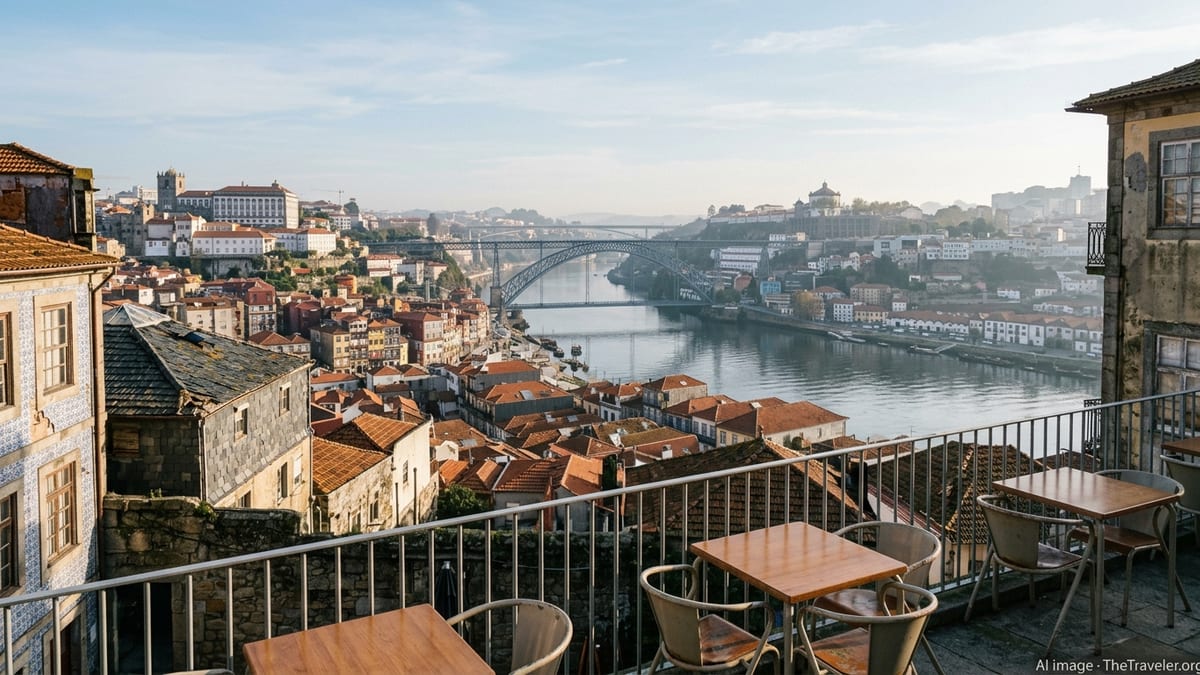
The first time I realized travelers were quietly breaking up with Paris, I was not standing by the Seine or beneath the Eiffel Tower. I was on a breezy terrace in Porto, Portugal, watching the sun sink behind the Dom Luís I Bridge as waiters carried balloon-shaped glasses of tawny port from table to table. At the next table, an American couple clinked glasses and the woman said, almost apologetically: “We were going to do Paris this year. Then we saw the prices and the crowds and thought… why not try here instead?” By the end of my week in Porto, I had heard some version of that sentence half a dozen times.
From Paris Daydream to Porto Plane Ticket
I remember the exact evening my own plans shifted. I was pricing a long weekend in Paris for early summer, casually flipping between flight tabs and hotel sites. Economy fares from New York had climbed so high that adding a checked bag and seat selection pushed the total close to what I paid for a whole week in Europe five years ago. Central hotels around the Marais and Saint‑Germain that once hovered in the 180 to 220 euro range were now often well above 300 euros per night in peak months, especially after new hotel and transport taxes tied to infrastructure upgrades.
Out of curiosity, I opened a separate tab and searched flights to Porto. Suddenly the math softened. On those same dates, there were multi‑carrier itineraries through Lisbon or Madrid for several hundred dollars less than Paris. Guesthouses overlooking the Douro River, with balconies and breakfast included, started around 120 to 160 euros per night. An apartment in the historic Ribeira district that would barely buy a cramped room on the Rive Gauche was listed for under 200 euros, with river views thrown in almost as an afterthought.
That price gap was only part of the story. Paris had just finished hosting a global sporting spectacle, and early reports spoke of record visitor numbers and new surcharges on hotel nights meant to finance transport improvements. At the same time, European tourism data showed Portugal’s star rising, with Americans becoming one of the country’s most important visitor groups. Porto, long in the shadow of Lisbon, was suddenly appearing in trend lists aimed at travelers seeking “overtourism alternatives” and slower, more authentic city breaks.
When I mentioned this to a travel agent friend in Chicago, she didn’t hesitate. “You’re not the only one,” she said. “A lot of my clients still love Paris in theory, but they’re tired of paying top dollar to stand in long lines. Once I show them pictures of Porto’s riverfront and price out a week there instead, the decision often makes itself.”
The Moment I Realized Porto Has Its Own Kind of Romance
I arrived in Porto on a damp April afternoon, the kind when Paris would wrap itself in melancholy chic. Porto wears gray skies differently. The terracotta rooftops glowed against the low clouds, and the blue‑and‑white azulejo tiles on church facades seemed to light the streets from within. The city felt compact, walkable, and immediately readable in a way that Paris, with its grand boulevards and sprawling arrondissements, often does not on a first visit.
My guesthouse sat halfway up one of Porto’s famously steep hills, a restored 19th‑century townhouse with original stone walls and a courtyard of lemon trees. The owner, Marta, checked me in with a warmth that felt more like visiting a cousin than a hotel. When I asked where to find the best view for sunset, she did not reach for a map. She simply pointed downhill. “Follow the church bells until you see the river. Then keep walking until the street smells like grilled sardines. You’ll know you’re in the right place.”
By the time I reached the Ribeira waterfront, the clouds had broken into streaks of gold. Locals were leaning against the stone embankment with plastic cups of beer, tourists in light jackets tested out their first sips of port from tasting rooms in Vila Nova de Gaia across the river, and teenagers practiced skateboard tricks between the café tables. It was busy but not suffocating. No one was shooing people along for blocking a photo line or yelling at influencers for climbing monuments. The romance here wasn’t choreographed; it unfolded in small, unscripted gestures.
Later that evening, as I watched traditional rabelo boats bob in the current, I realized something: Porto doesn’t try to imitate Paris’s glamour. It offers a different, more rough‑hewn kind of romance, one where peeling paint and laundry lines are part of the charm, and where you can still wander into a family‑run tasca and eat a slow, inexpensive dinner without a reservation or a dress code.
What Travelers Are Quietly Escaping When They Skip Paris
At breakfast my second morning, I struck up a conversation with a couple from Toronto who had just rerouted their anniversary trip. “We did Paris three years ago in October,” the husband told me. “We loved it, but even then the lines at the big museums were exhausting. We tried to see Monet’s water lilies and waited through two separate bottlenecks just to get into the room. When we saw that this year’s prices were higher and summer crowds expected to surpass pre‑pandemic highs, we started looking for somewhere calmer.”
They are not alone. Across Europe, local authorities have been grappling with overtourism, from Barcelona to Venice and Amsterdam. Paris, which regularly ranks among the world’s most visited cities, has faced its own pressures, particularly in districts like Montmartre. Residents’ associations have grown more vocal about the strain of record visitor numbers on housing and everyday life, and new restrictions on short‑term rentals have been one response. For many travelers, this conversation filters down as a vague sense that the old postcard Paris is hard to experience without wading through a tide of selfie sticks and tour groups.
Money compounds the fatigue. American travelers, in particular, have watched as hotel rates in central Paris climb each year, accelerated by special levies aligned with major events and infrastructure spending. A three‑night stay that might once have fit snugly into a long‑weekend budget can now feel as costly as a full week in a so‑called “second city” such as Porto, Valencia, or Kraków. When surveys show that much of global tourism spending is still concentrated in a handful of destinations, it is not surprising that cost‑conscious travelers begin asking themselves whether their euros might stretch further elsewhere.
There is also an emotional element. After years of social‑media feeds filled with the same Eiffel Tower shots and Louvre pyramid poses, a certain fatigue has set in. On my travels, I increasingly hear a quiet confession: “I still want to see Paris someday, but I don’t need it to be this year.” Porto benefits directly from that recalibration. It offers old‑world streets, river views, ornate churches, and a tangible sense of history, but few people back home will have seen their friends post from the exact same viewpoint a dozen times over.
What Porto Offers Instead: Tile, Wine, and the Atlantic Light
What Porto provides is not a bargain‑bin Paris, but an entirely different experience that happens to satisfy many of the same urges that send people to the French capital in the first place. You want café culture? Try ordering a bica and a pastel de nata at a neighborhood café in the Cedofeita district, where office workers linger over tiny espressos and students in vintage denim share cigarettes on the sidewalk. The coffee is strong, the prices gentle, and the people‑watching excellent.
You came for architecture? Porto’s historic center is a UNESCO‑listed wonderland of baroque churches, narrow alleys, and tiled facades that catch the Atlantic light in surprising ways. The São Bento railway station, with its sweeping azulejo panels depicting the history of Portugal, stopped me in my tracks more effectively than any ornate metro entrance ever has in Paris. Clerigos Tower, for all its steep climb, delivers a 360‑degree panorama over orange roofs and river curves that feels almost intimate compared with the distant, high‑altitude view from the Eiffel Tower.
Many visitors to Paris go for art and food. Porto will not overwhelm you with world‑class museums in the same sheer volume, but it rewards those who enjoy a quieter, more local version of cultural immersion. When I visited the Serralves Museum of Contemporary Art, set in a park of manicured lawns and art deco gardens, I wandered through exhibits with plenty of space to linger. Tickets cost less than most big‑name Parisian museums, and there were no timed‑entry battles or packed gallery bottlenecks.
As for food, consider what you can actually afford to enjoy. In Paris, a classic bistro dinner for two, with a bottle of decent wine, often hovers at a price point that encourages careful planning. In Porto, I splurged on fresh grilled dourada, a carafe of vinho verde, and a shared dessert, then watched my bill come to a figure that in Paris might cover only two glasses of house wine and an appetizer. Even signature experiences, like guided tastings at port wine cellars in Vila Nova de Gaia, are priced gently enough that many visitors book more than one without wincing.
A Day in Porto That Would Feel Impossible in Paris Right Now
On my fourth day, I set myself a challenge: plan the sort of unhurried, reasonably priced day that many travelers say they miss in big‑ticket cities like Paris. No pre‑booked time slots, no racing between major monuments, no tickets that required logging in three months in advance.
I started early with a walk through the Bolhão market, a refurbished food hall where fishmongers, florists, and bakers share space with newer gourmet stalls. For a few euros, I picked up still‑warm rolls, local cheese, and cherries, then found a bench in a nearby square to assemble an impromptu breakfast. No one hurried me along. There were tourists, certainly, but the majority of people around me seemed to be locals shopping for the day.
Later that morning I hopped on one of Porto’s vintage trams rumbling toward the Foz do Douro district, where the river finally meets the Atlantic. A single ticket cost less than a Paris metro ride, and as we clattered past crumbling warehouses and modern apartment blocks, I felt none of the crowding that has become normal on popular urban routes in peak season. At the waterfront, I walked along the promenade, watching surfers battle chilly waves while older men in flat caps played cards at a café. It was hard to reconcile this easy space and sea air with the images I had been seeing of gridlocked streets in Europe’s busiest city centers.
That afternoon, back in the historic center, I ducked into a tiny wine bar recommended by Marta. There were six tables, a blackboard menu listing half a dozen wines by the glass, and a plate of petiscos that appeared almost as soon as I sat down. The owner asked where I was from, then recommended a small‑producer Douro red I had never heard of. We ended up talking about the recent surge in American visitors and the efforts local tourism boards are making to encourage longer stays that spread spending beyond the city core. It was a level of unhurried connection that can still happen in Paris, of course, but feels more organic in a city where visitor numbers, while rising, have not yet tipped everyday life off balance.
The Trade‑Offs: What You Lose by Skipping Paris (for Now)
To be clear, choosing Porto over Paris is not a simple upgrade. If your dream is to stand in front of the Mona Lisa, picnic under the Eiffel Tower, or trace the footsteps of writers along the Seine, no Portuguese city can replace that. There is a reason Paris remains one of the most visited cities on earth: its combination of art, architecture, fashion, and myth is unmatched. Porto has no Louvre, no Orsay, no Boulevard Saint‑Germain lined with legendary literary cafés.
Porto also operates on a different cultural wavelength. French cuisine, with all its global prestige, does not have an exact counterpart in northern Portugal, where the food is heartier, saltier, and more anchored in tradition than in fine‑dining theatrics. If you live for three‑hour tasting menus in Michelin‑starred rooms, you may find Porto’s culinary scene more modest, though Lisbon and the wider region certainly offer pockets of high‑end experimentation.
Then there is the matter of scale. Paris is a capital in every sense: enormous, dense, and layered with national institutions. It offers symphony halls, opera houses, flagship designer boutiques, and sprawling department stores that draw fashion and design lovers from around the world. Porto, by contrast, feels closer to a large coastal town than a global metropolis. Many travelers see this as a plus, but if your ideal city break involves back‑to‑back blockbuster exhibitions and late nights in vast, pulsing nightlife districts, you may need to recalibrate your expectations.
The point, as more travelers are quietly realizing, is not that Porto is “better” than Paris. It is that in an era of rising prices and pressure on the world’s most famous cities, a place like Porto can deliver a deeply satisfying European trip without the emotional and financial overhead that now often comes bundled with a visit to the French capital.
How to Make the Most of Porto if You’re a Paris Regular
If you are a seasoned Paris visitor considering a change, it helps to think of Porto not as a substitute, but as a complementary chapter. Go for the things it does uniquely well, rather than chasing carbon‑copy experiences. Instead of matching Parisian museum marathons, allow yourself to sink into the rhythm of the streets. Wander the labyrinth of the Miragaia neighborhood, where residents still chat from balcony to balcony, and where small workshops sell hand‑painted tiles and textiles instead of branded souvenirs.
Food is an easy entry point. In Paris, café culture often accompanies a mental tally of what each stop will cost. In Porto, you can afford to be impulsive. Order a francesinha, the city’s famously indulgent sandwich, at a basic neighborhood restaurant where locals watch football on TV, then balance it the next day with grilled fish and crisp green salad at a simple seaside spot. Splurge where it counts on a port wine tasting that digs into the differences between tawny, ruby, and vintage, or on a Douro Valley day trip where you visit small, family‑run quintas that might never appear on big‑tour itineraries.
Leaning into language can also transform the trip. If you are used to leaning on English and basic French phrases, learning a few Portuguese words before you arrive goes a long way. I found that even an awkward “bom dia” and “obrigado” opened doors, earning smiles and, more than once, an unsolicited extra pastel de nata with my coffee. Locals spoke candidly about both the benefits and pressures of tourism, echoing broader European conversations about how to welcome visitors without erasing local life.
Finally, consider seasonality. Where Paris in high summer can feel saturated, Porto in shoulder seasons such as April, May, September, and October offers gentle weather, thinner crowds, and prices that are kinder on both accommodations and flights. On my last visit in late September, I paid less for a river‑view room than a friend spent on a budget hotel near a major Paris train station in the same week. That sort of comparison is what quietly nudges many experienced travelers toward Portugal’s second city.
The Takeaway
Paris is not going anywhere. It remains a global magnet, a city whose museums, monuments, and myth will continue to draw millions each year. But beneath the headlines about record visitor numbers and new tourist taxes, a subtler shift is underway. Travelers who have already “done” Paris once or twice, or who wince at the idea of burning half their annual travel budget on four crowded days, are quietly looking for cities that offer beauty and depth without the same level of strain.
Porto has emerged as one of the most compelling answers to that search. It is a city of tiled facades and river mists, of port wine cellars and Atlantic sunsets, of steep streets where laundry hangs over cobblestones and café tables spill onto sidewalks without pretense. It delivers much of what people romantically associate with Europe: walkability, history at every turn, strong coffee, late dinners, and the intoxicating sense of stepping into a place that has its own proud rhythm of life.
Choosing Porto over Paris this year does not have to mean abandoning the French capital forever. It can be a tactical pause, a chance to rediscover the joy of a city break that feels spacious, affordable, and genuinely welcoming, before circling back to the icons when the timing feels right. As I finished my last glass of tawny port on that terrace by the Douro, I realized I did not miss the Eiffel Tower at all. I had found a different kind of magic, and for now, it was more than enough.
FAQ
Q1. Is Porto really cheaper than Paris for a short city break?
In general, yes. Flights from North America can be similar or slightly cheaper, but the real savings are in accommodation, food, and everyday expenses like local transport and museum entries.
Q2. How many days do I need in Porto if I’m used to spending a week in Paris?
Most travelers find three to four full days is enough for Porto itself, but a week allows time for a Douro Valley day trip, beach time near Foz do Douro, and slower exploration of neighborhoods.
Q3. Will I miss out on major museums and famous landmarks by skipping Paris?
You will miss Paris’s big‑name museums and monuments, which have no real equivalents. Porto offers smaller‑scale cultural sights and historic architecture rather than blockbuster attractions.
Q4. Is Porto a good choice for first‑time visitors to Europe?
Yes. It is compact, walkable, relatively affordable, and less overwhelming than many capitals, which makes it an excellent introduction to European city travel.
Q5. How crowded does Porto get compared with Paris?
Porto’s visitor numbers are growing, but its streets and attractions generally feel less congested than Paris’s most famous districts, especially outside of peak summer months.
Q6. Is English widely spoken in Porto?
In most hotels, restaurants in central areas, and tourist services, you will find English speakers, though learning a few basic Portuguese phrases is appreciated and can enrich your interactions.
Q7. What is the best time of year to visit Porto as an alternative to Paris?
Spring and early autumn are ideal, offering milder weather, more manageable crowds, and better value than peak summer in either city.
Q8. Can Porto replace Paris for a romantic trip or honeymoon?
It depends on what you find romantic. Porto offers intimate river views, wine cellars, and cozy guesthouses rather than grand boulevards and iconic monuments, but many couples find it just as enchanting.
Q9. Is Porto safe for solo travelers compared with Paris?
Both cities are generally safe if you use normal urban precautions. Many solo travelers report feeling particularly comfortable in Porto’s central districts and along the riverfront.
Q10. Should I combine Porto with Lisbon or treat it as a standalone alternative to Paris?
Both options work well. Porto can anchor a full trip, or you can pair it with Lisbon or the Douro Valley for a varied itinerary that still costs less than a long stay in Paris.