

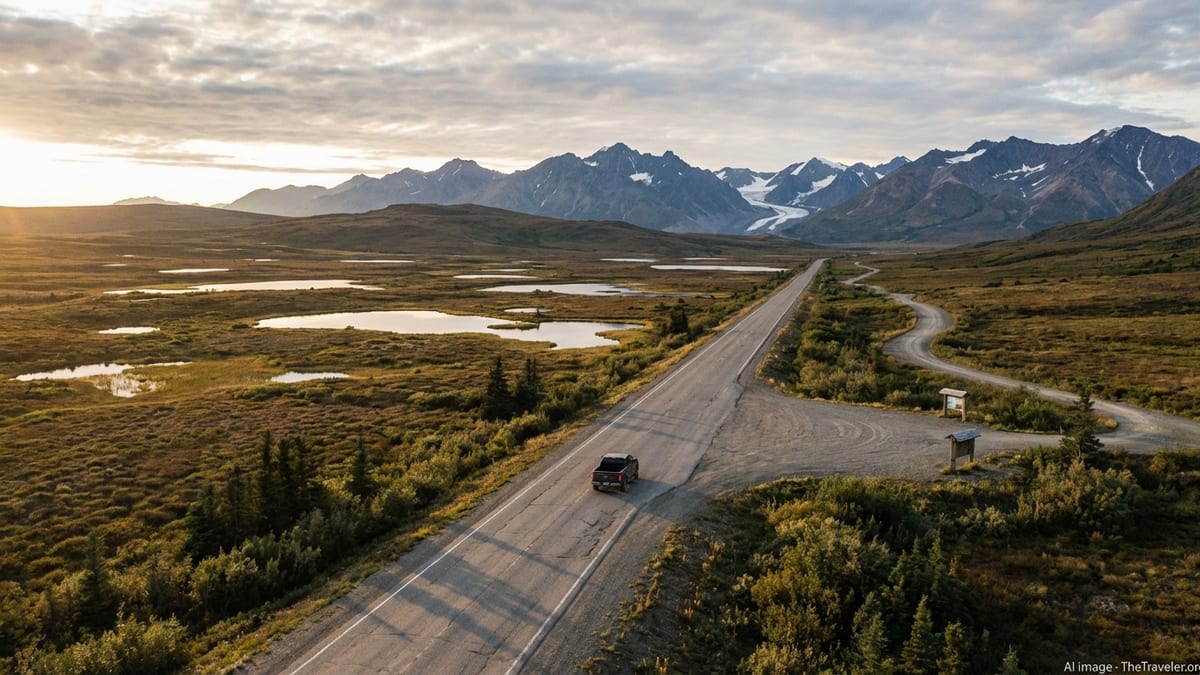
On a map, Alaska looks conquerable: a bold sweep of highways curling around mountains and coastline, a few dotted lines for ferries and a smattering of airports. From a distance, it is easy to imagine crossing the state like any other great American road trip. Spend just a few days on the ground, however, and a different Alaska appears. Distances stretch, schedules wobble, and the usual rules of getting from A to B no longer quite apply.
The Myth of the Simple Alaska Road Trip
Travelers often arrive in Anchorage or Fairbanks expecting to “do Alaska” in a week behind the wheel of a rental car. The reality is that Alaska’s paved highway system is surprisingly limited, its communities scattered across a landmass larger than Texas, California and Montana combined. You can drive from Anchorage to Fairbanks, or along the Kenai Peninsula, but most of the state will remain far beyond any road you can follow. Even many well-known destinations, from national parks to fishing towns, sit at the ends of gravel roads, airstrips or tidal channels instead of neat interstate exits.
Driving itself is not usually difficult in summer. Major highways are generally well maintained and traffic is light compared with most American states. What catches visitors off guard is how long everything takes. The road from Anchorage to Fairbanks can be driven in a day, but it is still several hundred miles, with long stretches where fuel, food and cell service are scarce. Throw in road construction, wildlife on the shoulder or a lingering storm front, and your tidy schedule quickly loosens by hours.
Then there are the places no car can reach at all. More than four out of five Alaskan communities are not connected to the road system, relying instead on small planes, boats or snow machines. A glance at the map might suggest you could simply detour to a coastal village or hop between fjord towns by highway. In practice, you soon discover that the road will only take you so far, and that the real Alaska begins where the pavement stops.
Ferries, Bush Planes and the Patchwork Network
Beyond the limited highways, Alaska functions on a web of ferries and small aircraft that bind together coastlines and interior settlements. The state-run ferry system, the Alaska Marine Highway, has long been a lifeline for coastal communities scattered along the Inside Passage and out toward the Aleutians. Its ships carry residents, freight and vehicles between towns that have no road access at all. For travelers, the ferries can feel both romantic and maddening, a slow-motion voyage through fjords that is also at the mercy of tight budgets, thinning schedules and unpredictable weather.
In recent years, sailings on some routes have been reduced, and locals have grown used to planning their lives around a timetable that can change with short notice. In small towns, ferry arrivals are announced with the daily weather, because a missed or canceled sailing has real consequences: delayed medical appointments, stranded workers, postponed school trips. Visitors who hope to link a road journey with a few strategic ferry crossings need to build in buffers of entire days, not just hours, because once the ship sails, the next one may be several days away.
Where the water ends, Alaska’s bush planes begin. Small aircraft are the backbone of travel to many villages, lodges and national park gateways. Airlines ranging from regional carriers to tiny charter outfits fly everything from single-engine floatplanes to sturdy twin props, landing on gravel strips, lakes and short runways carved out of forest and tundra. For outsiders, booking a seat on one of these flights can feel like stepping back to an earlier era of aviation, but these planes are not novelty rides. They are school buses, delivery trucks and commuter trains rolled into one.
That importance does not necessarily translate to reliability. Weather, especially in Southeast and along the Gulf of Alaska, frequently grounds small aircraft even when larger jets are still moving between Anchorage, Fairbanks and Seattle. Pilots and airlines have been steadily investing in modern navigation and GPS-based approaches to improve safety and cut cancellations, yet locals still routinely add an extra day to their travel plans to account for flights that do not get off the ground. For the visitor racing between a cruise, a flightseeing trip and a tight connection home, Alaska’s reliance on small planes introduces a form of uncertainty that does not fit neatly into a standard vacation spreadsheet.
Weather, Seasons and the Tyranny of Daylight
If Alaska’s infrastructure is intricate, its weather is even more so. The same forces that sculpt glaciers and feed rainforests also shape every itinerary. Even in high summer, when daylight stretches almost around the clock, storms can sweep the coast, covering mountain passes in low cloud and riling the seas that ferries must cross. Interior heat waves bake dusty gravel roads in July, then give way to frosty mornings just a few weeks later. In shoulder seasons such as May and September, visitors may encounter a confusing blend of lingering snow, early darkness and patchy road conditions.
Those seasonal patterns matter because many routes and experiences simply do not operate year-round. The majority of cruise ships that call on Alaska sail only from roughly May through September, closely tied to the months when weather and seas are most cooperative. Remote lodges often open for a tight summer window, and some ferries on marginal routes scale back their schedules or pause entirely once winter storms become too frequent. Roadside services can feel surprisingly seasonal too, with small fuel stations and eateries shutting down once the main flow of RVs and rental cars ebbs.
Daylight itself is both a gift and a constraint. In June, it is entirely possible to start a drive at nine in the evening and still have broad daylight for several more hours, which tempts many road trippers to push far beyond their usual limits. Yet in late autumn and winter, darkness closes in dramatically, and even relatively short drives can feel longer and more demanding. Those months introduce ice, snow and the possibility of avalanches or sudden whiteouts on mountain passes. For residents, these rhythms are part of life. For travelers used to stable conditions and predictable day lengths, they can quietly upend even a carefully researched plan.
Distances That Rewrite Your Sense of Scale
Alaska’s greatest illusion is scale. On the page, the road from Anchorage to Denali National Park looks like an easy hop. In reality, it is several hours of driving, enough that an early start and a late return still adds up to a very long day. The distances between other headline destinations are even more deceptive. A loop that includes the Kenai Peninsula, Denali and Wrangell–St. Elias National Park can involve thousands of road miles, especially if you add side trips down spur roads to fishing towns or backcountry airstrips.
Traveling those miles feels different here than on most American interstates. Traffic is sparse in many regions, and the temptation to stop is constant. A pullout with a view of a glacier, a moose browsing along the shoulder, a sudden opening in the clouds over a mountain range all invite unplanned pauses. These are highlights of an Alaskan road trip, but each one incrementally slows progress. Many visitors find their first few days unfolding more slowly than planned, only to realize mid-trip that their itinerary assumes a pace better suited to compact European countries than to the far north.
Getting off the main roads multiplies this effect. Driving the gravel spur into the Wrangell–St. Elias region, or the Parks Highway north toward the Arctic Circle, requires lower speeds and greater attention to changing conditions. Road maintenance can be sporadic, and storms or early thaws may leave washboard surfaces and potholes that punish conventional rental cars. Even where conditions are good, fuel stops may be separated by long gaps, which demands a more deliberate approach to refueling and rest than many travelers are used to.
The Hidden Costs of Getting Around
Alaska’s logistical tangle comes with a price tag that frequently surprises first-time visitors. Air travel between remote communities is essential, yet operating small aircraft in harsh conditions with relatively few passengers is expensive. Tickets on regional routes can cost far more per mile than a typical domestic flight in the lower 48. Federal subsidies help keep some essential routes alive, but they do not necessarily make them cheap or abundant for visitors. Ferry fares also add up quickly when you factor in vehicles, cabins and long-distance itineraries that span multiple days at sea.
On land, rental car costs can be higher than in many other states, especially in peak summer months, and some agencies limit where their vehicles can be driven. Insurance policies may exclude long gravel roads or remote areas, pushing travelers toward more robust vehicles or specialist rental outfits. Fuel prices tend to climb the farther you move from major hubs, reflecting the cost of getting gasoline or diesel into remote regions where roads are few and delivery itself is a logistical puzzle.
There are also opportunity costs baked into every decision. Opting for a budget road trip that skips ferries and small planes can limit how much of coastal or bush Alaska you ever see. Choosing instead to invest in a few key flights or a ferry passage may unlock spectacular experiences, but it might mean skipping other regions entirely. For many travelers, the most satisfying itineraries involve acknowledging these tradeoffs early and designing trips that go deeper in a few places rather than thinner across the entire map.
Planning for Uncertainty Without Losing the Magic
Confronted with stories of canceled bush flights, truncated ferry routes and fickle weather, some would-be visitors assume that traveling across Alaska is simply too complicated to be enjoyable. Yet millions of travelers do it every year, and many emerge with a sense that the challenges themselves are part of the adventure. The key is not to chase perfection, but to plan with humility, building an itinerary that expects detours and embraces them when they arrive.
That starts with time. Alaska rewards trips that allow a margin of error of at least a day or two at several points, particularly where your plans rely on a single daily ferry or a small-plane connection to a lodge or village. Instead of booking back-to-back activities almost every day, weaving in spare days around key transitions can turn potential misfortunes into unexpected discoveries. Being stranded in Juneau or Homer for an extra night because of high winds feels very different if you have room to explore an extra trail, café or museum rather than racing the clock to make a cruise or flight home.
Flexibility also extends to mindset. Delayed flights and detoured drives are almost inevitable in a state where infrastructure bends to geography and weather rather than the other way around. Choosing to treat these interruptions as part of the story, rather than as failures of planning, can transform frustration into curiosity. That might mean chatting with locals at a small-town café when a road closure halts your progress, or joining residents on a ferry deck as they point out their favorite coves and wildlife haunts. In Alaska, some of the most memorable encounters happen not in the places you meant to visit, but in the pauses along the way.
The Takeaway
The fantasy of Alaska as a simple road trip destination dissolves quickly once you begin to trace actual routes between its mountains, coasts and far-flung villages. Highways cover only a fraction of the map, ferries and bush planes introduce variables that few visitors have dealt with elsewhere, and weather reshapes even the most carefully constructed schedules. Distances are greater than they look, services more seasonal than many expect and costs more sensitive to fuel, storms and subsidies than glossy brochures tend to reveal.
Yet these same challenges are closely tied to what makes traveling across Alaska so compelling. This is a place where logistics are never entirely tamed, where each journey requires attention to maps, forecasts and local knowledge. The reward for accepting that complexity is a kind of travel that feels more grounded and vivid, whether you are watching mountains slide by from a ferry deck, listening to a pilot brief nervous first-timers before lifting off from a gravel strip, or driving into the late-night sun on a nearly empty highway. Crossing Alaska is not simple, and it is not meant to be. It is, instead, an invitation to slow down, plan carefully and let the last frontier shape your journey as much as you shape it.
FAQ
Q1. Can I see the main highlights of Alaska using only a rental car?
It is possible to visit major hubs like Anchorage, Fairbanks, Denali National Park and the Kenai Peninsula by car, but many iconic coastal towns and remote parks are not connected to the road system and require ferries or small planes.
Q2. How much extra time should I plan for weather delays?
Building at least one buffer day into any itinerary involving ferries or small aircraft is wise, and adding an extra night around key connections such as returning to Anchorage or Juneau provides additional security.
Q3. Are Alaska’s roads dangerous to drive in summer?
In summer, main highways are generally in good condition and not inherently dangerous for cautious drivers, though long distances, wildlife on the road and occasional construction zones demand alertness and unhurried schedules.
Q4. Do I need to book ferries and bush flights far in advance?
During peak season, ferries and popular small-plane routes can sell out, so it is advisable to reserve space weeks or months ahead, especially if you are traveling with a vehicle or connecting to remote lodges.
Q5. Why are flights within Alaska often more expensive than other domestic routes?
Operating small aircraft in remote regions with challenging weather, long distances and limited passenger numbers raises per-mile costs, and essential routes sometimes rely on subsidies rather than high traffic to survive.
Q6. Is it realistic to visit multiple distant regions in a one-week trip?
Trying to combine widely separated areas such as the Inside Passage, Denali and the Arctic in a single week usually leads to rushed travel and high costs, so focusing on one or two regions is more rewarding.
Q7. What is the best season for easier travel across Alaska?
Late spring through early autumn generally offers the most stable conditions, with long daylight hours and the widest choice of road services, ferries, tours and small-plane connections.
Q8. Will I have mobile phone coverage on long drives?
Coverage is good around larger communities and along some major highways, but there are extensive dead zones where there is no signal at all, so travelers should not rely on constant connectivity for navigation or communication.
Q9. Can I rely on navigation apps instead of paper maps?
Navigation apps are helpful where there is coverage, but carrying an up-to-date paper map or offline mapping on your device provides a crucial backup when signals disappear or batteries run low in remote areas.
Q10. How can I keep travel costs manageable given Alaska’s distances?
Concentrating on one or two regions, traveling slightly outside peak dates, sharing rental cars or accommodations and choosing a few carefully selected flights or ferries instead of many short hops can all help control expenses.