

Some states reveal themselves slowly. Pennsylvania announces its differences the moment your tires hit the highway. In a single day, you can leave a dense East Coast metropolis, cross old industrial river valleys, roll through Amish farmland and end up under some of the darkest night skies in the Northeast. Traveling through Pennsylvania can feel less like moving within one state and more like passing through several distinct versions of America stitched together by turnpikes and rivers.
The First Impression: Highways That Slice Through Different Worlds
The sensation of crossing into another America starts on the road itself. The Pennsylvania Turnpike, one of the country’s earliest long-distance toll highways, cuts across the southern heart of the state, threading through mountains, farmland and suburban sprawl over more than 350 miles. Drivers still pass through a series of rock-bored tunnels under the Appalachians, an almost cinematic reminder that the landscape here is something to be negotiated, not merely crossed.
Exit the turnpike near any of the major junctions and the scenery shifts almost immediately. Around Philadelphia, the road is crowded with commuters, logistics hubs and warehouse roofs that shimmer in the sun, echoing the energy of the Northeast Corridor. Head west and the density thins, billboards give way to barn roofs and the silhouettes of grain silos start to interrupt the horizon. Billboards for farm auctions, hunting outfitters and tractor dealerships replace the corporate logos of the suburbs. Within a couple of hours you sense a change not just in architecture but in priorities.
Further west toward the Laurel Highlands, the highway climbs into ridgelines that frame views of layered, forested hills. In winter these slopes are marked with ski trails; in fall they are cloaked in color that draws leaf-peepers from several states. Taking the same road over a long weekend can feel like reliving the state’s seasonal mood swings: steel-gray skies and wet pavement in late November, blinding green and river kayaks strapped to car roofs by June. It is an evolving corridor that hints at how varied Pennsylvania becomes once you leave the lane markers behind.
Philadelphia: A Northeastern Metropolis With Colonial Bones
In Philadelphia, Pennsylvania feels firmly rooted in the Northeast. Broad boulevards and marble-fronted institutions recall its role as a founding capital, while rowhouse neighborhoods speak to the city’s manufacturing and immigrant heritage. Independence Hall, brick townhouses and cobbled alleys fit easily into the same mental map as Boston or parts of New York, yet the city’s mood is distinctly its own, equal parts gritty and neighborly.
Walk from the Museum of Art down the Benjamin Franklin Parkway and you move past flag-lined parkways, international museums and city halls that feel recognizably East Coast. Coffee shops and corner bars spill onto sidewalks; the hum of regional rail and interstate traffic forms an invisible soundtrack. The skyline, though smaller than New York’s, delivers the same sense of vertical ambition that characterizes the northeastern seaboard.
Yet clues that you are in Pennsylvania appear quickly. The Schuylkill River loops through the city, its banks lined with boathouses and running trails that remind visitors how close the forested interior really is. Regional trains and intercity buses leave for small towns and county seats whose names reappear hundreds of miles away on interstate exit signs. In Philadelphia you feel the pull of the Atlantic world, but you can almost see the first ridges of the Appalachians on the western horizon, beckoning you inland.
Amish Country and Farmland: A Pastoral, Slower America
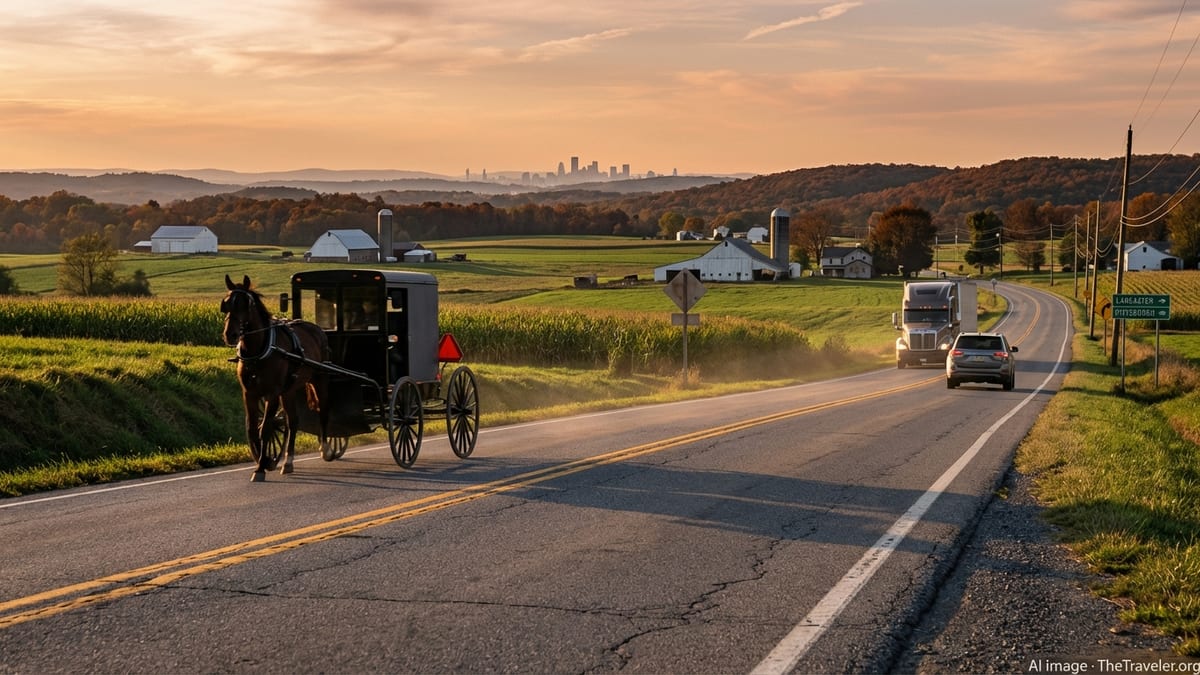
Drive an hour or so west into Lancaster County and it can feel as if you have crossed an international border rather than a county line. Subdivisions and shopping plazas recede in the rearview mirror, replaced by two-lane roads that crest gently over hills and dive into valleys of orderly fields. White farmhouses and immense bank barns anchor working properties trimmed with wash lines and tidy gardens. Horse-drawn buggies share the shoulder with pickup trucks, and the clip-clop of hooves becomes part of the ambient soundscape.
Lancaster County is home to one of the largest Amish communities in the world, and their presence shapes both the look and the rhythm of daily life. Country stores lit by natural light emphasize bulk staples and hand tools over packaged convenience. Signs advertise harness repair, quilt shops and roadside produce stands. Travelers from big coastal cities often remark on the sense of deceleration here, as if the pace of life has been dialed down a notch or two. Cell phone signals still reach the cornfields, but the culture does not revolve around them.
The farmland itself is a study in abundance. In late summer, fields of corn stand shoulder-high next to strips of alfalfa and pastures grazed by dairy cattle. Roadside stands overflow with sweet corn, tomatoes and homemade baked goods, a reminder that this region is not a museum piece but an active agricultural engine. To many travelers, this corner of Pennsylvania feels like the Midwest in miniature, evoking parts of Ohio, Indiana or Iowa, yet with an older, more densely layered history. It is one of the clearest moments when you feel that you have left the Northeast behind for another version of rural America.
The Industrial Rivers and Rust Belt Echoes of the West
Continue west toward the Susquehanna and the Monongahela and you enter a different narrative, one written by factories, rail lines and river barges. Former steel towns, coal patches and rail hubs line riverbanks that powered the rise of American heavy industry. Some mills now stand idle, their skeletal frameworks turned into historic sites or repurposed for offices and cultural centers. Others still operate in streamlined form, a reminder that manufacturing never disappeared entirely from this landscape.
In places like Johnstown, Altoona or the smaller boroughs outside Pittsburgh, the ghosts of the 20th century are impossible to ignore. Brick warehouses and row houses hug rail corridors, and hilltop neighborhoods are laced with switchback streets originally designed for workers walking home from shifts. You see murals celebrating union heritage, immigrant neighborhoods and high school football glory. The layered soot on some older facades feels like a physical archive of the state’s industrial past.
This corridor shares much with the Rust Belt arc that runs from Ohio through Michigan and into the Upper Midwest. There is the same bittersweet mix of economic struggle and community resilience, the same conversation about what comes after coal and steel. Yet Pennsylvania’s version has its own distinct topography. Towns cling to narrow river valleys carved deep into the Appalachians, climbing steep hills where in other states they might spread across broad plains. For travelers, this means a constant alternation between tight, almost claustrophobic valley roads and sudden panoramic overlooks that reveal entire industrial towns in a single glance.
Pittsburgh: The Urban Anchor of Appalachia
Arriving in Pittsburgh after crossing central Pennsylvania can feel like entering a completely different country. The city sits at the confluence of three rivers, its skyline packed onto a series of ridges and plateaus. It has long been described as a place with one foot in the Northeast and one in the Midwest, an urban anchor at the northern edge of Appalachia that does not resemble either coastal megacities or classic Midwestern grid-planned towns.
Bridges are the visual signature here: steel spans painted in signature yellows and blues connecting bluff-top neighborhoods, island parks and downtown streets hemmed in by water and hillside. Former steel mills have become technology offices and museums, while glass towers share the skyline with older brick high-rises. Neighborhoods shift quickly from polished cultural districts to tight-knit blocks of single-family homes with front porches and steep stairways that climb the hillsides.
Culturally, Pittsburgh can feel closer to Cleveland or even Chicago than to Philadelphia. Dialects lean toward the rounded vowels of the interior, and sports loyalty centers on teams with deep blue-collar roots. Yet the city also reflects the broader transformation of post-industrial America, with universities and medical centers drawing international students and workers. For travelers who have already experienced the pastoral calm of Amish country, the sudden appearance of a dense, hill-wrapped downtown underscores just how many worlds Pennsylvania contains.
Forest, Elk and Dark Skies in the Pennsylvania Wilds
Head north from the interstate corridors and the state opens into something quieter and more remote. The region often marketed as the Pennsylvania Wilds covers a broad swath of northern counties dominated by hardwood forests, state parks and public lands. Here, population thins dramatically compared with the urban hubs, and long stretches of highway pass beneath canopies of maple, oak and hemlock without a stoplight in sight.
The Pennsylvania Wilds is known for extensive public land and an outdoor economy centered on hiking, fishing, paddling and wildlife watching. Rivers snake through deep valleys, and smaller towns act as gateways to trailheads and campgrounds. In certain pockets, visitors gather to watch one of the largest wild elk herds in the eastern United States, a surprising sight for those who left city sidewalks only hours earlier. Campgrounds and simple motels replace skyscrapers and resort complexes; the night’s biggest show is often the Milky Way, visible thanks to some of the darkest skies in the region.
Traveling here feels closer to parts of upstate New York, northern Michigan or even the fringes of the Canadian Shield than to the dense suburbs around Philadelphia. Cell phone coverage drops in and out, and gas stations become small events on the horizon. For many travelers, the Wilds are where Pennsylvania stops feeling like a corridor state and starts feeling like a destination in its own right, a reminder that the American interior still holds true wilderness experiences within a day’s drive of major cities.
The Pocono Mountains and Resort Country: A Northeastern Playground
In the northeast corner of the state, the Pocono Mountains offer yet another personality. Unlike the rugged remoteness of the northern forests, the Poconos have long functioned as a holiday playground for residents of New York, New Jersey and Philadelphia. Here, wooded ridges frame ski slopes and golf courses, while artificial lakes and riverside trails support a year-round calendar of recreation.
The area’s roots as a resort destination date back more than a century, with grand hotels and later a wave of honeymoon resorts that branded the region as an affordable romantic escape. In recent decades, indoor water parks and family resorts have added a new layer, drawing multi-generational groups for long weekends. At the same time, a growing number of full-time residents commute from Pocono communities to jobs in the New York metropolitan area, turning parts of the region into exurban bedroom communities.
The effect for travelers is one of juxtaposition. You can spend the morning hiking to a waterfall in a state park, share a lunch spot with long-distance truckers at an old highway diner, and end the day in a resort lobby listening to live music while families splash in indoor pools. The Poconos feel recognizably Northeastern in their mix of second homes, outlet shopping and ski traffic, yet the forested ridges and mist-filled valleys root the experience firmly in the Appalachian chain that stretches down into the American South.
Central Ridges, College Towns and the Mythic “Pennsyltucky”
Between the coasts and corners lies a central band of Pennsylvania that many residents refer to, half jokingly and half seriously, as “Pennsyltucky.” The nickname blends Pennsylvania and Kentucky to describe the rural, mountainous stretch that separates the big metropolitan areas of Philadelphia and Pittsburgh. Here, the Appalachians run in long, parallel ridges, and towns cluster in the valleys between them, connected by two-lane highways and scenic byways.
College towns like State College rise from this landscape, pairing major universities with downtowns filled with bookstores, diners and sports bars. On football weekends, the population swells as tens of thousands of fans descend on stadiums that glow under banked lights. Drive a few minutes beyond the edge of campus and dairy farms, woodlots and game lands take over, reinforcing the impression that academia and agriculture share close quarters.
Elsewhere in this central belt, hunting camps and cabins line gravel roads leading into state forests. Roadside signs advertise venison processing and feed stores, and autumn brings a rhythm dictated by archery season, small game and rifle weeks. These communities can feel culturally closer to small towns in West Virginia or eastern Kentucky than to the polished downtowns of Pennsylvania’s major cities. For travelers who stop for gas or a diner breakfast, local conversations often revolve around weather, high school sports and the health of deer and turkey populations, reminding visitors that this is a working countryside defined by land and tradition.
The Takeaway
By the time you have crossed Pennsylvania from one corner to another, the idea of the state as a single, unified place feels inadequate. Each region lays claim to a different slice of the broader American story: colonial streets and constitutional history in Philadelphia, agrarian self-sufficiency in Amish country, industrial might and reinvention in the western river valleys, rugged wilderness in the northern forests, and resort leisure in the Poconos.
What makes traveling through Pennsylvania so compelling is the speed at which these identities change. A morning that starts with espresso in a Philly cafe can lead to lunch beside an Amish farm field and end with elk bugling under a dark northern sky. Along the way you absorb accents that shift subtly, food traditions that range from soft pretzels to pierogies to scrapple, and landscapes that alternate between urban skylines and forest canopies.
For travelers considering a road trip, Pennsylvania offers a condensed sampler of American geographies and cultures without requiring days of cross-country driving. It is a state where the journey itself becomes the destination, not because of one iconic landmark but because of the constant, almost cinematic transitions between worlds. To move through Pennsylvania is to watch a series of different Americas flicker past your windshield, each distinct, each authentic and all woven together by the shared ridges and rivers of the Keystone State.
FAQ
Q1. How many days do I need to experience Pennsylvania’s different regions?
Most travelers should plan at least five to seven days to sample Philadelphia, Amish country, an industrial river town, and either the Pennsylvania Wilds or the Poconos without rushing.
Q2. Is it easy to get around Pennsylvania without a car?
Major cities like Philadelphia and Pittsburgh are well served by trains, buses and local transit, but reaching rural areas, Amish communities and state parks is much easier with a car.
Q3. When is the best time of year for a Pennsylvania road trip?
Late spring and early fall are ideal for comfortable driving, scenic foliage and fewer crowds, though winter can be rewarding for those focused on skiing and city museums.
Q4. Can visitors explore Amish areas without being intrusive?
Yes, if you stick to public roads, respect private property, avoid photographing people without permission and use businesses that clearly welcome visitors, such as markets and bakeries.
Q5. Are the Pennsylvania Wilds suitable for first-time campers?
The region offers a range of options, from basic tent sites to cabins and lodges, so first-time campers can choose more developed campgrounds with amenities and ranger support.
Q6. How different do Philadelphia and Pittsburgh feel to a visitor?
Philadelphia feels like a traditional East Coast metropolis with colonial streets and dense rowhouse neighborhoods, while Pittsburgh has hilltop views, river gorges and a post-industrial, Appalachian edge.
Q7. Is driving in Pennsylvania’s mountain regions difficult?
Many roads are well maintained but can be steep, winding and narrow. In good weather most drivers manage comfortably, but winter conditions require extra caution and flexibility.
Q8. Can I visit both the Poconos and Amish country on the same trip?
Yes, many itineraries link Philadelphia, Lancaster County and the Poconos in a loop, allowing you to experience city life, farmland and mountain resorts within a single journey.
Q9. Are there still working steel or industrial sites open to visitors?
Several former industrial complexes now operate as museums or cultural centers, and some active plants offer limited tours or viewing areas; it is best to check ahead with local tourism offices.
Q10. What should I pack for a multi-region Pennsylvania trip?
Bring layers for changing weather, comfortable walking shoes, modest clothing for Amish areas, and outdoor gear such as rain jackets or hiking boots if you plan to explore parks and forests.