

More news on this day
Trenitalia is deepening its bet on rail as the backbone of European mobility, rolling out a new generation of high speed, regional and Intercity trains aimed at tightening links across the continent’s fragmented networks.
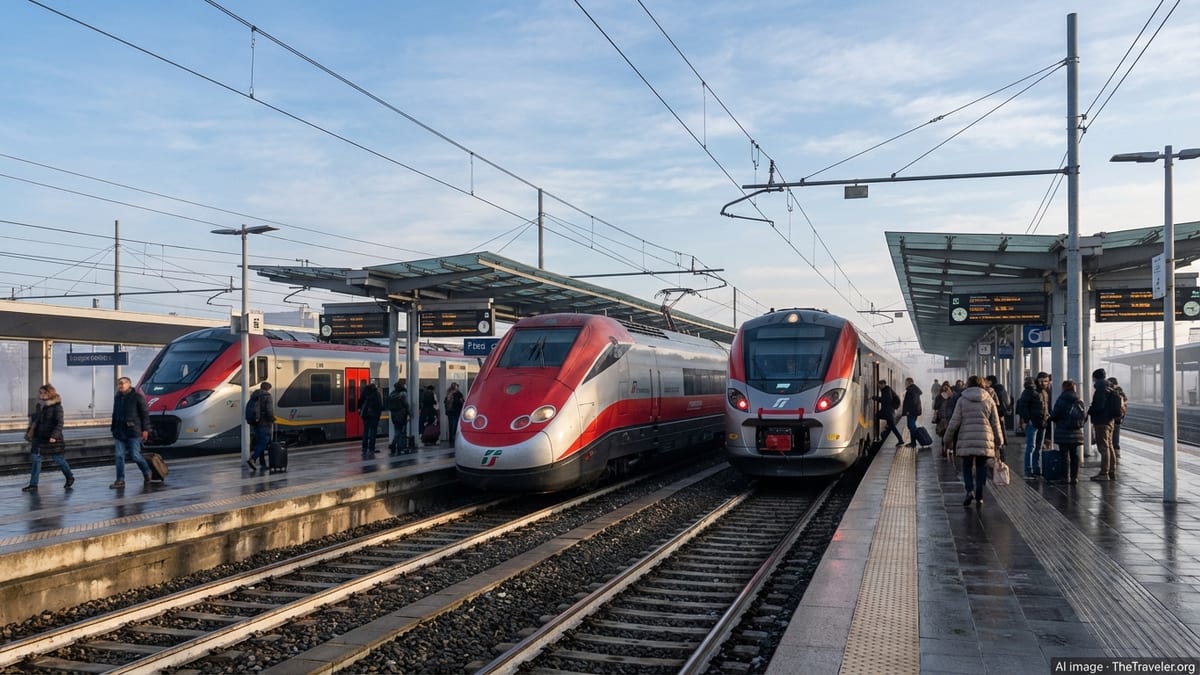
High Speed Frecciarossa Fleet Set for Wider European Reach
At the heart of Trenitalia’s strategy is a substantial expansion of its Frecciarossa 1000 high speed fleet, built by Hitachi Rail in Italy and engineered from the outset for seamless operation across multiple European countries. A major order signed in late 2023 covers 30 new trainsets, with options that could take the total significantly higher, positioning the Italian operator to run more cross-border services on some of Europe’s busiest corridors.
The new Frecciarossa units are equipped to switch between different national power systems and signalling technologies, allowing them to operate not only on Italy’s high speed lines but also in France, Germany, Spain, Austria, Switzerland, Belgium and the Netherlands. Deliveries are due to start in 2026 at a pace of up to ten trains per year, gradually enlarging the pool of rolling stock available for international routes.
For Europe’s rail travellers, the reinforced Frecciarossa fleet is intended to translate into more frequent and more direct services that compete head on with short-haul flights. With comfort-focused interiors, high capacity and an emphasis on energy efficiency, the trains are central to the wider Ferrovie dello Stato Italiane strategic plan, which foresees massive investments through the 2026 to 2034 period to decarbonise and modernise rail-based mobility.
Next Generation Regional Trains Move Onto High Speed Tracks
Trenitalia’s push is not limited to classic high speed services. Together with Alstom, the company has unveiled a new regional train capable of 200 kilometres per hour, designed to run on Italy’s high speed infrastructure while serving everyday commuters and regional travellers. The Coradia Stream based trains were presented in Milan in 2025 and mark the first time the operator has specified regional stock with performance tailored for high speed lines.
An initial batch of twelve eight car sets has been ordered, with capacity for more than a thousand passengers and dedicated spaces for bicycles and passengers with reduced mobility. The trains will begin operating from 2026 on the historic Florence to Rome Direttissima line and on key axes in Tuscany, Umbria and Lazio, taking advantage of underused high speed capacity to speed up regional journeys.
Technically, the new trains combine a low floor layout, barrier free access and advanced onboard diagnostics with an energy efficient design that can cut consumption by up to a third compared with older stock. For Trenitalia, they are a tool to blur the traditional divide between high speed and regional services, making better use of existing infrastructure while offering faster, more frequent connections within central Italy and, in time, on other suitable corridors.
Intercity Renewal Targets Gaps in the National and European Grid
Alongside the flagship high speed and regional fleets, Trenitalia is also renewing its Intercity trains, which knit together medium distance routes and form an essential layer in the broader European network. Backed in part by Italy’s recovery and resilience funds, the operator is introducing hybrid and battery powered trains to replace older locomotive hauled sets, especially on non electrified or partially electrified routes in the country’s centre and south.
The programme foresees thirteen new hybrid trainsets combining electric, diesel and battery traction, six pure battery trains and a series of electric multiple units capable of 200 kilometres per hour. Many of these are being supplied by Hitachi Rail and Alstom, and deliveries are scheduled to ramp up from early 2026, with completion of the current batch expected by mid 2026.
By bringing modern Intercity stock to secondary lines and long distance routes beyond the high speed grid, Trenitalia aims to reduce regional disparities and strengthen the “feeder” layer that supports both domestic and cross border travel. The operator presents these investments as a way to make rail a credible alternative to private cars and short flights on corridors where service quality has historically lagged behind that of flagship high speed routes.
European Ambitions: From Paris–Marseille to Future North–South Axes
Trenitalia’s rolling stock drive dovetails with an assertive international expansion that has already seen the Frecciarossa brand arrive on French tracks. Since 2021, the Italian operator has competed on the Paris to Lyon corridor, and in mid 2025 it extended high speed services south to Marseille, positioning itself as a challenger to the incumbent on one of Europe’s busiest domestic axes.
The company has invested hundreds of millions of euro in its French operations and is eyeing further European markets, with attention focused on links to Spain and Germany and, in the longer term, potential services toward London. New Frecciarossa 1000 trains approved for multiple national systems are a prerequisite for this strategy, enabling flexible deployment across borders as traffic rights and market conditions evolve.
Within Italy, the reinforced fleet is expected to underpin future north–south connections toward hubs such as Munich and Berlin once infrastructure and approvals are in place. These services would plug Italy more directly into the heart of the continental high speed grid, creating additional options for travellers who increasingly seek rail based alternatives for journeys of up to six or seven hours.
Massive Investment Plan Underpins Ambition to Shift Travellers to Rail
The wave of new trains is part of a much broader investment programme by the FS Group, which reported record spending in 2025 and has mapped out a multiyear plan worth well over one hundred billion euro through 2034. A central pillar of that strategy is modern rolling stock across all market segments, backed by digital signalling, upgraded infrastructure and new energy systems aimed at cutting emissions.
Trenitalia’s target is to renew the majority of its fleet within the current decade, with an emphasis on interoperable, low emission and high capacity trains that can support both domestic demand and a growing portfolio of international services. The company argues that such investment is essential to meet rising passenger numbers, improve punctuality and reliability, and make rail the default choice for medium distance travel across Europe.
As new Frecciarossa, regional and Intercity trains enter service from 2026 onward, their impact will be watched closely by other operators and policymakers seeking to unlock more capacity on constrained networks. For now, Trenitalia’s rolling stock offensive signals a clear intention: to use modern trains not only to refresh its image at home, but to cement a lasting role in the emerging map of European high speed and regional rail.