

More news on this day
International visitors planning a rail-focused trip to Japan will soon find it easier to reserve Shinkansen seats before they even land, thanks to a new partnership between online travel agency Trip.com and four of the country’s major JR railway operators.
Nationwide Partnership Covers Key Shinkansen Networks
Announced on February 26, the agreement brings together Trip.com with East Japan Railway Company, Central Japan Railway Company, West Japan Railway Company and Kyushu Railway Company to sell Shinkansen tickets across much of Japan’s high-speed rail network. The collaboration is aimed squarely at inbound travelers, a segment that has surged as Japan’s tourism recovery accelerates.
Under the partnership, international users can purchase tickets for prominent routes such as the Tokaido, Sanyo and Kyushu Shinkansen, along with services operated by JR East and JR West, covering links between major destinations including Tokyo, Osaka, Kyoto, Hiroshima and Fukuoka. The service is hosted on Trip.com’s global platform, which supports multiple languages and local currencies to make planning rail journeys more accessible for visitors who may be unfamiliar with Japan’s complex rail ecosystem.
By working collectively with a single online travel partner rather than on fragmented regional platforms, the JR companies are signaling a push toward a more unified digital experience for foreign riders. For travelers, that means less time navigating different booking portals and more time comparing options in one place.
Digital Ticketing and QR Code Boarding on Selected Lines
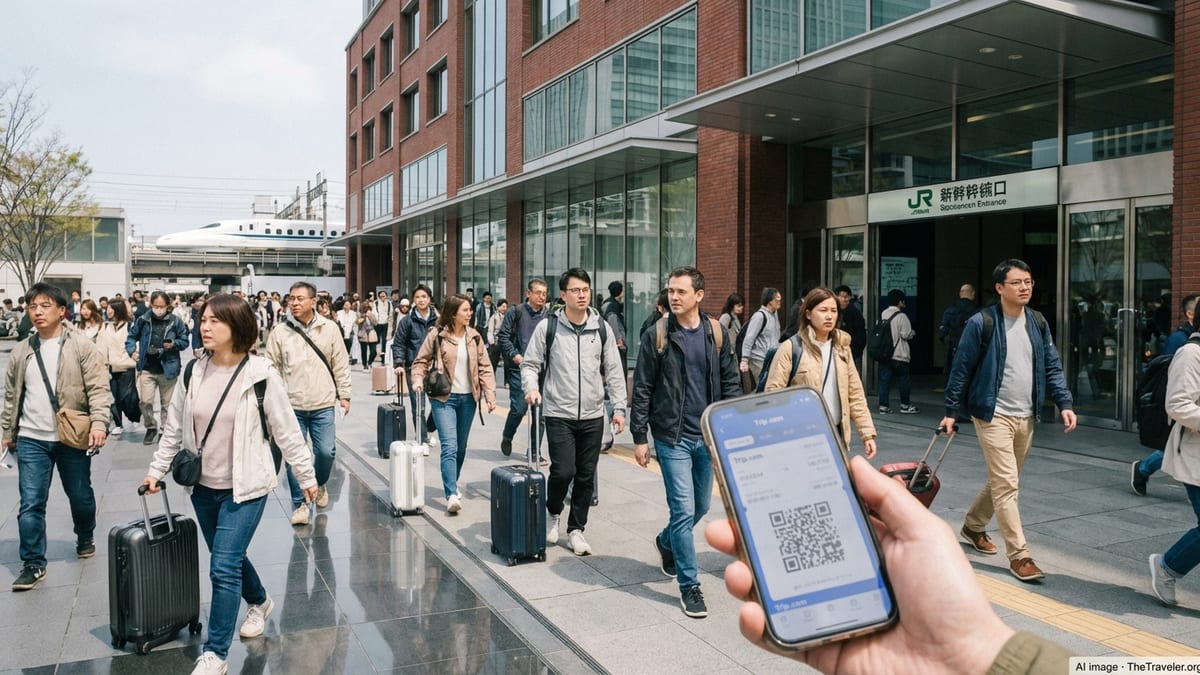
A notable element of the rollout is the emphasis on digital ticketing. Depending on the route and ticket type, passengers who book through Trip.com can either collect paper tickets from station vending machines or proceed directly to the ticket gates using a QR code on their smartphone. For the Tokaido, Sanyo and Kyushu Shinkansen, the partnership highlights QR code boarding as the exclusive method of access, reflecting Japan’s rapid shift toward contactless rail travel.
Once a booking is confirmed, travelers can choose non-reserved, reserved or Green Car seats, mirroring the options traditionally available at station ticket counters. The ability to preselect departure and arrival stations, travel dates, trains and seat classes online is expected to reduce last-minute ticket stress, particularly during peak seasons when popular services sell out days in advance.
For many visitors, the prospect of deciphering ticket machines in Japanese or queuing at busy station offices immediately after a long flight has long been a pain point. The new system is designed to remove much of that friction, letting travelers arrive in Japan with confirmed seat reservations and clear instructions on how to board using their chosen ticket format.
Targeting a Booming Inbound Tourism Market
Japan has been one of Asia’s standout tourism stories in recent years, with visitor arrivals rebounding strongly as borders reopened and the weak yen made the country more affordable for many overseas travelers. That surge has put renewed focus on how easily international guests can move around the country once they arrive, particularly given the central role rail travel plays in most itineraries.
Trip.com, headquartered in Singapore and serving users worldwide, already sells flights, hotels and attraction tickets in Japan, but the ability to integrate Shinkansen bookings is a significant expansion of its rail offering. The company positions the new service as a way for travelers to build complete city-to-city journeys in one transaction, pairing high-speed train seats with accommodation and domestic flights on the same platform.
For Japan’s rail operators, the collaboration is both a distribution opportunity and a customer-experience play. By giving overseas visitors a familiar, app-based booking environment, the JR companies hope to convert interest in regional destinations into concrete rail journeys, supporting tourism dispersal beyond central Tokyo and Osaka into areas such as Tohoku, Hokuriku and Kyushu.
Integrated Planning From Home to Bullet Train Seat
The integration of Shinkansen tickets into Trip.com’s ecosystem allows travelers to treat high-speed rail as just another component of a larger trip plan rather than a separate logistical hurdle. A traveler mapping out a two-week journey might now book an international flight into Tokyo, a series of Shinkansen segments to Kyoto, Hiroshima and Fukuoka, and a return flight from a different Japanese city without leaving the same booking environment.
For those unfamiliar with Japan’s regional JR companies or the distinction between various Shinkansen lines, the platform’s unified interface may help demystify the process. Travelers can focus on origin, destination and preferred time of day, then filter by seat class and price, instead of piecing together information from multiple operator websites that each follow their own conventions.
The partnership also aligns with broader trends in rail travel, where operators around the world are leaning on online travel agencies to tap into overseas demand. By tying rail inventory to a platform used heavily in markets across Asia, Europe and North America, Japan’s major railways are positioning Shinkansen journeys as a natural part of trip planning rather than an afterthought once travelers arrive.
Reducing Language Barriers and Station-Side Stress
Language support is at the heart of the new offering. Trip.com’s platform already operates in a wide range of languages, and the Shinkansen ticket service sits within that existing framework. Visitors can search, compare and pay using interfaces in their preferred language, avoiding the guesswork that can come with translating station signs or navigating monolingual booking sites.
On the ground in Japan, the combination of QR code access and ticket machine pickup is expected to cut down on lines at staffed ticket counters, particularly at major gateways such as Tokyo Station, Shin-Osaka and Hakata. Travelers who have already paid and selected seats can head straight to either the gates or a designated machine, leaving staff more capacity to assist those with complex itineraries or special needs.
Trip.com and the JR companies have framed the partnership as a step toward a more seamless, confidence-inspiring rail experience for overseas visitors. As Japan looks to maintain its momentum as a leading long-haul and regional destination, making its iconic bullet trains easier to book from abroad could prove a powerful draw for travelers planning multi-city itineraries across the country.