

More news on this day
International visitors heading to Japan will find it easier to ride the country’s famed Shinkansen bullet trains, as Trip.com rolls out nationwide online ticket sales in partnership with four Japan Rail (JR) companies, adding QR code boarding and multilingual support tailored to overseas travelers.
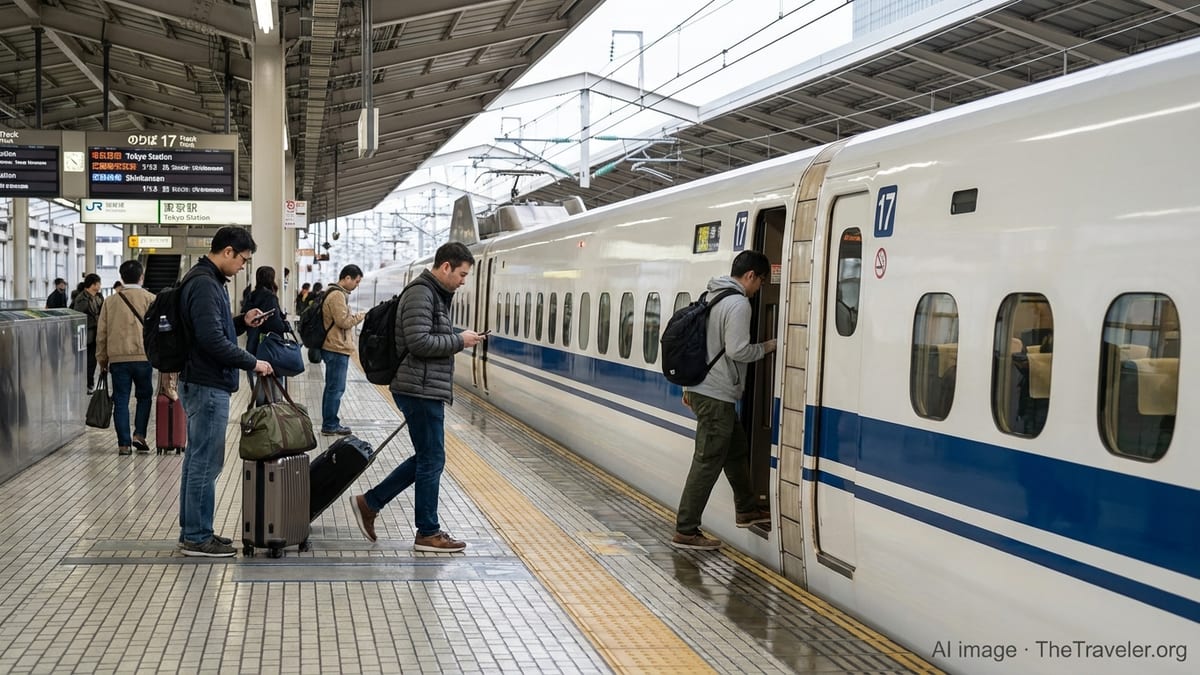
New partnership opens up Japan’s bullet train network
Trip.com announced that it has teamed up with East Japan Railway Company, Central Japan Railway Company, West Japan Railway Company and Kyushu Railway Company to sell Shinkansen tickets across much of Japan’s high speed rail network to international travelers. The collaboration, unveiled this week, is aimed squarely at inbound visitors who want to secure seats before landing in Japan and avoid complex on-site ticket purchases.
Through Trip.com’s global platform, users outside Japan can now search routes, select departure and arrival stations, choose travel dates and pick specific trains and seat types, including non reserved, reserved and Green Car, the premium first class option. The new service effectively brings together multiple JR operators on a single interface that is designed for overseas users rather than domestic commuters.
The initiative comes as Japan continues to experience strong tourism demand, with high speed rail journeys between cities such as Tokyo, Osaka, Kyoto, Hiroshima and Fukuoka remaining a highlight for many visitors. For the JR companies, the tie up offers a way to capture more advance bookings from the international market and better manage seat inventory during peak seasons.
QR code boarding adds seamless station experience
A standout feature of the partnership is the introduction of QR code boarding on several of Japan’s busiest bullet train corridors for tickets purchased via Trip.com. On the Tokaido Shinkansen linking Tokyo and Osaka, the Sanyo Shinkansen running onward to western Japan, and the Kyushu Shinkansen in the south, eligible passengers will be able to pass through ticket gates by scanning a QR code rather than inserting a paper ticket.
This move is designed to reduce queues at station ticket machines and counters, where international visitors often face language hurdles or confusion over fare types and seat reservations. With a QR code stored on a smartphone, travelers can head straight for the gates, treating the Shinkansen more like a modern urban transit system than a long distance rail service that requires advance paperwork.
For routes and ticket types that do not yet support QR code entry, the system still simplifies procedures by allowing paper tickets to be collected from station vending machines. Passengers can complete payment online in their home currency or an internationally familiar currency, then switch to local paper tickets on arrival, avoiding the need to navigate complex machine menus from scratch.
Multilingual, one stop booking for complex itineraries
The new Shinkansen ticket service is integrated into Trip.com’s existing multilingual interface, which supports a wide range of languages used by travelers across Asia, Europe and North America. This allows customers to complete the entire booking process, from search to payment, in their preferred language, with route names, seat classes and station information clearly labeled for non Japanese speakers.
Another advantage of the partnership is that Shinkansen tickets can be booked alongside flights, hotels and other ground transport on the same platform. Travelers planning multi city itineraries can, for example, pair an inbound flight to Tokyo with a bullet train to Kyoto and a domestic flight home from Osaka, all within a single Trip.com booking flow.
For first time visitors to Japan, the ability to view train schedules, journey times and seat options in the same place as accommodation and flight choices may help demystify the country’s intricate rail network. The service is positioned as an alternative or complement to existing products such as regional rail passes, appealing to travelers who prefer point to point tickets tailored to specific routes and dates.
Addressing language and ticketing pain points for visitors
Buying Shinkansen tickets in Japan has traditionally required travelers to either use ticket vending machines with limited English support or queue at staffed counters, where communication can depend heavily on diagrams, handwritten notes or the availability of multilingual staff. At busy hubs such as Tokyo, Shin Osaka and Hakata, this can mean long waits, particularly during holiday seasons when domestic demand is high.
By shifting much of the decision making and payment to an online platform used before departure, Trip.com and the JR companies hope to reduce stress at the station. Travelers can confirm in advance whether they want reserved seats, non reserved options or Green Car, and in some cases choose specific seating preferences such as positions near oversized baggage space or in quieter cars intended for remote work.
The partnership also responds to feedback from international tourists who have reported difficulties navigating different JR company websites and understanding which operator is responsible for which section of track. Consolidating ticketing for multiple Shinkansen lines inside a single, globally recognized travel app is intended to make Japan’s rail system feel more approachable for those planning trips from abroad.
Strategic move as Japan targets sustained tourism growth
The timing of the collaboration reflects the broader recovery and expansion of Japan’s inbound travel market, which has rebounded with strong demand from Asia Pacific, Europe and North America. Easier access to Shinkansen tickets is expected to support efforts to spread tourism beyond the main metropolitan hubs by making long distance rail journeys more convenient to book in advance.
Trip.com has signaled that it intends to deepen cooperation with Japanese transport providers, highlighting opportunities to integrate more regional services, discount passes and ancillary products into its platform. For the JR companies, digital distribution through a high profile global partner offers another channel to attract overseas customers in an increasingly competitive travel landscape.
As the new ticketing service rolls out, both Trip.com and the rail operators will be watching how international travelers respond to QR code boarding, bundled bookings and the ability to secure seats before arriving in Japan. If uptake is strong, the model could pave the way for further digital upgrades across Japan’s wider rail network, reinforcing the Shinkansen’s role as the backbone of long distance travel for visitors exploring the country.