

More news on this day
Travelers in South Florida can now swap morning commutes for Bahamian beach days in less time than it takes to cross Miami at rush hour, with Tropic Ocean Airways launching a new 25-minute seaplane route from Fort Lauderdale to Bimini that is designed as a same-day international escape.
A New Kind of Same-Day Island Escape
Branded as a “Bahamas in a Day” experience, the new route pairs Tropic Ocean Airways with The Bahamas Ministry of Tourism to reframe Bimini as an easy, spur-of-the-moment getaway rather than a weeklong commitment. The program offers scheduled seaplane flights from Tropic Ocean’s private terminal at Fort Lauderdale-Hollywood International Airport directly to North Bimini Seaplane Base, landing travelers in the islands in about 25 minutes.
Operating initially on Saturdays, the service is structured around a fixed timetable that maximizes island time while keeping the logistics simple. Passengers are asked to arrive just 30 minutes before departure, depart Fort Lauderdale at 8:30 a.m., and are typically stepping onto Bahamian sands before 9 a.m. The return flight leaves Bimini at 5 p.m., putting travelers back in South Florida around 5:30 p.m.
The concept is aimed squarely at busy professionals and weekend travelers who might otherwise hesitate to plan an international trip. With no hotel stay required, no ferry transfers, and Tropic Ocean handling customs coordination on both sides, the airline is betting that convenience will be the deciding factor for those craving a quick reset by the sea.
Capacity on each flight is intentionally limited, with Tropic Ocean’s small seaplanes carrying only a handful of passengers per departure. The airline says this scale helps preserve a boutique, premium feel while allowing the operation to be nimble as demand grows across the winter and spring travel seasons.
From Private Terminal to Bahamian Beach in 25 Minutes
The defining feature of the new route is speed. The flight, which crosses the roughly 50 miles between South Florida and Bimini in about 25 minutes, is one of the fastest air links between the United States and The Bahamas. By using seaplanes that can land directly on the water near resorts and marinas, Tropic Ocean avoids the runway constraints of larger jets and trims ground transfer times once travelers arrive.
Passengers begin their trip at Tropic Ocean’s private seaplane facility in Fort Lauderdale, a quieter alternative to the main commercial terminal complex. Here, check-in, security procedures, and customs pre-clearance are streamlined into a short, low-stress process. Free valet parking, a lounge with snacks and Wi-Fi, and direct boarding from the lobby to the dock are designed to feel more like a private yacht club than a traditional airport concourse.
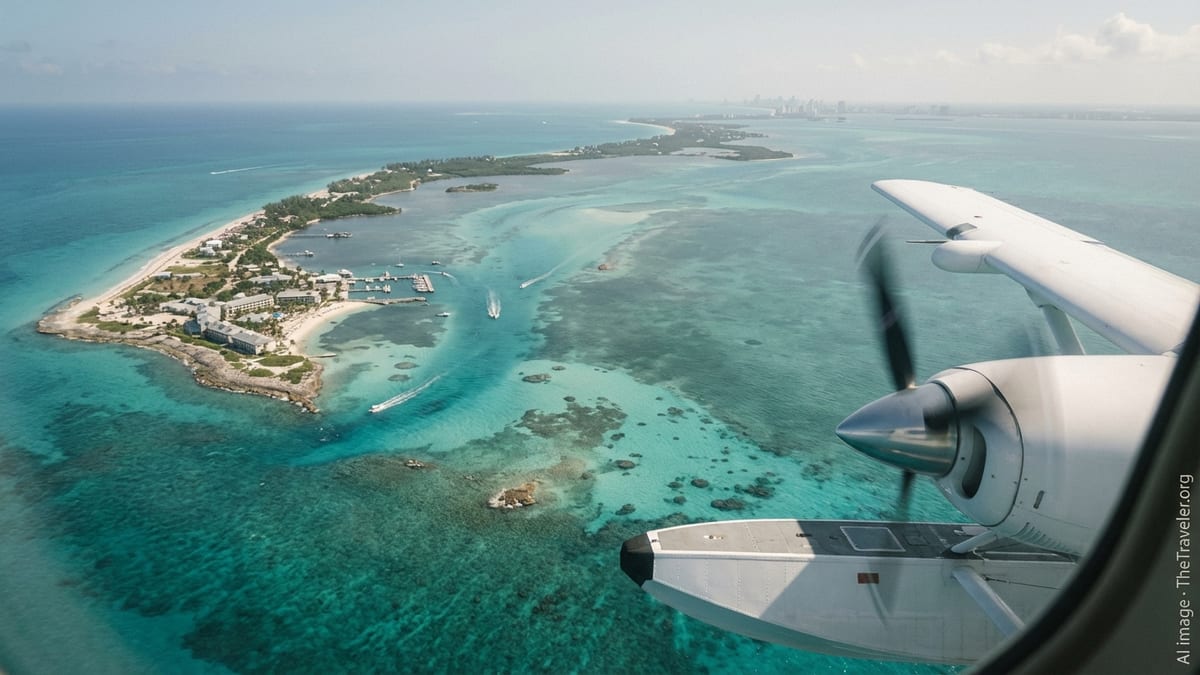
Once airborne, the aircraft cruise at relatively low altitudes compared to larger commercial jets, trading speed for scenery. On clear days, travelers can expect sweeping views of the Fort Lauderdale shoreline, sandbars and coral heads scattered across the Bahama Bank, and the vivid color shifts of shallow turquoise shallows dropping into deeper blue channels.
On arrival in Bimini, the seaplanes touch down on the water and taxi to a floating dock at North Bimini Seaplane Base. From there, ground transportation is pre-arranged to popular spots such as Resorts World’s beach club or the Bimini Big Game Club, keeping total transit time from Florida doorstep to island beach to just over an hour in typical conditions.
What the “Bahamas in a Day” Package Includes
The new offering is structured as a turnkey package meant to eliminate the friction points that often complicate short international trips. Round-trip seaplane flights between Fort Lauderdale and Bimini form the core of the product, with Tropic Ocean guaranteeing same-day return and handling customs processing both in Florida and on arrival in The Bahamas.
Included in the fare are several premium touches more common to private aviation than scheduled service. Free valet parking at the Fort Lauderdale facility removes the need to budget extra time for airport garages, while a private lobby gives passengers space to check in, clear formalities, and relax with light refreshments before boarding. The airline’s two-pilot crews, a hallmark of its brand, are part of a broader emphasis on safety and professionalism drawn from its U.S. Navy roots.
Once in Bimini, the package covers ground transfers from the seaplane dock to partner resorts and activity operators. Travelers can opt to spend their five to six hours of “island time” at a beach club, wandering through Alice Town, or building their own mix of activities. The fixed schedule is intended to remove guesswork, with the operator marketing the experience as simply a matter of showing up with a passport while the airline manages the rest.
Pricing is positioned in the premium leisure segment, reflecting both the seaplane experience and the bundled services. An introductory launch fare undercuts the standard price for early bookers, and seats are limited to keep the operation manageable. While the cost is higher than traditional ferry options, Tropic Ocean is betting that time savings and comfort will appeal to travelers who value maximizing their day over minimizing every dollar.
Partnerships That Expand Access to Bimini and Beyond
The day-trip launch builds on a broader trend of enhanced connectivity between Florida and the islands of The Bahamas. Tropic Ocean already operates scheduled flights between Fort Lauderdale and Bimini as well as charter services to a host of Out Islands, and has recently increased capacity on its Bimini route and added direct service from Fort Lauderdale to North Eleuthera.
For The Bahamas Ministry of Tourism, the 25-minute hop is another way to underscore just how close the islands are to the U.S. mainland. Tourism officials have framed the initiative as part of a strategy to break down psychological and logistical barriers that make international travel feel more complicated than domestic getaways. By simplifying documentation, formalities, and travel time into a single, curated experience, they hope to win over new visitors who may never have considered a same-day trip.
The new route also dovetails with efforts by Bimini resorts, marinas, and activity providers to reposition the island as a versatile playground appealing to both day-trippers and longer-stay guests. Existing partnerships with properties such as Resorts World Bimini and the Bimini Big Game Club mean many travelers will be able to step off the plane and directly into a resort environment with pools, beaches, restaurants, and water sports at their doorstep.
Beyond Bimini, Tropic Ocean’s growing network and its collaboration with local Bahamian operators are gradually improving access to more remote cays and Out Islands. While the current focus is on the day-trip package, the airline’s leadership has signaled that streamlined, seaplane-based connections could ultimately support everything from yacht transfers to specialized adventure travel and even medical transport across the archipelago.
What Travelers Can Expect On Board
Tropic Ocean’s seaplanes are configured for small groups, with seating typically capped at around eight passengers. The cabin experience is intentionally informal but polished: no overhead bins, shorter safety briefings than on major airlines, and large windows framing continuous water views for most of the flight. The low passenger count makes for personalized interaction with the crew, who often double as informal guides to the islands below.
The seaplane environment is more akin to a boutique excursion than a crowded shuttle. Takeoff from the water in Fort Lauderdale and splashdown in Bimini give the experience a sense of adventure, but the airline underscores that captains and first officers are highly trained in both aviation and maritime operations. Noise levels and cabin movement are similar to those on other small aircraft, and ear protection is available for travelers sensitive to sound.
Onboard service is simple but tailored to the short flight time. The focus is less on in-flight amenities and more on the views and the novelty of the water landing. For many passengers, the transit itself becomes part of the trip’s storytelling value, transforming the commute into an Instagram-ready moment before a single beach chair has been unfolded.
Travelers accustomed to large commercial jets should be prepared for a different rhythm. Boarding and disembarking can involve short walks along docks, ramps, or floating pontoons, and luggage allowances are more limited than on major carriers. The payoff, Tropic Ocean argues, is the ability to land directly where people want to be, cutting out buses, long taxi lines, and secondary ferry rides.
Weather, Formalities, and Practical Considerations
As with any seaplane operation, weather is a key operational factor. Flights are subject to winds, visibility, and sea state, particularly during the Atlantic hurricane season and periods of unsettled weather in the Straits of Florida. Tropic Ocean emphasizes that safety remains the overriding consideration, and the airline reserves the right to adjust timing or cancel departures when conditions warrant.
For travelers, that means building some flexibility into weekend plans and paying close attention to pre-departure communications from the airline. While the scheduled timetable is tight, the shorter distances involved make it easier to shift flights within a day when necessary. The guaranteed same-day return feature is designed to reassure customers who might worry about being stranded across an international border.
On the formalities front, passengers still need a valid passport and must clear customs and immigration on both sides of the trip. However, the process is managed within Tropic Ocean’s private terminal in Fort Lauderdale and at the seaplane base in Bimini, reducing exposure to long queues. Travelers who have experienced traditional international terminals may find the contrast striking, with door-to-door times shortened not just by the flight itself, but by fewer bottlenecks along the way.
Given the small size of the aircraft, baggage limits are more restrictive than on large jets, which naturally encourages day-trip packing. A beach bag, change of clothes, swimwear, and light personal items are typically sufficient for the five to six hours of island time built into the itinerary, a simplicity that aligns with the overall “no planning needed” marketing message.
How the 25-Minute Hop Fits a Changing Travel Market
The launch of Tropic Ocean’s rapid Florida–Bahamas link comes at a moment when travelers are seeking shorter, more frequent escapes rather than committing all their vacation days to a single long trip. Long weekend getaways, micro-cations, and “wellness days” have become part of the travel vocabulary, particularly among professionals tied to hybrid or flexible work arrangements.
South Florida’s dense population, large base of frequent flyers, and high concentration of hospitality and cruise travelers make it a natural testbed for a product that turns an international border into a brief detour rather than a major hurdle. For residents of Miami-Dade, Broward, and Palm Beach counties, the prospect of breakfast at home, lunch in The Bahamas, and dinner back stateside is more than a marketing line; it becomes a realistic way to reclaim time.
The Bahamas, for its part, continues to diversify the ways visitors can access its 700 islands and cays. While cruise ships and weeklong resort stays will remain mainstays of the tourism economy, initiatives like the Bimini day trip are part of a broader push to highlight flexibility and variety. Officials hope that day-trippers who get a taste of Bimini’s beaches, coral reefs, and fishing grounds may return later for longer stays, spreading visitor spending across more properties and communities.
For Tropic Ocean Airways, success with the 25-minute hop could encourage further investment in aircraft, routes, and joint marketing campaigns with both tourism authorities and private-sector partners. If the model gains traction, similar same-day concepts could eventually emerge linking Florida to other nearby Bahamian islands, reinforcing the airline’s vision that, where there is water, its seaplanes can effectively turn the ocean itself into a runway.