

More news on this day
Severe Tropical Cyclone Narelle has torn into Far North Queensland, with destructive winds, torrential rain and storm surges lashing remote communities as residents and visitors shelter from the intensifying system.
Get the latest news straight to your inbox!
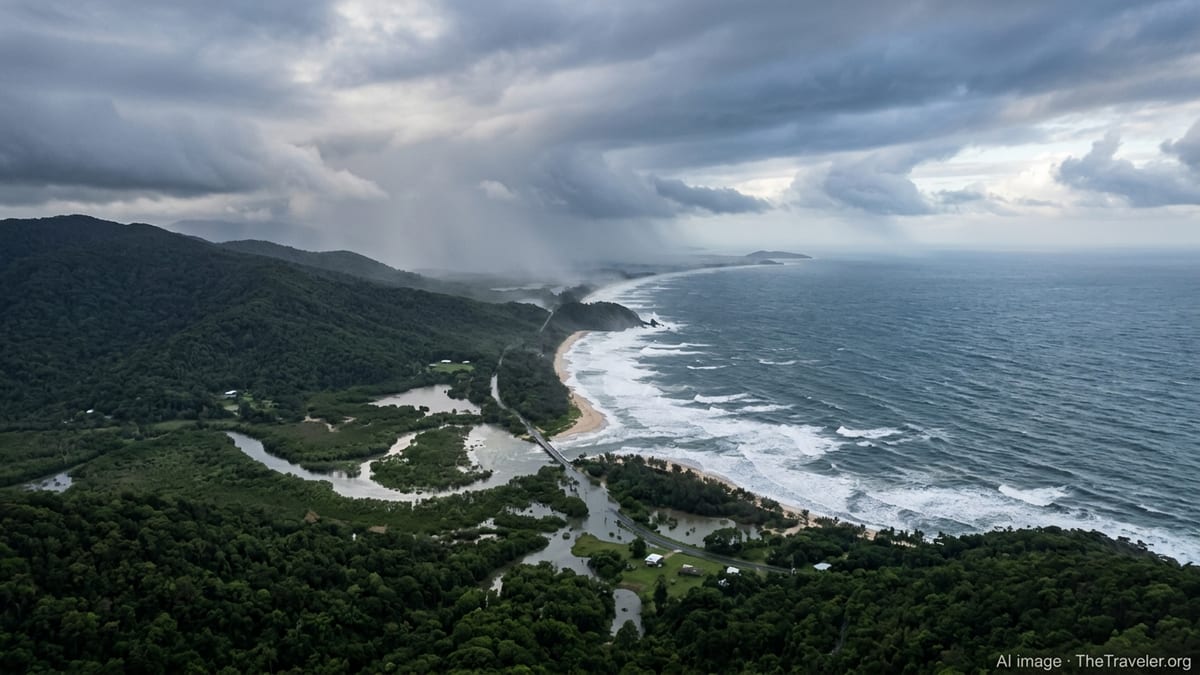
Powerful System Makes Landfall on Remote Peninsula Coast
Publicly available tracking data indicates that Tropical Cyclone Narelle intensified rapidly in the Coral Sea after forming on 15 March, reaching Category 5 strength on the Australian scale before approaching the Queensland coastline. Forecast maps showed the system moving steadily westwards towards a sparsely populated stretch of the Peninsula coast between Lockhart River and Cooktown.
On Friday, the cyclone crossed the far northeast Queensland coast as a severe system, with early technical bulletins indicating landfall at low-end Category 4 intensity. Wind gusts in the core were estimated at well over 200 kilometres per hour, with exposed headlands and offshore islands likely experiencing even stronger conditions as the eye wall came ashore.
The impact zone includes remote Aboriginal and Torres Strait Islander communities, mining outposts and small service towns scattered across the Cape York Peninsula. Many of these settlements have limited road access and rely heavily on aerial resupply during the wet season, raising concerns that damage to airstrips, roads and communications could complicate post-storm relief and assessment.
Satellite imagery through Friday showed a compact but intense circulation, with a clearly defined eye surrounded by deep convection. Meteorological commentary circulating on specialist platforms highlighted Narelle as one of the strongest systems in the Australian region since Cyclone Ilsa in 2023, underscoring the exceptional nature of this event so late in the 2025–26 cyclone season.
Communities Bunker Down as Wind and Rain Intensify
In the days leading up to landfall, publicly disseminated advisories pointed to a broad watch and warning zone stretching from Lockhart River south to Port Douglas, including inland communities on the Cape. Residents were urged through local messaging and media coverage to secure properties, prepare cyclone kits and identify their safest shelter options as Narelle tracked closer.
By Thursday night, reports from the region described power interruptions, falling trees and corrugated iron sheeting torn from older buildings as outer rainbands moved onshore. Wind gusts strong enough to topple vegetation and bring down power lines were recorded well away from the eventual landfall point, with conditions deteriorating rapidly after dark along the Peninsula Development Road and other key routes.
Heavy rainfall has been one of the most widespread impacts. Forecast guidance ahead of landfall indicated the potential for intense falls leading to flash flooding between Cape Melville and Port Douglas, with locally extreme totals possible north of Coen and in inland catchments. Early rainfall observations on Friday morning suggested that some gauges were already recording several hundred millimetres in less than 24 hours.
Local tourism operators in gateway hubs such as Cairns and Port Douglas closely monitored the changing track. While model guidance generally kept the most destructive core of Narelle to the north, outer bands brought squally showers, rough seas and minor inundation to beaches and marinas, prompting precautionary closures and adjustments to reef and rainforest tour schedules.
Storm Surge and Flooding Threaten Coastal and River Communities
Coastal flooding and storm surge are emerging as key concerns as Narelle continues inland. Prior to landfall, outlooks published by emergency management agencies warned that tides along the far north east coast could rise significantly above the normal high tide, with large waves pushing water into low-lying areas and across exposed coastal flats.
Communities near Princess Charlotte Bay and along the outer reef-fringed coast were highlighted as particularly vulnerable to a combination of strong onshore winds, high seas and astronomical tide peaks. Visual material shared through social media on Friday morning showed waves overtopping seawalls, debris-littered roads and inundated beachfront camping areas in parts of the watch zone.
As the cyclone’s core moves inland, the focus is shifting to riverine flooding. Hydrological outlooks ahead of the event flagged the risk of rapidly rising creeks and rivers across Cape York Peninsula, with the possibility of major flooding in catchments already saturated by the monsoon. Low-level crossings, unsealed sections of highway and remote tracks are expected to become impassable, isolating some communities for days.
Further south, rainfall associated with Narelle’s outer bands is feeding into larger river systems that drain towards the Gulf of Carpentaria and the Coral Sea. Travel advisories and regional media reports are already urging motorists to avoid driving through floodwaters and to reconsider non-essential travel in the affected areas as water levels continue to respond to intense rain.
Transport, Tourism and Essential Services Face Disruption
The arrival of Narelle in Far North Queensland is disrupting transport and tourism at a key time for the region. Airlines servicing remote Cape communities and regional centres have adjusted schedules or cancelled flights, with aviation notices referencing hazardous crosswinds, heavy rain and reduced visibility around key airstrips.
Road conditions are deteriorating quickly. Publicly shared updates from regional councils and state transport agencies on Friday noted debris, fallen branches and localised flooding on key connectors, with some sections closed as a precaution. Heavy vehicles supplying fuel, groceries and medical goods to remote townships are likely to face significant delays until crews can safely assess and clear routes.
In major tourist gateways such as Cairns, many operators have spent the week securing vessels, removing outdoor furniture and tying down infrastructure in anticipation of rough seas and strong winds. While the city itself lies south of the primary landfall zone, the broader tourism economy is feeling the effects as travellers reconsider northbound road trips, reef excursions and Cape York expeditions in the immediate aftermath of the cyclone.
Essential services are also under pressure. Energy providers have been preparing for widespread outages, particularly in areas with long radial lines threaded through heavily forested country. Health facilities, aged care homes and community centres in the region have implemented their severe weather procedures, with backup generators and contingency plans in place in case networks remain down for extended periods.
Attention Turns to Inland Track and Gulf of Carpentaria
With Narelle now inland over Far North Queensland, the next phase of the event is coming into focus. Official forecast discussions in recent days have consistently indicated that the system is likely to weaken over land while continuing westwards, before re-emerging over the warm waters of the Gulf of Carpentaria late Friday or during Saturday.
Once over the Gulf, some re-intensification remains possible, raising the prospect that communities along the southern Gulf coast and in the Northern Territory could face severe weather later in the weekend. Emergency management messaging is already encouraging residents across northern Australia to follow updated forecasts closely as the system evolves and interacts with the monsoonal flow.
For now, the most immediate concerns remain in Far North Queensland, where damaging winds are still affecting areas near the cyclone’s core and rainfall totals continue to climb. A clearer picture of the full extent of damage to homes, infrastructure, crops and natural environments is expected to emerge as conditions ease and assessment teams are able to reach the hardest-hit communities.
Narelle’s arrival underscores the continuing volatility of the 2025–26 Australian cyclone season and serves as a reminder to residents and travellers across the tropics that severe systems can still form and intensify rapidly in March. As the clean-up and recovery begin, attention will also turn to how lessons from this event can inform future preparedness in one of the country’s most cyclone-exposed regions.