

More news on this day
President Donald Trump’s plan to send Immigration and Customs Enforcement agents to U.S. airports on Monday is injecting new uncertainty into an already strained air travel system, as passengers brace for potential delays, heightened anxiety and shifting security procedures amid an ongoing Department of Homeland Security funding standoff.
Get the latest news straight to your inbox!
Shutdown Standoff Spills Into Airport Security
The decision to deploy ICE agents to airports comes against the backdrop of a partial shutdown of the Department of Homeland Security that began in mid February, after lawmakers failed to reach agreement on funding tied to immigration enforcement. Transportation Security Administration officers have been working without full pay, and chronic understaffing has produced record wait times at screening checkpoints in recent days at major hubs including Atlanta, Houston, Chicago and New York.
According to published coverage of the shutdown’s impact, some travelers have already reported waits of three to five hours at peak times, with security lines spilling into terminal concourses and prompting missed flights, rebookings and packed customer service desks. Airlines have warned of knock on disruptions as delayed departures ripple through tightly scheduled networks, while airport operators are juggling overtime, staff reassignments and crowd control measures to keep terminals functioning.
In this context, the White House has framed the planned ICE deployment as an emergency step aimed at easing pressure on unpaid and overworked TSA personnel. Publicly available information indicates that Trump first threatened to send immigration agents into airports if Congress did not move quickly on a funding deal, then moved ahead with the plan as negotiations stalled and scenes of gridlocked checkpoints dominated news coverage and social media.
For travelers, the result is a convergence of political brinkmanship and operational strain at the very start of the busy spring break period, raising the likelihood of continued congestion even as additional federal personnel arrive on site.
What Travelers Can Expect to See on Monday
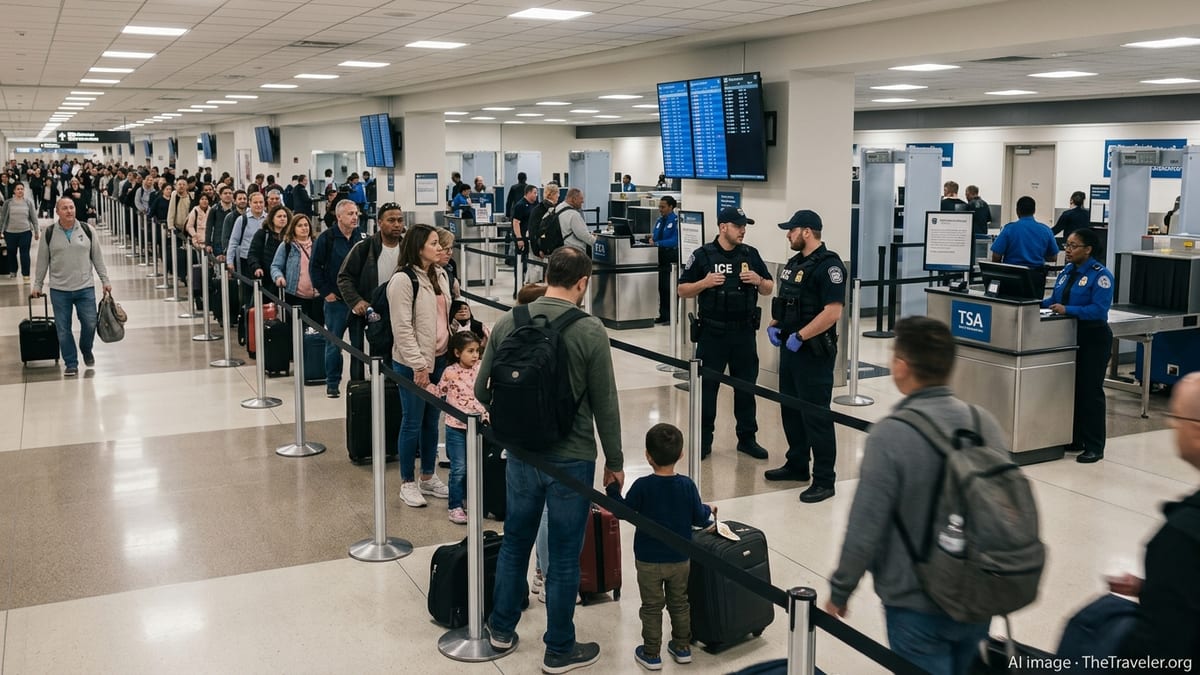
Reports indicate that ICE agents will be dispatched to a selection of the nation’s busiest and most delayed airports beginning Monday, with early deployments already visible at locations such as Atlanta, New Orleans, Chicago and New York. At some terminals, immigration officers in tactical vests have been seen walking aisles near security queues, standing beside checkpoint entrances and occasionally assisting with ID checks or line management.
Based on descriptions from passengers and airport employees cited in recent coverage, travelers may encounter ICE personnel directing people into lanes, scanning boarding documents or observing interactions between TSA officers and the public. In other locations, agents have largely been posted as a visible presence near security without taking on core screening duties, contributing more to an atmosphere of heightened enforcement than to measurable improvements in throughput.
Federal worker unions and travel industry analysts quoted in news reports have questioned how much relief the plan can offer, noting that ICE officers are not trained as aviation security screeners and may require on the spot instruction before they can safely assist with tasks such as baggage handling, scanner operation or pat down procedures. Some union statements argue that the move risks shifting skilled personnel away from their primary immigration enforcement responsibilities without meaningfully resolving gaps at TSA.
On the ground, that uncertainty translates into a wide range of possible experiences for passengers on Monday, from relatively normal flows at smaller airports to visibly heavier federal presence and slower moving, more scrutinized queues at congested hubs.
Concerns Over Civil Liberties and Travel Confidence
Beyond questions of efficiency, civil liberties advocates and immigrant rights groups have raised alarms about the potential chilling effect of placing immigration agents at domestic airport checkpoints. Commentaries in national and local outlets warn that travelers who are noncitizens, hold dual nationality or live in mixed status families may feel less safe moving through terminals where ICE personnel are stationed in close proximity to security lines.
Some legal organizations and advocacy groups have issued travel alerts emphasizing that routine TSA checkpoints within the United States are normally governed by administrative security rules rather than immigration enforcement. They caution that the integration of ICE officers into visible front line positions could blur those boundaries in the public perception, even if formal policies on ID checks and questioning do not change.
Reports from airports where the deployment has already begun describe heightened anxiety among some passengers, including families weighing whether to postpone trips for fear of encounters with immigration authorities. In cities that market themselves as welcoming gateways or international transit hubs, local leaders have publicly criticized the move, arguing that it undermines community trust and may discourage tourism and convention travel at a vulnerable economic moment.
For international visitors connecting through U.S. airports, the visibility of armed agents in tactical gear near security lanes may reinforce perceptions of a more enforcement oriented travel environment, with potential reputational consequences for American gateways competing for long haul traffic.
Practical Advice for Travelers Navigating the Changes
While the policy debate unfolds, practical considerations remain top of mind for travelers with flights scheduled in the coming days. Airlines and airport operators are advising passengers to arrive earlier than usual, particularly at large hubs already reporting extended wait times. For morning departures during peak spring break periods, that can mean planning to be at the terminal three hours in advance for domestic flights and four hours for international itineraries.
Publicly available guidance from travel experts suggests that passengers should monitor their airport’s social media channels, local news and airline alerts for location specific information about security delays or terminal adjustments. Where possible, choosing flights outside peak morning and late afternoon banks, traveling with carry on baggage only and using mobile boarding passes may help reduce time spent in crowded checkpoints.
For travelers who are immigrants, dual nationals or part of mixed status households, legal advocacy groups recommend carrying valid identification and copies of travel documents, staying calm and asking whether an interaction is part of routine security screening or an immigration inquiry if approached by an officer. Many organizations have circulated know your rights materials outlining what types of questions travelers are required to answer at domestic checkpoints and when they may request legal counsel.
Given the evolving situation, industry analysts expect that the coming week will serve as an informal test of whether the ICE deployment has any measurable impact on wait times or simply layers additional tension onto an already stressed system. Until funding for the Department of Homeland Security is resolved and full pay and staffing are restored at TSA, travelers should be prepared for continued unpredictability at U.S. airports.
Broader Implications for U.S. Air Travel
The decision to send immigration agents into airports underscores how deeply federal policy disputes can reach into the day to day realities of travel. The current Homeland Security shutdown has already disrupted hiring and training pipelines for air traffic control and security personnel, while the ICE deployment blurs traditional lines between border control and domestic passenger screening.
Airport leaders and tourism officials quoted in recent analysis worry that recurring images of chaotic terminals, unpaid federal workers and heavily armed officers could erode confidence in the reliability of U.S. air travel. That concern is particularly acute for cities that rely heavily on convention business, international tourism and connecting traffic, where even a modest drop in visitor numbers can have substantial economic effects.
Some policy analysts note that the situation may accelerate conversations about long standing structural issues, including chronic underfunding of aviation security, the reliance on mandatory overtime to staff checkpoints, and the vulnerability of travel infrastructure to political standoffs. For passengers, however, those debates remain largely abstract compared with the immediate questions of whether they will make their flight and how intrusive or intimidating the journey to the gate will feel on Monday and in the weeks ahead.
As the shutdown continues and the ICE deployment rolls out across more airports, the travel sector will be watching closely for data on wait times, missed connections and booking patterns. For now, the message for anyone flying through U.S. gateways is clear: allow extra time, expect visible changes at security and be prepared for a more heavily policed atmosphere at the airport.