

More news on this day
Cross-border tourism between Canada and the United States has entered a sharp downturn in early 2026, with new Trump administration tariffs and rising political tensions prompting a steep drop in Canadian visitors and delivering a painful blow to Niagara Falls and small U.S. border communities that depend on their spending.
Get the latest news straight to your inbox!
Tariffs Deepen a Trade Rift With Direct Tourism Fallout
The second Trump administration’s decision in 2025 to impose broad tariffs on Canadian goods under a revived “trade emergency” has shifted quickly from a technical trade issue to a visible shock for travel. Publicly available information on the 2025–2026 trade dispute indicates that higher duties on a wide range of imports, combined with threats of further escalation, have hardened attitudes on both sides of the border and helped fuel what Canadian media and analysts describe as an informal boycott of travel to the United States.
Economic briefings on the trade war note that Canada remains the top international source market for the United States, with Canadian travelers historically generating more than 20 billion U.S. dollars in annual spending and supporting well over one hundred thousand American jobs. As tariffs and rhetoric intensified through 2025, surveys showed large majorities of Canadians planning to avoid leisure trips south of the border, redirecting holidays to domestic destinations or overseas instead.
By early 2026, that sentiment has translated into hard numbers. Government statistics and industry reports cited in recent coverage show month after month of double-digit declines in Canadian vehicle crossings into the United States, with some months registering drops of more than 30 percent compared with the previous year. Analysts argue that tariffs have become a symbolic focal point for broader frustrations, turning cross-border shopping trips and weekend getaways into a political statement.
Niagara Falls Feels the Shock on Both Sides of the Gorge
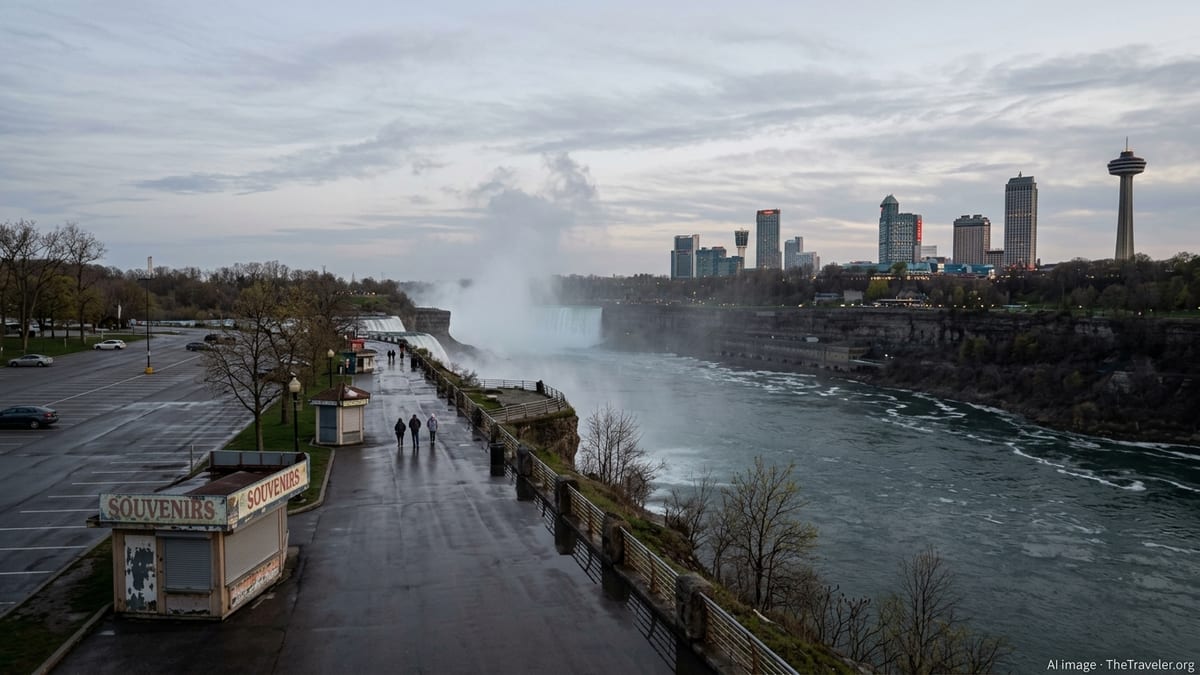
Niagara Falls, one of North America’s most visited natural attractions, sits at the center of the unfolding tourism slump. Business organizations and local commentary around the falls point out that roughly 22 to 23 million people typically visit the destination annually when both the U.S. and Canadian sides are considered together, supporting a dense cluster of hotels, restaurants, tour operators and small retailers that rely on a fluid, friendly border.
Published opinion pieces in regional outlets highlight how the trade dispute has disrupted that model. While the iconic waterfalls themselves remain a powerful draw, publicly available data on border crossings through nearby bridges show traffic well below 2019 and 2023 levels. Operators on the U.S. side report thinner weekend crowds, shorter lines at attractions and lower midweek occupancy, especially among value-focused properties that historically depended on Canadians arriving by car for day trips and short stays.
The situation is particularly stark for businesses that straddle the binational market. Tour and transportation companies that once promoted cross-border itineraries now face higher operating costs, stricter documentation checks and longer perceived wait times that discourage spontaneous visits. Industry associations warn that if frictions persist into the peak summer season of 2026, Niagara’s U.S. gateway communities could see a second consecutive year of weak performance even as travel rebounds elsewhere.
Border Town Economies Lose Their Most Reliable Customers
The tourism collapse is not limited to Niagara. A string of small and mid-sized U.S. communities from Washington State and Montana to North Dakota, Michigan, New York and Vermont report a pronounced drop in Canadian traffic, according to recent regional coverage and economic analyses. These places often rely on visitors from nearby Canadian provinces for retail sales, hotel nights, casino gaming, campgrounds and event attendance.
Recent data shared by state tourism offices and U.S. Customs and Border Protection, as reported by local news organizations, point to vehicle crossings down by 20 to 30 percent at several land ports in 2025 compared with 2024, with the negative trend continuing into the opening months of 2026. In some isolated border enclaves, declines have been even steeper, prompting comparisons to the early stages of the COVID-19 pandemic.
For local economies with limited diversification, that contraction is severe. A minority staff report from the U.S. Congress’s Joint Economic Committee, released in late 2025, estimated that Canadian tourism contributed more than 20 billion dollars to the U.S. economy in 2024 and supported around 140,000 jobs. The same report warned that year-over-year declines in passenger vehicle crossings approaching 20 percent from January to October 2025 were already translating into job losses and business closures in border states, with restaurants, independent retailers and small lodging operators among the hardest hit.
Boycott Sentiment, Fees and Perceived Hassles Deter Canadian Visitors
While tariffs are at the center of the current conflict, they interact with a wider mix of deterrents that collectively suppress demand. Canadian polling reported by national broadcasters and research firms in late 2025 and early 2026 shows a substantial share of respondents expressing less willingness to travel to the United States, citing not only trade tensions but also concerns about unpredictable border experiences and political climate.
Advocacy groups and travel-rights organizations in Canada have published guidance highlighting stories of secondary inspections, device searches and prolonged questioning at U.S. ports of entry. Although such incidents affect only a fraction of travelers, coverage of them has amplified the perception that crossing the border has become more stressful and less welcoming, especially for discretionary leisure trips.
At the same time, new and higher administrative fees for certain land-border processing forms, introduced as part of broader budget measures in Washington, add a modest but symbolically important cost for frequent crossers. Industry submissions to Canadian government consultations on the future of North American trade stress that these “soft barriers” combine with formal tariffs to create a chilling effect on cross-border visits, particularly short, spontaneous trips that once formed the backbone of border-town economies.
Tourism Officials Seek a Path to Stabilization Before Peak Season
Against this backdrop, tourism organizations and economic planners on both sides of the border are searching for ways to stabilize travel flows ahead of the crucial summer of 2026. Policy submissions from Canadian and U.S. industry associations emphasize the importance of restoring predictability for visitors, arguing that tourism was historically insulated from broader trade frictions and should again be treated as a shared economic interest.
Some regional campaigns are quietly pivoting to promote cross-border events that are already in motion, such as preparations for the 2026 FIFA World Cup matches in Canadian and U.S. host cities. These efforts frame travel as a unifying experience, even as the broader trade dispute continues. However, analysts caution that marketing alone cannot offset the impact of tariffs, elevated fees and deteriorating public sentiment without broader policy shifts.
For now, publicly available economic forecasts suggest that the tourism downturn tied to the Trump tariffs and the Canadian boycott could extend through at least the remainder of 2026 if the underlying trade conflict remains unresolved. That outlook leaves Niagara Falls and dozens of U.S. border towns facing another year of uncertainty, forced to adapt to a reality in which their most dependable visitors are choosing to stay on the other side of the line.