

More news on this day
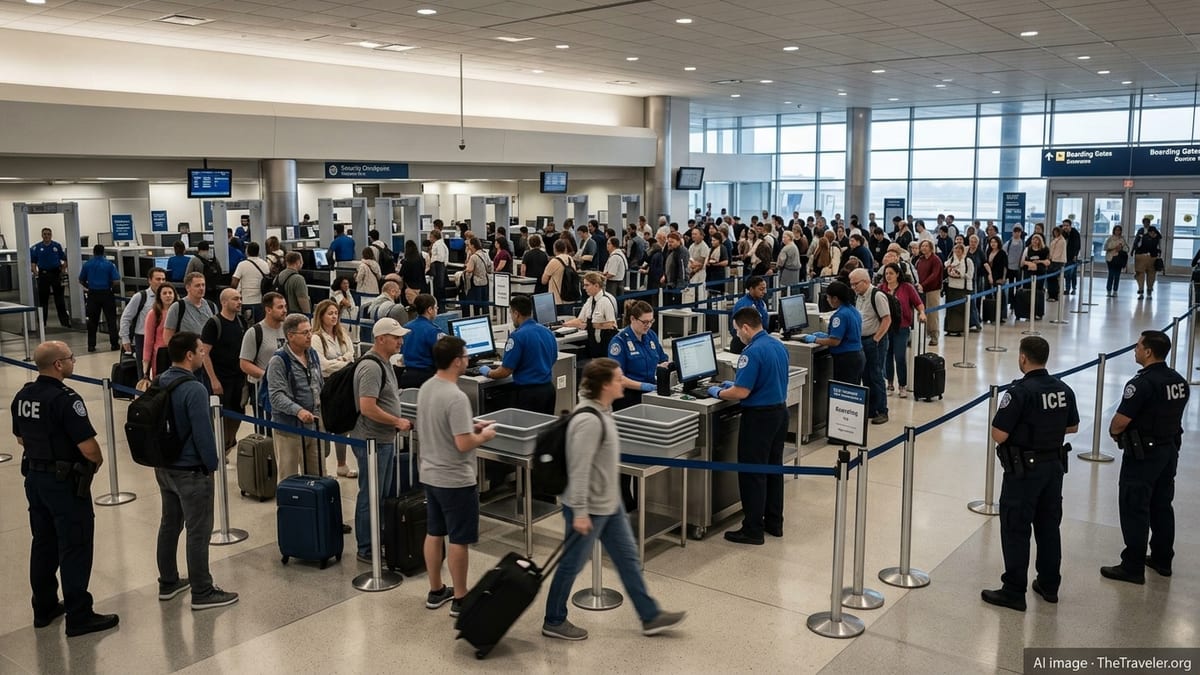
The Trump administration is preparing to deploy Immigration and Customs Enforcement officers to assist Transportation Security Administration staff at U.S. airports on Monday, a move framed as an emergency step to ease staffing shortfalls during the ongoing Department of Homeland Security funding lapse.
Get the latest news straight to your inbox!
ICE Deployment Tied to Deepening DHS Shutdown
According to recent public statements and media coverage, the decision to send ICE personnel into airports comes as a partial shutdown at the Department of Homeland Security stretches on, with key security staff working without pay and growing numbers of officers calling in absent. TSA data cited in broadcast and online reports indicate that over the past week, callouts have reached record levels, leading to longer lines and sporadic checkpoint disruptions at some major hubs.
President Donald Trump signaled the deployment in a social media post on Sunday, saying that ICE would be sent to airports beginning Monday to “help” TSA officers who have continued to report for duty. Follow-up television interviews with White House border adviser Tom Homan, summarized in multiple news accounts, outlined a plan to position ICE officers at airport entrances, exits and non-screening posts so that trained TSA screeners can remain focused on baggage and passenger checks.
Publicly available information shows that the move is part of a broader pattern during the shutdown in which the administration has shifted personnel across agencies to cover critical functions, especially in aviation security. While core screening operations are still being carried out by TSA employees, the new plan effectively widens ICE’s visible presence in civilian travel environments at a moment of heightened political tension over immigration and border policy.
What ICE Officers Will Do at Airports
Reporting from national and local outlets indicates that ICE officers are expected to take on support roles rather than direct passenger screening when they arrive at airports Monday. Descriptions of the plan suggest duties may include monitoring terminal access points, helping manage queues, staffing exit lanes and providing additional uniformed presence in public areas around checkpoints.
Homan, in televised remarks described by several networks, has emphasized that ICE officers will not be operating X-ray machines or conducting pat-downs, tasks that require specialized TSA training and certification. Instead, the intent, as laid out in those interviews, is to free up TSA’s aviation security specialists for the more technical and regulated parts of the screening process by shifting lower-risk, non-screening functions to ICE personnel.
Airports already rely on a mix of federal, local and in some cases private security staff for non-screening roles, and security analysts quoted in recent coverage note that using additional federal personnel in support capacities is not unprecedented during periods of strain. The difference in this case, they point out, is the specific choice of ICE, a law enforcement agency closely associated with immigration raids and deportations, to fill gaps in a civilian travel setting.
Concerns Over Training, Mission Creep and Civil Liberties
The deployment has prompted pushback from labor organizations and civil liberties advocates, who argue that ICE officers are not trained as aviation security specialists and that their presence in terminals risks confusing travelers about the purpose of various federal agencies. Statements from the largest federal workers union, as reported by national media, stress that TSA officers undergo detailed security, screening and customer-service training that is distinct from ICE’s enforcement-oriented preparation.
Union representatives and outside experts quoted in recent analyses warn that inserting an immigration enforcement brand into the airport environment could have a chilling effect on some passengers, particularly noncitizens and mixed-status families who may already harbor anxiety about air travel. They also caution that, even if ICE personnel are officially limited to non-screening roles, the visual of armed officers in tactical gear near checkpoints could be perceived as an extension of immigration policing into routine domestic travel.
Civil liberties groups cited in published commentary have raised questions about whether the temporary assignment might evolve into longer-term data sharing or enforcement initiatives, especially given past reporting on information exchanges between TSA and ICE. For now, publicly available descriptions of the plan indicate that ICE’s mandate on Monday will be restricted to general security support, but advocates are calling for greater transparency about how long the deployment will last and what safeguards apply to any interactions with travelers.
Impact on Travelers and Airport Operations
For air passengers, the most immediate effect of Monday’s deployment is expected to be visible changes in who is standing near security lines rather than a fundamental shift in screening procedures. TSA has indicated in public statements carried by several outlets that it remains responsible for all screening decisions and that existing security rules, from liquid limits to identity-check protocols, remain unchanged.
Travel industry analysts quoted in recent coverage say that, in the short term, additional federal personnel could help ease congestion at some of the hardest-hit airports by keeping lanes open that might otherwise have been closed due to staffing gaps. However, they also note that the underlying causes of the strain, including the funding dispute and the cumulative effects of unpaid work on front-line staff, will not be resolved simply by reassigning personnel from ICE.
Passenger reactions reported from airports where ICE officers have already begun to appear in small numbers have been mixed. Some travelers told reporters that any added security presence is reassuring during a period of political uncertainty, while others expressed unease at seeing immigration enforcement uniforms at domestic checkpoints. For international visitors and mixed-status families, advocacy organizations warn that the optics alone may be enough to deter some discretionary trips until the situation stabilizes.
Airport managers quoted in local news reports emphasize that they are working to communicate clearly that TSA retains responsibility for screening and that ICE’s role is limited. Still, with federal workers’ paychecks caught in the broader DHS funding impasse, operational experts caution that the travel experience is likely to remain unpredictable in the coming days, even with Monday’s influx of additional federal officers.
Broader Context: Labor Tensions and Security Policy
The ICE deployment is unfolding against a backdrop of longer-running tensions between the Trump administration and the TSA workforce. Over the past year, policy moves targeting TSA’s collective bargaining rights have drawn lawsuits and court challenges, contributing to what union leaders describe in public filings and press conferences as low morale and high turnover among airport screeners.
Observers of federal labor policy note that the shutdown has magnified those issues, with thousands of TSA employees required to work without pay for weeks at a time. Industry groups representing airlines and airports, in statements summarized by national financial and travel publications, have warned that prolonged disruption at checkpoints could weigh on passenger confidence and, ultimately, on the broader travel economy.
Security scholars quoted in recent think-tank and academic commentary point out that aviation security depends on a highly trained, stable workforce familiar with both evolving threats and airport-specific procedures. From that perspective, temporarily backfilling gaps with personnel from a different agency may provide short-term relief but does not address structural staffing challenges at TSA or clarify long-term strategy for managing future shutdowns.
As ICE officers take up posts at airports on Monday, the move highlights the degree to which domestic travel has become entangled with broader political battles over immigration, federal labor policy and budget brinkmanship. How long the deployment lasts, and whether it meaningfully improves checkpoint wait times without unsettling travelers, is likely to be a key test for the administration’s approach to managing security during high-stakes funding disputes.