

More news on this day
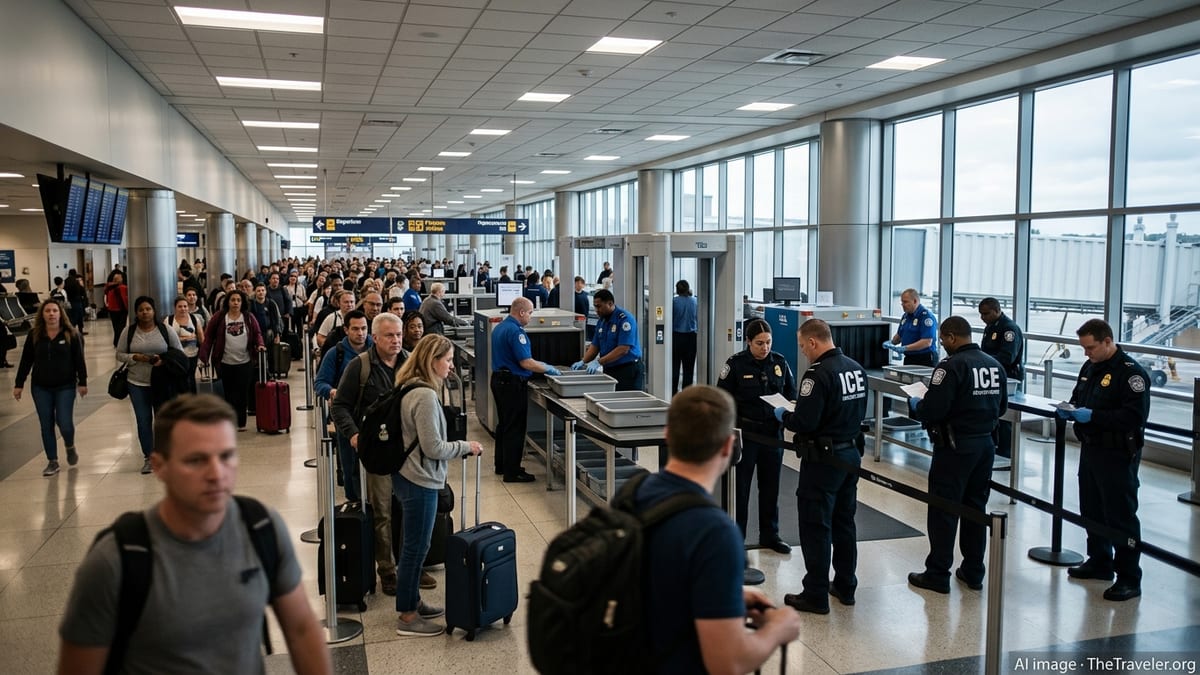
Airports across the United States are grappling with extraordinary disruption as a deepening Department of Homeland Security funding standoff, mounting TSA staffing shortages and President Donald Trump’s move to deploy Immigration and Customs Enforcement agents to passenger checkpoints converge into a perfect storm for travelers.
Get the latest news straight to your inbox!
How a DHS Funding Standoff Triggered Airport Gridlock
The latest wave of airport chaos is rooted in a partial shutdown of the Department of Homeland Security that began on February 14, 2026, after Congress failed to agree on a new funding package. Publicly available information shows that hundreds of thousands of DHS personnel, including Transportation Security Administration staff, have been working without full pay as the dispute drags into its second month.
By mid‑March, DHS disclosures cited in national coverage indicated that at least 366 TSA officers had resigned since the lapse began, while unscheduled absences surged at some airports to more than half of scheduled staff. With fewer screeners to handle rising spring travel demand, security lines that were already long at major hubs have swollen into multi‑hour waits.
Reports from major outlets describe scenes of stranded passengers snaking through terminals at airports in Atlanta, Houston, New York and Chicago, with some travelers missing flights despite arriving the recommended two or even three hours early. Social media posts from passengers and airport workers have amplified images of crowded checkpoints and departure boards filled with delayed flights.
The funding impasse has also disrupted trusted‑traveler and security programs that previously helped ease congestion. In late February, DHS briefly suspended TSA PreCheck and Global Entry before partially reversing course, adding further uncertainty for frequent fliers and international visitors trying to navigate a fast‑changing security landscape.
Trump’s ICE Plan: From Threat to Airport Reality
On Saturday, March 21, President Trump signaled a major escalation, saying he would order ICE officers into U.S. airports starting Monday if Democrats did not accept his preferred DHS funding bill. In posts and public remarks, he framed the move as both a response to security line breakdowns and a way to intensify his broader immigration enforcement agenda.
By Sunday, March 22, published coverage from national wire services and major newspapers reported that the administration was moving ahead with the plan. ICE agents, traditionally focused on immigration enforcement and detention, are being sent to airports to “assist” the TSA, with roles expected to include guarding exit lanes, helping verify identification documents and providing additional visible security in crowded terminal areas.
The White House portrayal of the initiative emphasizes restoring order to overwhelmed checkpoints and keeping air travel moving even as TSA staffing remains under pressure. However, statements and documents highlighted in recent reporting also show Trump linking the deployment directly to efforts to “arrest all illegal immigrants,” placing immigration enforcement squarely inside already tense airport corridors.
The scale of the rollout remains fluid. Commentators citing federal data note that there are hundreds of commercial airports with federalized security operations, meaning that effectively deploying ICE to each facility would require thousands of agents. Early indications suggest that the initial focus will be on the busiest hubs where lines and delays have been most acute.
What Travelers Are Experiencing on the Ground
For passengers, the policy shift is landing on top of an already punishing travel environment. In the past week, a major storm system sweeping across the Midwest and into the East Coast complicated operations just as security staffing issues intensified. Flight‑tracking data cited in recent reports show thousands of cancellations and delays over several days, with airlines scrambling to reposition crews and aircraft.
At airport entrances, travelers are now encountering a patchwork of security arrangements that vary by city and even by terminal. Some hubs have consolidated screening into fewer lanes to cope with staff shortages, while others are opening overflow checkpoints in underused concourses, further lengthening the walk to gates. Announcements urging passengers to arrive even earlier than normal are becoming commonplace.
Into this environment, ICE officers are beginning to appear in uniform at or near checkpoints. While TSA remains responsible for baggage x‑rays and body scanners, ICE personnel may be visible directing foot traffic, checking boarding passes and IDs, or monitoring exit corridors that feed back into public areas. For many travelers, especially non‑U.S. citizens and mixed‑status families, the sight of immigration agents in new roles is adding a layer of anxiety to an already stressful experience.
Airport employees, from airline agents to concession workers, are also feeling the strain. Public posts from worker advocacy groups and travel forums describe late‑running crews, long lines at employee security entrances and concerns that confusion over new responsibilities could slow operations further before any benefits are felt.
Security, Civil Liberties and Tourism Concerns
Immigration and civil rights organizations have quickly raised alarms about the implications of blending airport security with stepped‑up immigration enforcement. Analyses circulating among advocacy groups argue that placing ICE agents alongside TSA screeners could deter some non‑citizens from traveling by air at all, or push them toward less safe, less regulated transportation options.
Legal commentators point to earlier court findings and investigations into ICE practices, including recent controversies over raids and detentions far from border regions, as reasons to scrutinize how the agency conducts itself inside airport terminals. Questions being raised publicly include what databases ICE officers may access when checking IDs, how long passengers can be questioned before missing flights and what recourse travelers have if they believe they have been targeted unfairly.
The tourism and airline sectors are watching closely. Industry associations have warned in previous funding battles that protracted security disruptions can undercut international visitation, particularly among travelers who perceive U.S. airports as uniquely stressful or unpredictable. Some travel analysts are already speculating that high‑spending overseas visitors could choose alternative hubs in Canada, Europe or the Middle East if the situation persists into the peak summer season.
Domestic travelers may also change their behavior, opting for nonstop flights over connections, avoiding certain hubs, or postponing discretionary trips altogether. Such shifts could ripple across hotel bookings, conference planning and local tourism economies that depend heavily on smooth airport operations.
Practical Advice for Travelers Facing the Turmoil
With conditions changing rapidly, travelers planning to fly in the coming days and weeks are being urged by airlines and airport operators to build in far more time than usual. Many major hubs are recommending arriving at least three hours before domestic departures and four hours before international flights, especially at peak times such as early morning and late afternoon.
Passengers who are already en route can take basic steps to reduce friction at security, including consolidating carry‑on bags to minimize secondary screening, having identification and boarding passes in hand well before reaching the document check, and reviewing current rules on liquids, electronics and prohibited items to avoid avoidable delays.
For non‑U.S. citizens and dual nationals, advocates advise traveling with all relevant immigration and residency documents readily accessible, even for domestic flights. While civil liberties groups emphasize that passengers retain constitutional protections, they also note that refusing to answer questions or consent to searches could lead to missed flights or extended screening encounters in the current environment.
Above all, publicly available airline and airport guidance stress that conditions may differ significantly by location and can shift quickly based on staffing and weather. Travelers are encouraged to monitor their airline’s notifications closely, check airport and carrier social feeds for checkpoint wait‑time updates and be prepared for last‑minute gate or terminal changes as the system adjusts to the new ICE deployment.