

More news on this day
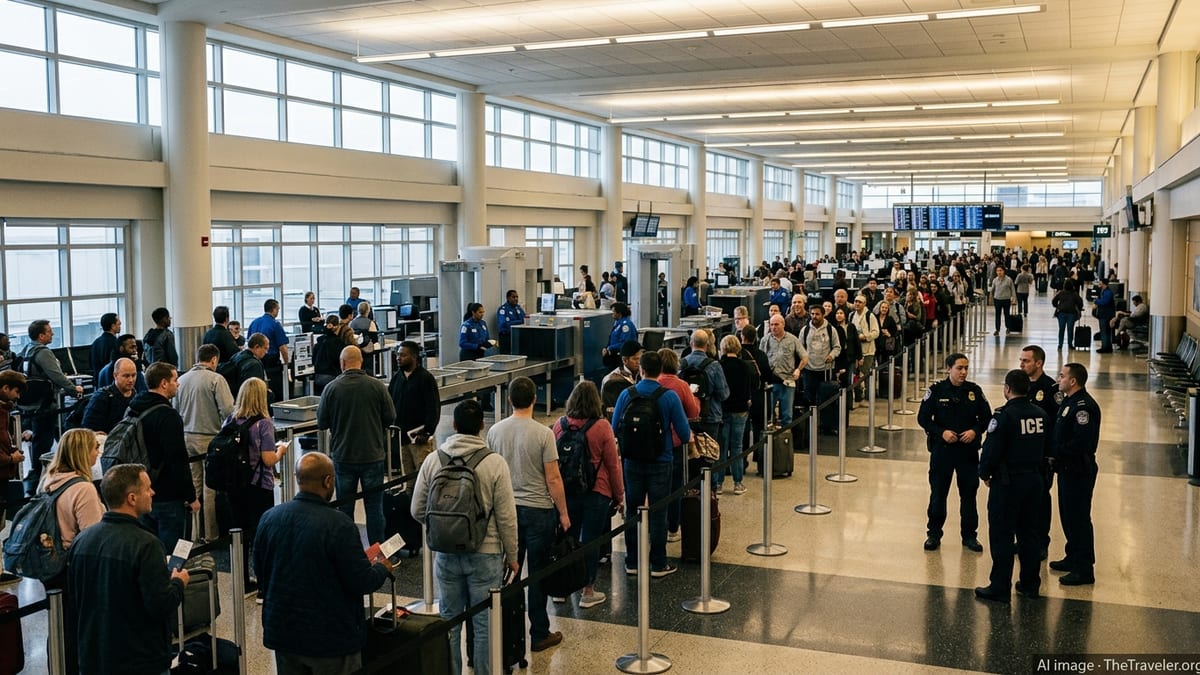
President Donald Trump’s push to deploy Immigration and Customs Enforcement personnel in roles around Transportation Security Administration checkpoints is colliding with legal, operational and civil liberties concerns, raising fresh questions about how far immigration enforcement should extend into the nation’s airports.
Get the latest news straight to your inbox!
Plan Emerges Amid Shutdown And Growing Airport Strain
The latest proposal surfaced over the weekend as the Department of Homeland Security remained partially unfunded, leaving thousands of TSA employees working without pay and fueling fears of mounting delays at major hubs. Publicly available information shows the White House framing the move as a way to bolster strained security operations by assigning ICE officers to assist at airports starting Monday.
Reports indicate that the plan envisions ICE personnel at or near security lanes, exit corridors and identity checkpoints, although administration figures have offered shifting descriptions of the precise duties they would perform. Some accounts describe ICE officers helping manage lines and guard exit lanes, while others suggest they could be involved in checking identification documents or monitoring passengers pulled aside for additional screening.
Travel industry observers note that the proposal lands at a time when airport operations are already under pressure from staffing shortages, suspended trusted‑traveler programs and heightened political tension over immigration policy. Airport managers and airline executives are watching for signs of disruption, mindful that even modest slowdowns at checkpoints can ripple through flight schedules nationwide.
Legal Tangles Over Authority And Constitutional Limits
Legal analysts are scrutinizing whether embedding immigration enforcement agents into core aviation security functions could blur statutory lines between transportation safety and civil immigration policing. TSA’s mission is defined in federal law around preventing acts of terrorism and other threats to transportation systems, while ICE is primarily charged with enforcing immigration and customs laws away from the border.
According to published coverage, critics argue that assigning ICE officers to positions where travelers must submit to screening raises Fourth Amendment questions about searches, seizures and consent. If passengers effectively cannot avoid encounters with immigration agents while trying to catch a domestic flight, civil liberties lawyers warn that courts may view these interactions differently from traditional airport security checks focused strictly on weapons or explosives.
There are also concerns about data sharing and due process. Recent reporting has highlighted how TSA has already shared passenger names, birthdates, photographs and itineraries with ICE to help locate people with outstanding removal orders. Extending that collaboration to a visible on‑the‑ground presence at checkpoints, skeptics contend, could deepen challenges over how traveler data is collected, retained and used for civil enforcement rather than immediate security threats.
Security Experts Question Operational Readiness And Risk
Aviation security specialists are also weighing the potential impact on safety inside crowded terminals. Many note that TSA officers undergo specific training to detect prohibited items, manage screening equipment and respond to evolving threats within a rigid, federally regulated system. ICE officers, while experienced in law enforcement, are not typically prepared for the split‑second decisions required to run passenger screening lines.
Public commentary from security professionals suggests that inserting non‑TSA personnel into those environments without extensive joint training could introduce confusion about command authority and operational protocols. Questions remain about who would make final calls on clearing passengers, responding to alarms from scanners, or handling disputes that arise when travelers refuse searches or question identification checks.
There is also a worry that dual missions could dilute focus. If ICE officers stationed near checkpoints are simultaneously scanning for immigration targets and potential security threats, experts argue that both objectives may suffer. Misaligned priorities, they say, could increase the chance of human error at precisely the point where vigilance is essential.
Travelers And Airports Brace For Chilled Mobility And Longer Lines
For travelers, particularly those in immigrant and mixed‑status families, the prospect of encountering ICE in or around security lanes may further discourage air travel. Advocacy groups have documented instances in which passengers flagged in government systems were detained at or near gates, a pattern they warn could become more common if immigration officers take on a larger airport footprint.
Reports from previous immigration operations inside terminals have already described missed flights, cascading delays and heightened anxiety among both passengers and airport workers. Airport authorities and airline representatives have raised alarms in past episodes when unannounced enforcement activities disrupted boarding processes or restricted access to secure areas, complicating their own safety and customer‑service obligations.
Industry analysts caution that if large numbers of travelers begin avoiding airports out of fear of detention or data misuse, the effect could reach beyond individual itineraries. Reduced demand on certain routes, they note, can reshape airline schedules and undermine connectivity for communities that depend on a limited number of daily flights for business and tourism.
Political And Policy Backlash Spurs Calls For Guardrails
The plan has rapidly drawn political resistance, with governors, members of Congress and local officials warning of what they describe as an expansion of a “personal police force” into everyday travel. According to media reports, some lawmakers are exploring legislative options that would restrict how passenger data gathered for security may be used for deportation efforts or that would explicitly bar immigration agents from taking on TSA‑style roles at checkpoints.
Civil liberties and immigrant‑rights organizations are urging more transparency about any memorandums of understanding between TSA and ICE, including what training, if any, is envisioned for officers deployed to airports and how complaints from travelers would be handled. They argue that without clear rules and oversight, airports could become de facto interior immigration checkpoints rather than neutral transportation hubs.
Policy analysts point out that whatever form the deployment ultimately takes, it is likely to influence how safe and welcome travelers feel in U.S. airports for years to come. The outcome of the current standoff may determine whether TSA checkpoints remain narrowly focused on aviation security or evolve into broader arenas where immigration enforcement and constitutional rights are tested in real time.