

More news on this day
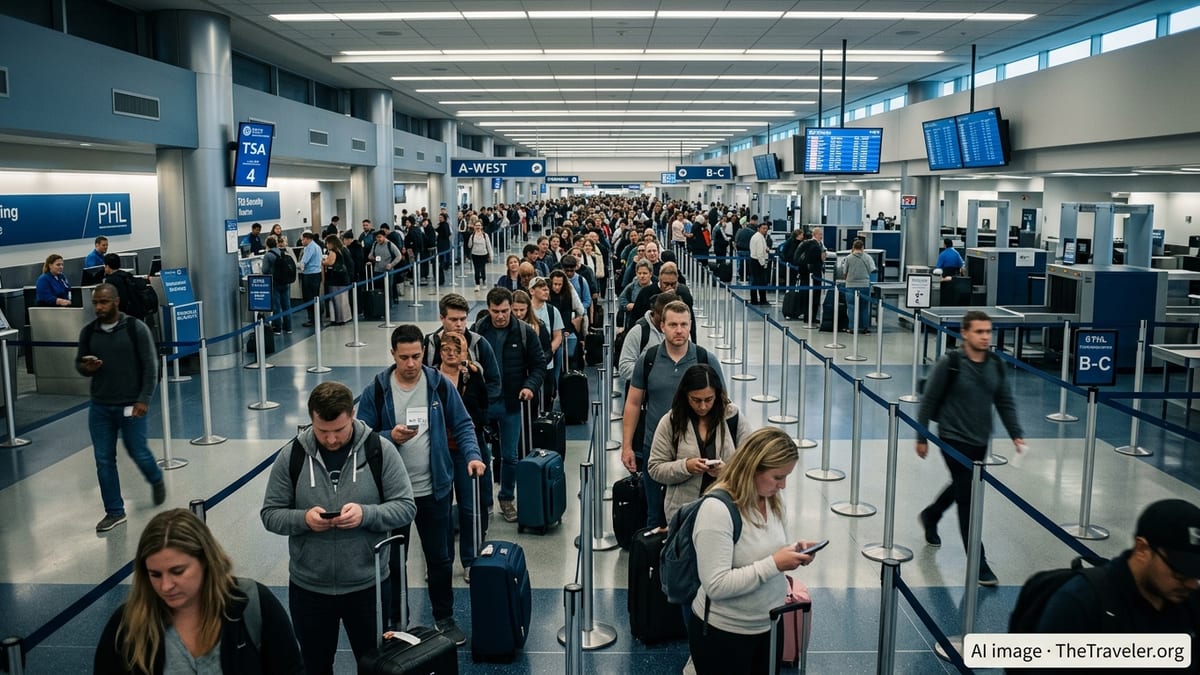
Travelers flying through Philadelphia International Airport this week are facing mounting delays and confusion as multiple TSA security checkpoints close or scale back operations amid a Department of Homeland Security funding lapse, tightening already strained staffing and pushing security lines to unprecedented lengths across key terminals.
Get the latest news straight to your inbox!
Checkpoint Closures Spread Across Key Terminals
Philadelphia International Airport has become a focal point of disruption during the Department of Homeland Security shutdown, with several Transportation Security Administration checkpoints shuttered or operating at reduced capacity. Recent public information and local coverage indicate that the Terminal A-West, Terminal F and, most recently, Terminal C security checkpoints have either closed outright or limited screening hours, forcing passengers into fewer active lanes across the sprawling hub.
The Terminal C closure, which followed earlier shutdown-related changes in A-West and F, has had an outsize impact because it typically handles a high volume of domestic departures and TSA PreCheck travelers. Reports note that the Terminal C checkpoint, once a dedicated option for PreCheck, is now offline, sending all eligible passengers to alternate screening points and significantly increasing wait times in those areas.
Airport communications emphasize that flights themselves continue to operate, but the consolidation of screening activity means that reaching the gate has become the bottleneck. With the same or greater number of passengers funneled through fewer checkpoints, lines are building quickly at peak hours and snaking deep into the ticketing halls in some terminals.
Shutdown-Driven Staffing Strain Behind Long Lines
The immediate driver of the closures is a shortage of available security staff. Public statements from airport representatives and news coverage link the situation directly to the partial federal government shutdown that has frozen regular pay for TSA personnel. Although security officers are deemed essential and are still required to report for duty, the lack of paychecks is contributing to rising absenteeism, schedule disruptions and an overall reduction in available screeners at airports nationwide.
National reporting describes this as a cascading effect. As more TSA employees call out, checkpoints that cannot be safely or efficiently staffed are temporarily taken offline, as appears to be happening across multiple terminals at Philadelphia International Airport. The process is being framed as a collaboration between TSA and airport management, with the goal of concentrating available staff where they can move the greatest number of travelers through security.
Layered on top of the shutdown is the seasonal surge in demand and ongoing weather volatility. The recent winter storm that brought some of the heaviest snowfall in years to the Philadelphia region has already disrupted flight schedules and created backlogs of passengers seeking rebooked flights. The combination of full or nearly full aircraft, weather recovery operations and reduced checkpoint capacity is amplifying the sense of chaos for those passing through the airport.
Travelers Report Hours-Long Waits and Missed Flights
Social media posts, local forums and on-the-ground accounts describe a patchwork of experiences at Philadelphia International Airport, ranging from relatively smooth transits during off-peak times to hour-plus waits at dawn and midday. Some travelers report clearing security in 20 to 30 minutes when lines are moving, while others describe the longest waits they have ever encountered at the airport, with queues stretching toward parking garages and ticket counters.
Several of these accounts highlight a disconnect between advertised wait estimates and reality. Travelers checking airport and airline tools for projected security times are finding significantly longer queues on arrival, particularly in the early morning window between 4 a.m. and 7 a.m., when multiple departures leave in rapid succession and all travelers converge on the few open checkpoints.
Missed flights are becoming more common in this environment, especially for those who arrive at the airport following pre-shutdown norms. Passengers who once budgeted 90 minutes for a domestic flight or two hours for an international departure are reporting that those cushions are no longer sufficient when checkpoints are closed and traffic is heavy. Families with young children, infrequent travelers and those unfamiliar with the airport layout appear to be among the hardest hit.
What Passengers Can Do Right Now
Publicly available guidance from the airport and national travel coverage converge on one central recommendation for travelers using Philadelphia International Airport during the shutdown: arrive significantly earlier than usual. The airport has advised passengers to build in at least two and a half hours for domestic flights and three and a half hours for international journeys, reflecting the expectation of slower security processing and potential bottlenecks at active checkpoints.
Travel experts also recommend that travelers check which checkpoint is currently open for their terminal before leaving home, as some gates can be reached from multiple screening points via secure-side walkways. At Philadelphia, passengers departing from terminals with closed checkpoints may still be able to clear security at A-East or the combined D/E checkpoint and then walk to their actual gate, a strategy that airport communications have promoted during previous shutdown-related closures.
Digital tools can provide additional situational awareness, even if they are not always perfectly current. The MyTSA app, airport websites and third-party flight-tracking platforms can help travelers monitor general congestion, departure delays and terminal activity, which may serve as indirect indicators of how stressed the system is at a given moment. However, published coverage notes that some federal digital channels are not being actively updated during the shutdown, so these resources are best used as rough guides rather than guarantees.
How Long Could Disruptions at PHL Last?
The duration of the turmoil at Philadelphia International Airport is tightly bound to the broader political stalemate in Washington. The current shutdown, which specifically affects the Department of Homeland Security and its component agencies, including TSA, has no clear end date. Past shutdowns have shown that once appropriations are restored, checkpoints can reopen relatively quickly, but it may still take time for staffing levels and normal schedules to stabilize.
Analysts note that the closures at Philadelphia are part of a wider national pattern. Airline executives have publicly urged Congress to pass measures that would insulate critical aviation functions from future funding lapses, pointing to the risk that repeated shutdowns pose to the reliability of the air travel system. In the meantime, airports like PHL are left to manage day-to-day operations in an environment of uncertainty, adjusting checkpoint configurations as staffing rises or falls.
For travelers, that means conditions may fluctuate from one day to the next. A checkpoint closed today could reopen with limited lanes tomorrow, or additional closures could be announced with little notice if staffing deteriorates further. Until lawmakers reach a funding agreement, those planning to fly through Philadelphia International Airport should assume longer lines, build in extra time and stay alert for last-minute operational changes that could affect which checkpoints are open and how long it will take to reach their gate.