

More news on this day
Passengers at Hartsfield-Jackson Atlanta International Airport are facing hourslong security lines, unpaid screening officers and a cascade of flight disruptions as a prolonged Department of Homeland Security funding standoff pushes the country’s busiest hub into mounting travel turmoil.
Get the latest news straight to your inbox!
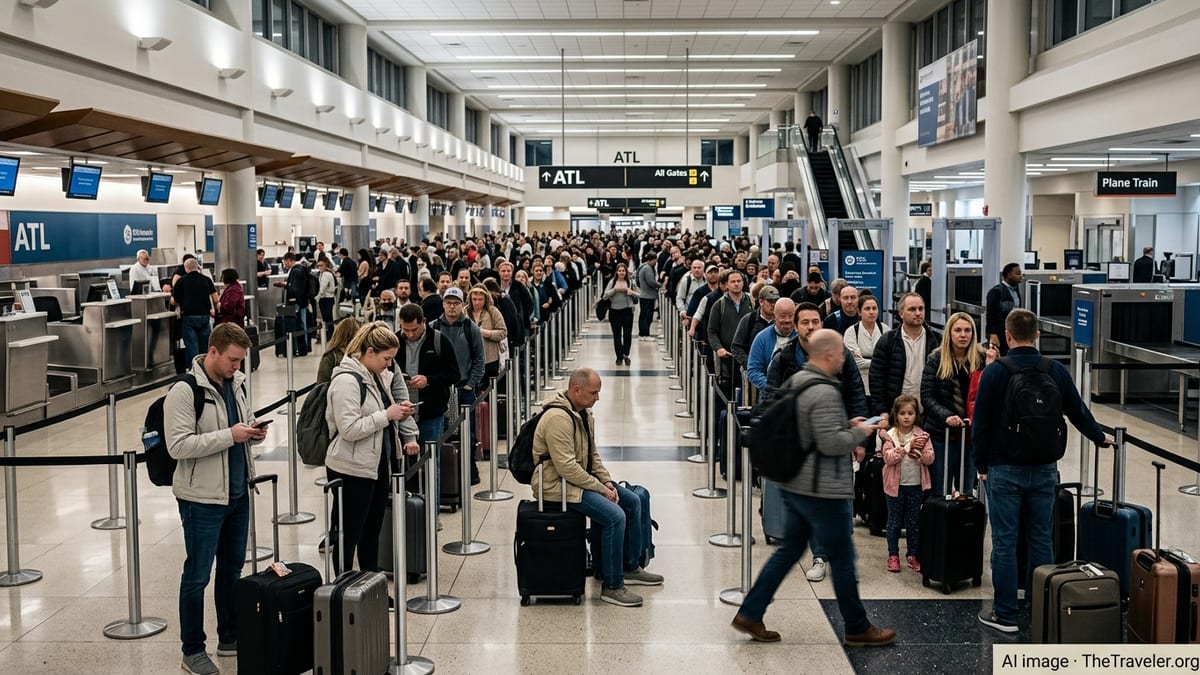
Hourslong Lines Turn Atlanta Departures into an Ordeal
Security wait times at Atlanta’s main airport have surged in recent days, with reports describing lines snaking through the domestic terminals, wrapping around baggage claim areas and at times exceeding two hours for standard screening. Some travelers recount early-morning waits of more than 90 minutes, with occasional peaks well above that, particularly during rush periods when departures are heaviest.
Publicly available wait-time dashboards have struggled to keep pace with conditions on the ground. Airport messaging has cautioned that official estimates may understate actual delays, while local coverage and traveler reports describe crowds building long before dawn and persisting into mid-morning banked departure waves. Guidance circulating among Atlanta flyers now routinely recommends arriving three hours or more before scheduled departure, even for domestic trips.
Experiences remain uneven from hour to hour. On some evenings and late-night banks, travelers report clearing security within 20 to 30 minutes, highlighting how staffing gaps, callouts and spikes in demand can quickly flip a relatively normal checkpoint into a bottleneck stretching across the terminal concourse.
Unpaid TSA Officers Bear the Brunt of the Shutdown
The current disruption is rooted in a partial federal government shutdown that began affecting the Department of Homeland Security in mid-February 2026. Transportation Security Administration officers are classified as essential employees and are required to report to work, but many have now missed multiple paychecks, according to widely cited government updates and union briefings.
Publicly available information from the Department of Homeland Security indicates that hundreds of TSA officers have resigned nationwide since the shutdown began, with callout rates climbing across key airports. Internal assessments previously warned that if the funding lapse dragged on, major hubs could face severe screening slowdowns and potential partial closures as staffing thinned.
In Atlanta, which relies on a high volume of screening lanes to handle the airport’s role as a domestic and international transfer hub, even modest increases in absenteeism can ripple across operations. When fewer officers are available to operate checkpoints, lanes are consolidated and passengers for general screening, TSA PreCheck and other expedited programs may find themselves funneled into shared queues, erasing many of the time savings frequent travelers typically expect.
Political Gridlock Leaves Aviation System Caught in the Middle
The partial shutdown traces back to a funding fight in Congress over homeland security and immigration enforcement that has hardened into one of the longest departmental funding lapses on record. Despite weeks of negotiations, lawmakers have not yet approved a compromise that would restore full funding to the Department of Homeland Security, leaving TSA and other agencies operating in a prolonged contingency posture.
Reports from Washington describe aviation workers becoming collateral damage in the stalemate. Senior airline executives, including leaders of several major U.S. carriers and cargo operators, recently published an open letter urging Congress to pass a package of aviation and homeland security funding bills that would guarantee pay for air traffic controllers and security officers during any future lapses. The letter framed the current situation as a case of air travel being used as a political bargaining chip.
Travel industry analysts warn that as long as the funding dispute continues, airports such as Atlanta will remain vulnerable to sudden swings in staffing and wait times. The longer TSA officers go unpaid, the more difficult it may become to maintain morale, retain experienced staff and recruit replacements, raising concerns about both passenger experience and the resilience of the broader aviation system.
Travelers Scramble to Adjust Plans Amid Uncertain Wait Times
For passengers, the immediate impact is practical and personal. Social media posts and local message boards from the past week show travelers in Atlanta sharing real-time photos of queues, comparing checkpoint experiences and swapping advice on which terminal entrance appears to be moving faster at any given moment.
Some recount missing flights after underestimating the severity of the delays, particularly when official wait-time tools showed moderate conditions that did not match the scenes in the terminal. Others describe sprinting to catch connections after clearing security, pointing to the additional 10 to 20 minutes often needed to reach distant concourses via the Plane Train once screening is complete.
The variability has made planning difficult. On one morning, precheck travelers report clearing in under half an hour while general screening stretches far longer; on another day, even expedited lanes face substantial backlogs. This unpredictability has led many Atlanta residents and frequent flyers to adopt a conservative approach, shifting airport arrivals earlier and building in extra time for both security and inter-terminal transfers.
Industry Pressure Builds for a Long-Term Fix
The turbulence at Atlanta is emblematic of a broader strain across the national aviation network. Public statements from airline trade groups, pilot unions and airport associations in recent weeks have stressed that repeated shutdowns and near-shutdown threats risk normalizing crisis operations for essential safety and security staff.
Proposals circulating in Congress and among industry stakeholders include legislation that would shield aviation safety and security workers from future funding lapses by creating automatic pay protections or dedicated trust funds. Advocates argue that predictable funding is critical not only to avoid travel chaos for passengers, but also to preserve the training pipelines and institutional knowledge on which complex operations like Atlanta’s hub structure depend.
For now, passengers at Hartsfield-Jackson are left to navigate an unstable status quo. With no immediate breakthrough reported in the funding impasse, public guidance continues to emphasize early arrival, close monitoring of airline notifications and flexibility in travel schedules, as the world’s busiest airport works to manage unprecedented security line volatility fueled by unpaid labor and political deadlock.