

More news on this day
A whiplash series of announcements from Washington over the weekend left millions of U.S. travelers confused about whether they could still rely on trusted-traveler programs, as the Department of Homeland Security moved to suspend TSA PreCheck and Global Entry only to partially reverse course hours later amid a deepening funding standoff and mounting airport delays.
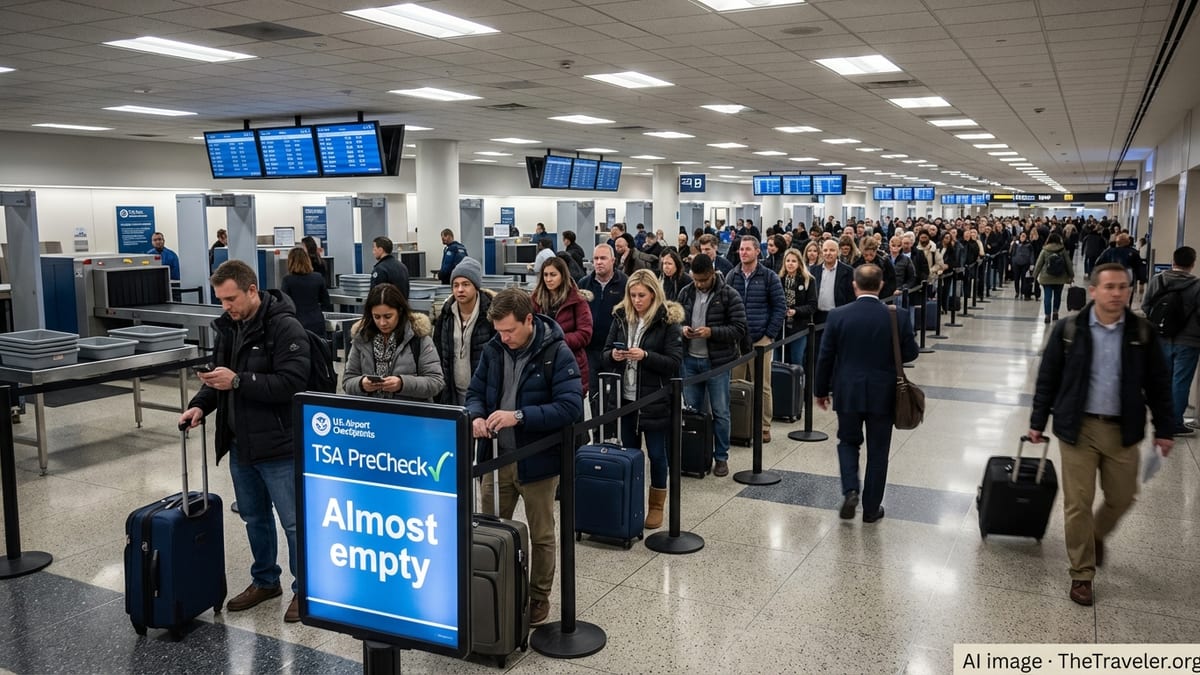
Shutdown Politics Spill Into Airport Security Lanes
The turbulence began late Saturday, February 21, when the Department of Homeland Security (DHS) said it would suspend both TSA PreCheck and U.S. Customs and Border Protection’s Global Entry program starting early Sunday morning as part of its contingency plan for an ongoing partial government shutdown. The department framed the step as a necessary move to conserve limited funding and prioritize basic screening operations at airports and ports of entry.
The shutdown, which began on February 14 after Congress failed to reach agreement on a DHS spending bill, has left tens of thousands of employees working without pay while political leaders clash over immigration and border enforcement policies. Senior officials warned that, with each passing day, pressure on security staffing, overtime and technology support would intensify, forcing difficult trade-offs that could ripple through the air travel system.
The initial DHS announcement treated expedited screening as a luxury that could be paused to protect core operations. Ending PreCheck lanes and Global Entry kiosks, officials said, would allow them to redeploy personnel to standard checkpoints and primary inspection booths, theoretically keeping overall throughput steady even as staffing became more constrained.
But the prospect of abruptly switching off programs used by tens of millions of travelers immediately raised alarms across the aviation industry and on Capitol Hill. Airlines, airport operators and trade associations warned of widespread disruption, calling the suspension a self-inflicted wound at a time when winter storms and high passenger volumes were already straining the system.
TSA PreCheck Survives After Last-Minute Reversal
By early Sunday, the official narrative began to shift. Just hours after the stated cutoff time, travelers at major hubs including Chicago, Dallas-Fort Worth, San Francisco and Washington-area airports reported that TSA PreCheck lanes were still open and processing passengers. In some locations, signage had been briefly removed or covered before being restored as local managers awaited updated guidance.
Late Sunday morning, the Transportation Security Administration issued a clarifying statement saying that PreCheck “remains operational with no change for the traveling public.” The agency added that it would monitor staffing and adjust operations on a case-by-case basis, signaling that while the program was not formally grounded, its availability could still fluctuate at particular airports or during peak surges.
The last-minute reversal followed intense backlash from lawmakers and industry groups, who argued that shuttering PreCheck would punish frequent travelers and slow down screening for everyone by funneling low-risk passengers back into standard lines. Critics also noted that PreCheck is funded by enrollment fees rather than direct appropriations, questioning why it should be targeted in a budget dispute.
For Sunday’s flyers, the result was a patchwork experience. At some airports, dedicated PreCheck queues functioned much as they normally do, with travelers keeping their shoes on and laptops in their bags. Elsewhere, passengers arriving for early morning departures encountered signs indicating PreCheck was unavailable, only to see those notices quietly removed later in the day as TSA adjusted its stance.
Global Entry and Nexus Remain Grounded
While TSA PreCheck has largely been restored for now, the outlook is far less reassuring for travelers who rely on Global Entry and affiliated programs such as Nexus. DHS officials have said that Global Entry will remain paused as the shutdown continues, effectively grounding one of the most popular tools for reducing long waits at immigration checkpoints.
At international arrival halls, Global Entry kiosks have been roped off or switched to display “out of service” messages, redirecting previously pre-screened travelers into the same primary inspection lines used by the broader public. That shift has been especially painful during busy arrival banks in gateway cities like New York, Miami and Los Angeles, where long-haul flights from multiple continents land within tight windows.
Airports near the Canadian border have also reported spillover strain on Nexus, the joint U.S.-Canada trusted-traveler program that shares infrastructure and membership pathways with Global Entry. At Vancouver International Airport, Canadian officials have publicly linked disruptions in fast-track lanes to the U.S. shutdown, warning that routine cross-border travelers should brace for longer waits and more variable processing times.
The partial nature of the policy shift has compounded confusion. Many travelers assumed that a reprieve for PreCheck meant a similar restoration for Global Entry, only to discover at the arrivals hall that their memberships currently provide little practical benefit. Enrollment centers that handle interviews and renewals have similarly scaled back operations, raising concerns that backlogs will grow even if the programs return to normal later this year.
On the Ground: Longer Lines and Frayed Tempers
As agencies debated policy in Washington, the most immediate effects played out in front of security belts and passport counters. Over the weekend and into Monday morning, travelers across the country described scenes of snaking queues, inconsistent signage and frazzled staff trying to explain fast-moving changes they themselves had only just learned about.
At some domestic checkpoints, the shortfall created by diverting personnel and the uncertainty around lane configuration forced passengers into a handful of open lines, with estimated waits stretching beyond 60 minutes during peak periods. In airports already dealing with weather-related cancellations and rerouted flights, the added delays left many fliers sprinting to gates and missing connections.
International terminals reported similar challenges as Global Entry users rejoined standard inspection lines. Families returning from long overseas trips found themselves inching forward behind hundreds of other travelers while a limited number of officers staffed primary booths. In several cases, officers walked the line to identify passengers with imminent departures to domestic connections and bring them forward, a triage approach that eased some pressure but heightened frustration for those left waiting.
Airport customer service desks and airline social media channels were inundated with questions from confused travelers wondering whether their paid memberships would be honored. Many said they received automated reminders to renew their PreCheck or Global Entry status even as headlines suggested the programs were about to shut down or had already been halted, adding to a sense of whiplash.
Why a Self-Funded Program Became a Political Flashpoint
The decision to target trusted-traveler programs, even temporarily, has drawn particular scrutiny because they are largely funded by user fees rather than annual congressional appropriations. Applicants pay nonrefundable fees to cover background checks and administration for memberships that typically last several years. That model was designed to insulate the programs from the normal swings of the federal budget cycle.
DHS officials have argued that even self-funded programs depend on a broader ecosystem of personnel, information technology and physical infrastructure that is directly affected by a lapse in appropriations. When staff are stretched thin and some support functions are paused, they say, leadership must prioritize basic security screening and border protection over expedited services, regardless of how those services are financed.
Critics in both parties counter that the shutdown strategy appears designed to maximize visible inconvenience in order to gain leverage in negotiations. By touching the travel experience of business flyers and vacationers alike, they contend, the administration and congressional leaders are effectively using airport frustration as a pressure campaign aimed at their political opponents.
Industry groups point out that previous government shutdowns have already cost the travel sector billions of dollars in lost revenue, missed trips and long-term booking shifts. They warn that repeatedly undermining trusted-traveler programs could erode confidence in the stability of U.S. security operations, pushing some travelers to rearrange itineraries around foreign hubs or avoid discretionary travel during periods of political brinkmanship.
Economic Ripples for Airlines, Airports and Tourism
The timing of the latest turmoil could hardly be worse for airlines, airports and tourism-dependent communities. February is often a peak month for winter getaways, business conferences and school breaks, and this year’s travel season was already complicated by major winter storms in the Northeast and Midwest that have triggered hundreds of cancellations and diversions.
When expedited lanes are fully functional, they serve as a crucial pressure valve that keeps passenger flows moving through choke points at security and passport control. Shutting them down or limiting their use forces more travelers into the same finite space, amplifying the impact of every weather delay, aircraft swap or staffing hiccup across the system.
Airlines say the uncertainty around security processing times complicates crew scheduling and aircraft utilization. If a higher percentage of passengers miss connections because they are stuck in unusually long lines, carriers must scramble to rebook them, find hotel rooms and reposition aircraft, all of which raise operating costs. Smaller airports with limited screening capacity can be especially vulnerable when several flights depart or arrive in quick succession.
Local economies that rely on international visitors are also watching closely. Global Entry has been a key selling point for inbound business travelers and high-spending tourists who prioritize predictable, fast processing when choosing between transit hubs. Prolonged disruptions or a perception that U.S. entry procedures have become less efficient could push some global travelers to favor competing hubs abroad.
Travelers Scramble for Workarounds
In response to the shifting landscape, frequent flyers are adopting a range of strategies to reduce their exposure to sudden program changes. Many are building in extra time at departure airports, arriving three or even four hours early for domestic flights if they are traveling at peak times or through especially busy hubs.
Some travelers have turned to privately operated services such as biometric fast-lane systems where available, though these services also rely on TSA staffing and checkpoint capacity, limiting their ability to fully compensate for federal disruptions. Others are strategically booking flights at off-peak hours or through secondary airports in hopes of encountering shorter lines and less congestion.
Travel advisers recommend that passengers monitor their airline and airport social channels and check terminal maps before leaving for the airport to see which security lanes are open. They also urge travelers to pay particular attention to connection times on itineraries involving an international arrival followed by a domestic flight, as the loss of Global Entry can easily turn a once-safe connection into a riskier dash.
For those who have already paid for memberships, the uncertainty is as much about value as convenience. Some are questioning whether to renew Global Entry while the program is partially suspended, while others say they still see long-term benefits but want clearer assurances that future political fights will not repeatedly interrupt services they have come to rely on.
What Comes Next for Trusted-Traveler Programs
The fate of both TSA PreCheck and Global Entry now hinges largely on how long the DHS funding standoff continues and whether political leaders choose to use the programs as bargaining chips again. Officials at TSA and Customs and Border Protection have stressed that their overriding priority is to maintain security while moving as many people as possible through the system safely.
Policy experts say one likely outcome, once funding is restored, will be a renewed push to formally wall off trusted-traveler programs from future shutdown battles, either through explicit legal protections or more robust contingency planning that acknowledges the crucial role they play in overall throughput. Some lawmakers have already floated proposals to treat these services as essential because of their contribution to both security and economic activity.
In the meantime, travelers can expect an uneven experience. On some days and at some airports, PreCheck lanes may look and feel much as they did before the crisis, with familiar green signs and relatively swift processing. At others, staffing shortages or internal directives could temporarily narrow or close those lanes while officers are reassigned.
For Global Entry users, the message is starker: until the shutdown is resolved or DHS provides new guidance, they are likely to keep standing shoulder to shoulder with the broader flying public at passport control. The trusted-traveler cards in their wallets still attest to their low-risk status, but for now the kiosks they once sailed through remain another casualty of Washington’s budget gridlock.