

More news on this day
Millions of U.S. air passengers are bracing for longer lines and fresh uncertainty after the Department of Homeland Security abruptly suspended TSA PreCheck and Global Entry nationwide on Sunday, citing a deepening political standoff in Washington that has left the agency partially unfunded.
Programs Halted as DHS Shutdown Enters Second Week
The suspension of the trusted traveler programs took effect at 6 a.m. Eastern on Sunday, February 22, 2026, as the partial shutdown of the Department of Homeland Security entered its second week. The move freezes the benefits of two of America’s most widely used expedited screening programs, which together serve millions of frequent flyers and international travelers each year.
In a statement, Homeland Security Secretary Kristi Noem said Transportation Security Administration officers and Customs and Border Protection personnel were being redirected to focus on the “general traveling population” instead of offering what she characterized as courtesy and special-privilege services. She framed the decision as a necessary but painful tradeoff forced by Congress’s failure to approve additional funding.
The shutdown, which began on February 14, affects only the Department of Homeland Security, leaving most other federal agencies funded through the end of the fiscal year. Still, the impact is being felt acutely at airports and land-border crossings, where staffing levels are tight and the loss of expedited lanes is expected to ripple across an already stressed travel system.
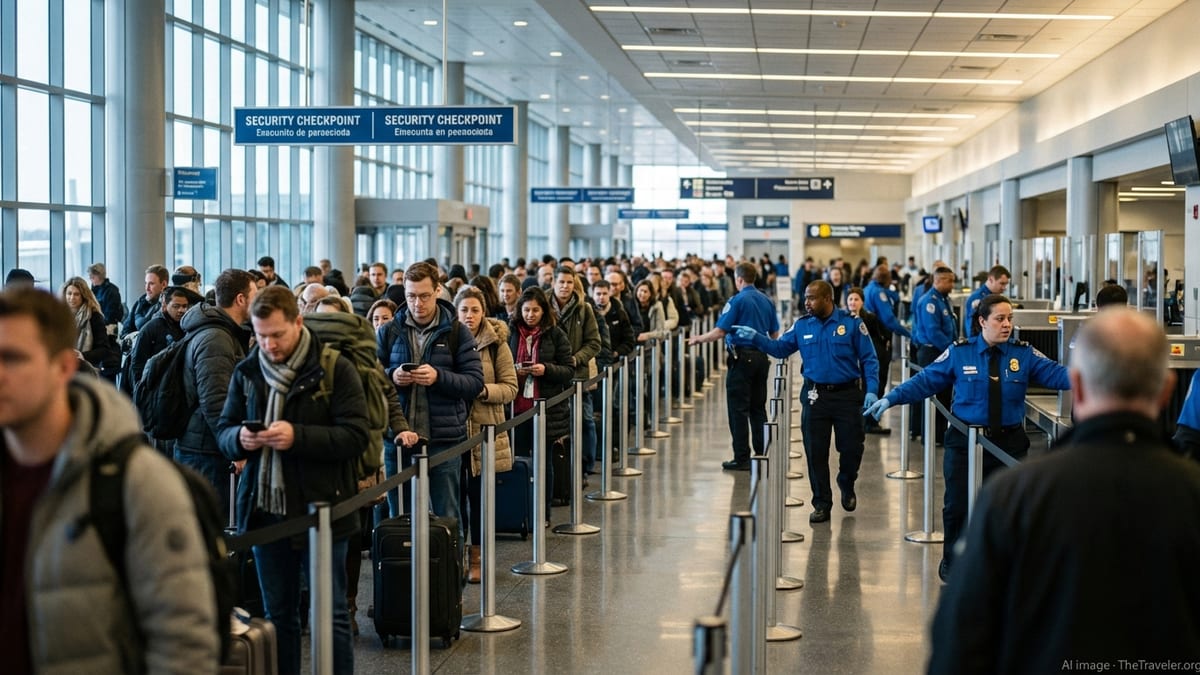
Early reports from major hubs on Sunday showed security lines lengthening as travelers accustomed to shorter, faster queues were pushed back into standard screening lanes. Industry and passenger groups warned that this may only be a preview of the disruptions to come if the shutdown drags on.
What the Suspension Means for Travelers
TSA PreCheck and Global Entry are designed to speed up security and immigration checks for pre-vetted travelers who undergo background checks, pay enrollment fees and, in many cases, wait months for an interview. The programs typically allow members to keep shoes and light jackets on, leave laptops in bags and use dedicated lanes that move significantly faster than regular lines.
As of Sunday, those benefits are effectively on hold in airports and ports of entry across the country. DHS officials have indicated that the suspension will apply broadly to all participating airports and border facilities, meaning members will be processed in standard lines alongside other travelers. Enrollment centers for new and renewing applicants are also expected to be affected, with interview appointments delayed or canceled.
Airports have been warned to prepare for a sharp increase in load on standard security checkpoints. While TSA says that the majority of its workforce has been deemed essential and must continue working without pay, the agency’s contingency plans assume slower throughput when staffing cannot be flexibly deployed and overtime budgets are frozen.
For travelers, the practical advice is blunt: arrive earlier than usual, expect fewer dedicated lanes and be ready for more extensive screening of electronics and personal items. Frequent flyers who built their routines around expedited processing may face the most significant disruption, particularly on peak travel days in busy hubs such as Atlanta, Chicago, Denver, Los Angeles and New York.
Airlines and Airports Warn of Systemwide Disruption
Airlines and airport operators reacted with alarm to the announcement, warning that the timing could hardly be worse. The shutdown comes as the winter travel season remains active and a major blizzard is forecast to sweep through parts of the Northeast and Midwest, raising the risk of cascading delays and cancellations.
Industry trade groups representing major U.S. carriers said they were given little notice about the DHS decision, making it difficult to adjust staffing, signage and passenger communication. Several airlines scrambled overnight to issue travel alerts and push notifications urging customers to arrive earlier at airports and to allow for additional screening time before boarding.
Airport authorities, already operating under tight security and staffing budgets, say they have limited ability to cushion the blow. While local police and contract staff can help manage crowds and wayfinding, only TSA can conduct federal security screening. The loss of expedited lanes, they argue, effectively removes one of the few pressure valves in a crowded system.
Some airport leaders drew comparisons to previous federal shutdowns and security slowdowns, warning that even modest increases in processing times can translate into missed flights, snarled queues spilling into public areas and heightened tensions between frustrated passengers and front-line staff.
Political Stalemate Over DHS Funding and Immigration
The suspension of TSA PreCheck and Global Entry is the most visible consequence yet of a bitter funding dispute that has paralyzed the Department of Homeland Security. The current shutdown began after negotiations over the agency’s budget collapsed amid Democratic demands for stricter oversight and reforms to federal immigration enforcement.
At the center of the standoff are calls from Democrats to tie new funding to changes in Immigration and Customs Enforcement and Customs and Border Protection operations, following high-profile incidents in which federal agents fatally shot protesters in Minneapolis. They argue that additional guardrails, including body camera requirements and tighter limits on raids, are needed before Congress approves more money.
Republicans and the White House have accused Democrats of jeopardizing national security by withholding DHS funding and say the shutdown is being used as political leverage over immigration policy. They contend that enforcement agencies must remain fully empowered to carry out existing law and that broader reforms should be debated separately from emergency funding to keep the department running.
In that partisan crossfire, the trusted traveler programs have become collateral damage. Secretary Noem and administration allies say suspending expedited services is an unavoidable consequence of limited resources, while Democratic lawmakers counter that the programs actually improve efficiency and reduce strain on security staff, and that cutting them is a political choice designed to maximize public discomfort.
Trusted Traveler Programs as a Political Flashpoint
Trusted traveler programs such as TSA PreCheck and Global Entry have typically enjoyed broad bipartisan support since their creation, seen as pragmatic tools to focus security resources on higher-risk passengers while improving the travel experience for low-risk, pre-screened individuals. Sunday’s suspension underscores how even once-routine components of air travel can become entangled in Washington’s wider political battles.
Democrats on the House Committee on Homeland Security have publicly condemned the decision, accusing the administration of “kneecapping” programs that make travel “smoother and secure.” They argue that halting PreCheck and Global Entry will not resolve the underlying funding dispute and instead punishes ordinary travelers and workers who are already stressed by airport crowding and staffing shortages.
Republican leaders, meanwhile, have rallied behind the DHS decision, emphasizing statements from Secretary Noem that shutdowns carry “serious real world consequences.” In their view, highlighting those consequences, including travel delays, is a way to pressure Democrats back to the negotiating table and underscore what they describe as the cost of the opposition’s stance on immigration enforcement.
Policy analysts note that this is not the first time trusted traveler programs have been pulled into political controversy. Previous administrations have restricted access for certain states or groups of travelers in disputes over data sharing and compliance. The scale of the current suspension, however, is unprecedented, affecting virtually all participants nationwide simultaneously.
Impact on Enrollment, Renewals and International Travel
Beyond the immediate headache of longer lines, the shutdown threatens to snarl the pipeline for new and renewing trusted traveler members. Enrollment centers located in airports and urban areas rely on DHS funding and personnel to process applications, conduct interviews and run background checks.
With those operations now curtailed, travelers who were weeks or months into the approval process may face fresh delays. Some applicants could see upcoming interview appointments canceled or rescheduled indefinitely, while others may have their applications held in limbo until staff can be reassigned. DHS has not provided a clear timeline for when interviews might resume or how it will prioritize backlogs once funding is restored.
For international travelers, the suspension of Global Entry poses specific challenges. The program allows preapproved travelers returning to the United States to bypass standard passport lines and use automated kiosks, significantly reducing wait times during peak arrival periods. With those kiosks now effectively offline for participants, major international gateways such as New York, Los Angeles, Miami and Dallas are preparing for longer immigration lines and additional strain on customs officers.
Travel advisors say business travelers and frequent international flyers are likely to feel the impact most acutely, especially those whose tight itineraries rely on quick clearance through customs. Some are urging clients to build in extra layover time for connections through U.S. hubs or, where possible, to consider alternate routings until there is clarity on the status of the programs.
Front-Line Workers Caught Between Duty and Uncertainty
Amid the political wrangling and passenger frustration, TSA and CBP employees remain on the front lines, many working without pay as long as the funding lapse continues. Under DHS contingency plans, the vast majority of security screeners and border officers are deemed essential, meaning they must continue reporting for duty even as paychecks are delayed.
Union representatives say morale has been strained by the combination of financial uncertainty and growing public anger over longer lines and changing procedures. Some workers have expressed concern that passengers may direct their frustration at front-line officers, who have no role in the political decisions that triggered the shutdown or the suspension of trusted traveler services.
Supervisors are being instructed to rotate staff where possible and to communicate clearly with travelers about what is happening and why. Yet with overtime budgets restricted and staffing inflexible, there are limits to how much managers can do to prevent bottlenecks at peak times, particularly in large hubs where passenger volumes can surge quickly.
Security experts warn that prolonged stress on front-line personnel, coupled with an erosion of tools designed to manage risk efficiently, could carry safety implications if not carefully managed. They argue that efficient, predictable processes are a key component of aviation security and that constant last-minute changes imposed by budget crises only add to operational risk.
What Travelers Can Expect in the Days Ahead
For now, DHS has not provided an end date for the suspension of TSA PreCheck and Global Entry, saying only that trusted traveler services will remain on hold as long as the department is caught in a funding impasse. That uncertainty leaves airlines, airports and travelers planning day by day while watching developments on Capitol Hill.
Travel experts recommend that passengers flying in the coming days build in a larger time buffer, especially at busy hub airports and during early morning and evening peaks. For domestic flights, that may mean arriving at least two hours in advance, and for international departures, three hours or more. Travelers accustomed to zipping through dedicated lanes are being urged to reset expectations and prepare for more extensive document checks and bag screening.
Some carriers are quietly modeling worst-case scenarios in which the shutdown stretches into March, coinciding with spring break travel and putting further pressure on a security system operating without its usual relief valves. In those scenarios, delays and missed connections could multiply, hitting both leisure travelers and business trips across the country.
Ultimately, the fate of TSA PreCheck and Global Entry now rests less on technical or security considerations than on the politics of the DHS funding fight. Until lawmakers reach a deal to reopen the department, the once-routine experience of breezing through an expedited lane will remain another casualty of Washington’s gridlock, and millions of travelers will be left waiting in slower lines for movement on both sides of the security checkpoint.