

More news on this day
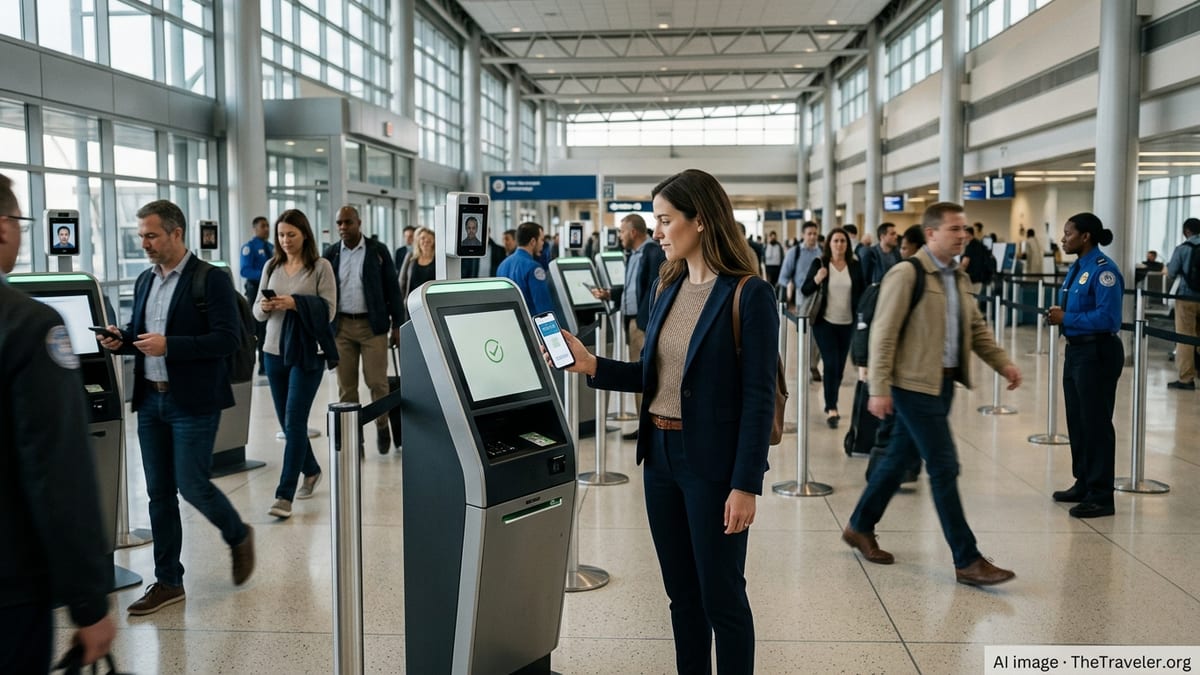
U.S. travelers heading to the airport in 2026 are increasingly encountering a new kind of TSA PreCheck lane, where a quick face scan, a mobile boarding pass and a digital ID are beginning to replace the familiar shuffle of plastic cards and paper documents at security checkpoints.
Get the latest news straight to your inbox!
From Pilot Program to Wider Rollout
PreCheck Touchless ID began as a limited pilot, but reports indicate it is now moving into a broader deployment across major U.S. airports. The system links TSA PreCheck eligibility with biometric identity verification, allowing some passengers to pass through the first stage of screening with little more than a look at a camera. Recent industry coverage shows that the Transportation Security Administration has been expanding its network of Credential Authentication Technology 2, or CAT-2, units, which combine document authentication with facial matching to confirm a traveler’s identity.
According to aviation and biometrics trade reporting, TSA plans to extend Touchless ID-style facial recognition capabilities to dozens of additional airports, building on a base of more than 2,000 CAT-2 devices in service. PreCheck members flying certain airlines, and who have uploaded passport details and consented to biometric use, can see a special Touchless ID indicator on their mobile boarding passes. At participating checkpoints, that digital token signals that the traveler should be able to proceed through security without showing a physical ID.
The rollout is not uniform. Some smaller airports and terminals are still relying on traditional PreCheck lanes, while others are running mixed operations with both facial recognition and conventional ID checks. For travelers, that means the experience in early 2026 can vary significantly from one checkpoint to the next, even when the same Touchless ID symbol appears on the boarding pass.
How Touchless ID Changes the Checkpoint Experience
In a Touchless ID lane, the familiar handoff of license and boarding pass to a TSA officer is increasingly handled by the machine. A traveler steps up to the CAT-2 unit, which reads the mobile boarding pass and prompts the passenger to look into a small camera. The system compares the live face image against identity data supplied through the airline profile and government records, then returns a simple pass-or-fail result to the officer monitoring the lane.
Publicly available descriptions of the process emphasize that only a limited set of biometric templates, rather than full raw images, are retained for operational use. The technology is designed to speed up the identity check by automating the comparison that an officer previously performed visually, while still allowing staff to intervene when the system cannot make a confident match. In practice, travel forums and consumer travel sites suggest that when the match works, the interaction often takes only a few seconds.
For PreCheck members, the promise is a streamlined journey through security. Once the identity step is completed, the rest of the familiar PreCheck benefits generally remain in place: leaving on light jackets and shoes, keeping laptops in bags and using screening lanes that are typically shorter than standard security. As more airports adopt Touchless ID, the first stage of the checkpoint is increasingly starting to resemble an automated gate rather than a manual inspection station.
Digital IDs Move Into the Mainstream
The rise of Touchless ID is unfolding alongside a rapid expansion of digital identification options. Apple and Google have both introduced ways for users to store government-issued IDs and passport information in their mobile wallets, and published coverage shows that TSA now accepts certain mobile driver’s licenses and digital IDs at a growing number of airports. State programs in places such as Virginia are adding their own mobile ID apps, which can be used for both airport security and selected state services.
In late 2025, technology and consumer news outlets reported that Apple Wallet’s Digital ID feature, including passport-based identity credentials, became usable at hundreds of TSA checkpoints for domestic travel. Similar reports describe Google Wallet’s digital ID as being accepted at select TSA locations, giving Android users a comparable option. These initiatives are separate from PreCheck Touchless ID but complement it by providing more secure digital identity data for the biometric systems to draw upon.
At the same time, federal rules on mobile driver’s licenses have evolved. A final rule published in late 2024 cleared the way for states to seek TSA approval to use mobile licenses for identity verification, including at airport checkpoints, under temporary derogations while standards mature. Together, these changes have created a patchwork of digital ID programs that, when combined with PreCheck and biometric screening, are gradually shifting airport security away from physical documents and toward phone-based credentials and facial recognition.
New Options for Those Without Real ID
The move toward digital and biometric identity at checkpoints is also intersecting with the long-delayed enforcement of Real ID standards, which are set to be enforced for commercial air travel in May 2025. To address travelers who arrive at security without compliant identification, TSA has been preparing an updated alternative identity verification process, known in industry briefings as a modernized ConfirmID system, scheduled to expand in 2026.
Under this approach, travelers who forget their wallet or present an ID that does not meet federal standards may be offered a separate, more time-consuming verification pathway that relies on additional personal information and database checks. Trade association alerts summarize that this process is expected to take significantly longer than a standard screening and may involve additional fees, signaling a clear incentive for passengers to arrive with Real ID, a passport, or an accepted digital credential.
For PreCheck users, the message is that the fastest experience in 2026 will belong to those who combine trusted traveler status with up-to-date identification in digital form. Travelers who have not upgraded their documents, or who prefer to rely solely on traditional IDs, are likely to face slower fallback procedures if anything goes wrong at the document check stage.
Benefits, Friction and Privacy Concerns
Advocates of PreCheck Touchless ID point to shorter lines and fewer bottlenecks at the document check podium as early wins. Aviation trade press and biometrics industry outlets report that, when systems are running smoothly, facial recognition-based checkpoints can process more passengers per hour than traditional lines, a key advantage as U.S. airports brace for record-breaking traffic tied to events such as the 2026 World Cup and the United States semiquincentennial.
Real-world feedback from frequent flyers, however, suggests that the transition period is not always seamless. Online travel communities are filled with accounts of Touchless ID lanes that are closed, equipment that is temporarily out of service, or staff unfamiliar with the new processes. Some passengers report being redirected to standard PreCheck lanes even when the Touchless ID icon appears on their boarding passes, underscoring that the technology is still maturing.
The broader expansion of facial recognition at airports has also drawn scrutiny from privacy and civil liberties groups. Oversight reports from federal advisory bodies and coverage in national media highlight concerns about data retention, algorithmic bias and the potential for biometric systems to be repurposed for broader surveillance. TSA maintains, in public-facing fact sheets, that participation in facial recognition programs is voluntary and that traditional ID checks remain available, although traveler experiences with opting out can vary by location.
As 2026 progresses, the balance between speed, convenience and privacy at the checkpoint is likely to remain a central topic in U.S. travel. For now, TSA PreCheck Touchless ID is transforming the first minutes of the airport experience for a growing subset of passengers, even as the system continues to evolve in real time across the nation’s terminals.