

More news on this day
Airline passengers across the United States are waking up to a new reality at airport security checkpoints: show up without a compliant ID and you will now be hit with a 45 dollar fee to verify your identity before you can fly.
The Transportation Security Administration’s new ConfirmID program, which officially took effect on February 1, 2026, turns what was once an inconvenient delay into a direct financial penalty. With the policy now active nationwide, travelers are being urged to make one crucial check before every trip if they want to avoid the new charge.
More News
- Bomb Cyclone Gianna Paralyzes Flights and Roads from Gulf Coast to New England
- After Deadly Mauao Landslide, Mount Maunganui Balances Grief With Tourism Survival
- Wet, Icy Start to February Disrupts Travel Across Britain
What the new 45 dollar TSA fee actually is
The 45 dollar charge is not a traditional government tax added to your ticket, but a service fee tied to TSA’s new ConfirmID identity verification option. ConfirmID is designed for passengers who arrive at the security checkpoint without a REAL ID compliant driver’s license or other acceptable form of identification and still want to fly. Instead of being automatically turned away, these travelers can opt into a more intensive identity check by paying the fee.
Under the rule now in effect, the fee applies to domestic air passengers aged 18 and over who do not present a REAL ID, passport, or another credential on TSA’s list of acceptable IDs. They are then referred to the ConfirmID process, which uses biographic data, databases, and in many cases biometrics to establish identity. TSA has stressed that the 45 dollars is nonrefundable, charged per verification period, and is intended to shift the cost of extra processing from taxpayers to those who arrive unprepared.
The agency estimates that roughly 94 percent of air travelers already present an acceptable ID at checkpoints, thanks in large part to the federal REAL ID requirements that took full effect in May 2025. That leaves about 6 percent of passengers who may now be at risk of facing the new fee if they have not updated their documents or forget to bring them to the airport.
How ConfirmID works at the airport
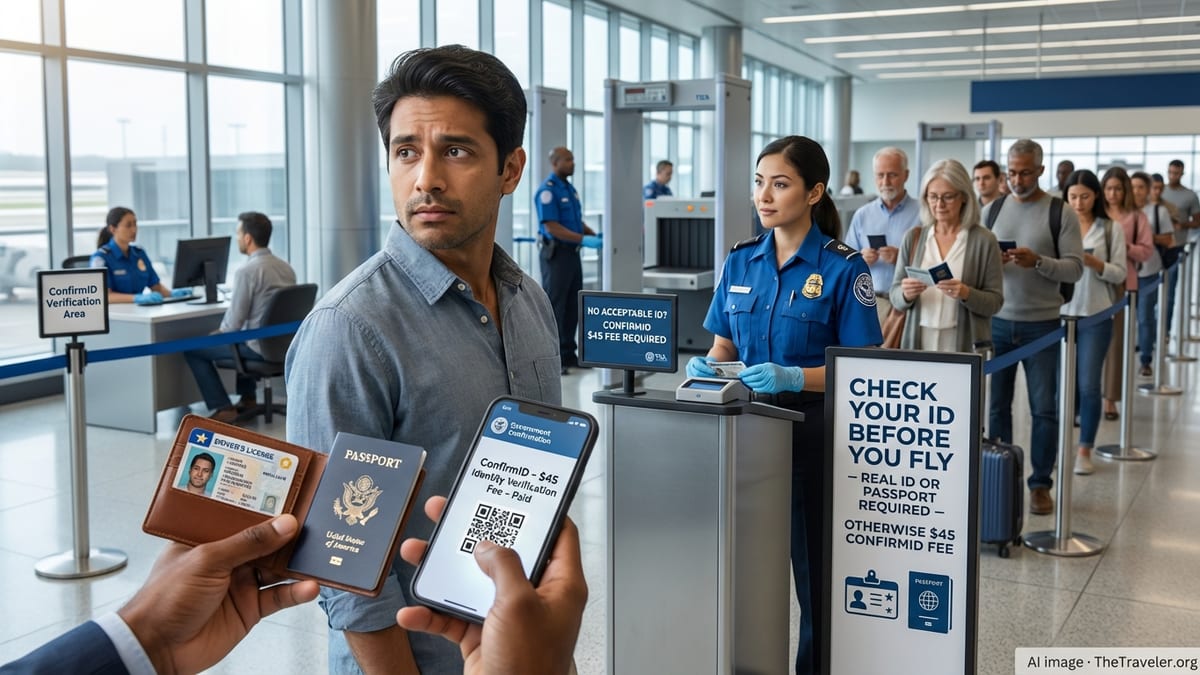
For those who fall into that 6 percent, the ConfirmID process is now the only way to proceed through security without an acceptable ID. Once at the checkpoint, a passenger who fails the ID check will be directed to a designated area where TSA officers initiate the alternative verification. Travelers must show proof that they have paid the 45 dollar fee and then follow officers’ instructions for additional questioning, document review, and potential biometric checks.
The 45 dollars covers a 10 day travel window, meaning it can apply to an outbound journey and a return flight or multiple domestic segments within that timeframe. However, each discrete verification period requires its own fee, so travelers making trips weeks apart would pay again. The process can add 10 to 30 minutes or more to the security experience, and TSA cautions that verification is not guaranteed. If officers cannot confidently establish a traveler’s identity, that person may still be denied access to the secure area and miss their flight despite having paid.
One key operational detail is that the fee is collected digitally. TSA instructs passengers to pay online in advance through government payment portals, then present the digital or printed receipt at the checkpoint. In many airports, QR codes and signage near security now point to payment options for those who arrive without having paid, but the agency repeatedly warns that handling the transaction on the spot will almost certainly lengthen delays.
The crucial check travelers must make before flying
The single most important step for avoiding the new fee is a simple one: verify before you leave home that the ID you plan to use is accepted for airport security. That means checking whether your driver’s license or state ID is REAL ID compliant, and if not, confirming that you have another acceptable document such as a valid passport, passport card, enhanced driver’s license in participating states, or trusted traveler card.
REAL ID compliant licenses and IDs typically bear a star or other marking in the upper corner, but designs vary by state. Because that visual cue can be confusing, transportation officials and state motor vehicle agencies are urging residents to double-check the status of their document with their state DMV and to review TSA’s current list of acceptable IDs before travel. Temporary paper licenses and many older, noncompliant cards do not meet the standard and will trigger a referral to ConfirmID if no alternate ID is presented.
For travelers who rely on digital wallets and smartphone passes for much of their daily life, the new rule is also a reminder that physical identification remains essential at the checkpoint. While TSA is testing digital and mobile IDs in some states, those programs are limited and do not replace the need for an approved physical document in most cases. Officials advise passengers to make a pre-trip checklist that includes confirming the ID in their wallet, not just their boarding pass on a phone.
Who is most likely to be impacted by the new rule
Although the majority of frequent fliers have already upgraded to REAL ID or routinely use passports for domestic travel, several groups are expected to feel the impact of the new fee more acutely. Infrequent travelers and families who fly only once every year or two are among those most at risk of discovering at the checkpoint that their license is not compliant or that a young adult’s identification is missing or expired.
College students traveling between home and campus, older adults who rarely fly, and residents in states where REAL ID outreach has lagged are also considered vulnerable. In addition, large family groups can face multiplied costs if multiple adults show up without acceptable identification. Travel industry advocates have already warned that for a family of four with two parents and an 18 year old without proper IDs, ConfirmID could quickly add more than one hundred dollars to the cost of a trip.
Another concern is for travelers making last minute trips for emergencies. Someone booking a same day flight for a funeral or urgent medical situation may not have time to visit a DMV in advance. For these passengers, ConfirmID offers an important backstop that can still get them onto a plane, but now with a financial penalty attached.
Why TSA introduced the fee now
The ConfirmID rollout comes less than a year after full enforcement of the REAL ID Act at airports, a security standard Congress first passed in 2005 in the wake of the September 11 attacks. After years of extensions and delays, May 7, 2025 became the final deadline to present a compliant ID or other approved document to enter the secure side of U.S. airports. For the first months after that deadline, TSA officers largely relied on enhanced manual screening and calls to verification centers to handle passengers who did not yet have upgraded documents.
According to TSA officials, that interim system was time consuming, expensive, and inconsistent across airports. The agency says the new fee is meant both to recover some of the cost of alternative identity verification and to provide a clearer incentive for travelers to comply with the identification rules. By creating a structured, technology supported process that passengers pay for when they arrive unprepared, TSA argues it can focus its resources on the vast majority of travelers who do bring acceptable ID.
Critics, including some consumer advocates and family travel groups, counter that the fee functions as a de facto fine that disproportionately affects infrequent travelers, lower income households, and those navigating complex documentation issues. They argue that identity verification is a core security responsibility that should not be shifted onto individuals who may have been confused by years of changing deadlines. Nonetheless, with the policy now in force nationwide, the practical question for travelers is how to navigate it, not whether it will change.
How to avoid paying the 45 dollars in the first place
The most reliable way to avoid the new fee is to ensure you hold at least one accepted form of ID and to bring it to the airport every time you fly. For many Americans, that means upgrading to a REAL ID compliant driver’s license or identification card at their state DMV. This typically requires an in person visit with original documents such as a birth certificate or passport, proof of Social Security, and proof of residency. Processing times and appointment availability vary by state, so travelers are advised not to wait until days before a trip.
For those who already have a U.S. passport or passport card, that document remains fully acceptable at TSA checkpoints and can serve as a backup if there is any doubt about a driver’s license. Trusted traveler cards such as Global Entry, NEXUS, and SENTRI, military IDs, permanent resident cards, and certain foreign passports are also on the approved list. Checking expiration dates well in advance is crucial, as an expired passport or ID will not satisfy the rules.
TSA also emphasizes the importance of planning ahead even for those who may ultimately decide to use ConfirmID. If a traveler knows they do not have an acceptable ID for an upcoming trip and cannot obtain one in time, paying the 45 dollar fee online before arriving at the airport and allowing extra time at security can help reduce stress. However, officials continue to stress that ConfirmID is intended as a backup option, not a substitute for bringing appropriate identification.
What happens if you ignore the rule
Passengers who show up at the airport without an acceptable ID and without having paid for ConfirmID will still be directed to the alternative process if they want to fly. They will need to complete the digital payment, wait for confirmation, and then undergo enhanced identity checks and screening. This can easily add half an hour or more to the security experience and significantly increases the risk of missing a flight, especially during peak travel periods.
In some cases, identity verification may ultimately fail. If TSA officers cannot establish that a traveler is who they claim to be to the agency’s satisfaction, that person will be denied entry past the checkpoint, even after paying the fee. Airlines are not required to rebook passengers for free in such circumstances, leaving the traveler to absorb both the loss of the fee and the cost of a missed trip.
By contrast, those who arrive with compliant documents will proceed through security as they did before, subject to standard screening but without any additional charge. That stark difference is why officials and travel experts are urging passengers to treat ID verification as seriously as checking flight times or baggage allowances before leaving for the airport.
FAQ
Q1. What exactly is the new 45 dollar TSA fee?
The fee is a nonrefundable 45 dollar charge for using TSA’s ConfirmID alternative identity verification process when you show up at airport security without a REAL ID, passport, or another acceptable form of identification.
Q2. When did the rule take effect?
The rule took effect on February 1, 2026, and now applies at airport security checkpoints nationwide for domestic air travel.
Q3. Who has to pay the 45 dollars?
Adults 18 and older who arrive at a TSA checkpoint for a domestic flight without an acceptable ID and still wish to fly are referred to ConfirmID and must pay the 45 dollar fee to attempt alternative identity verification.
Q4. What is the “crucial check” I should make before traveling?
Before you leave home, confirm that the ID in your wallet is on TSA’s list of acceptable documents and, if it is a driver’s license or state ID, that it is REAL ID compliant. If there is any doubt, plan to bring a valid passport or another approved credential.
Q5. How long is the ConfirmID fee valid?
The 45 dollar payment covers a 10 day travel window, so you can use it for an outbound trip and return flight or multiple domestic flights within that period. After 10 days, you would have to pay again for any new travel that requires ConfirmID.
Q6. Can I pay the fee at the airport, or must it be done in advance?
You can technically pay at the airport using your phone or a kiosk, but TSA strongly recommends paying online in advance and bringing your receipt, since handling payment at the checkpoint can add significant delays.
Q7. Does paying the 45 dollars guarantee that I will be allowed to fly?
No. The fee only gives you access to the ConfirmID verification process. If TSA officers cannot confirm your identity through their checks, you may still be denied access to the secure area and miss your flight.
Q8. Do I need to use ConfirmID if I do not have a REAL ID but I have a passport?
No. If you present a valid U.S. passport, passport card, or another acceptable document, you do not need a REAL ID and you will not be referred to ConfirmID or charged the fee.
Q9. Are temporary paper licenses or photos of my ID on my phone acceptable?
No. Temporary paper licenses are not accepted at TSA checkpoints, and a photo of an ID stored on a phone does not replace the requirement for an approved physical document, except in limited pilot programs that most travelers will not be able to use.
Q10. How can I make sure my family avoids unexpected fees on a trip?
Check every adult’s ID weeks before departure to ensure it is REAL ID compliant or backed up by a passport or other accepted credential, verify expiration dates, and put all IDs in a dedicated travel wallet or pouch that you confirm is packed before leaving for the airport.