

More news on this day
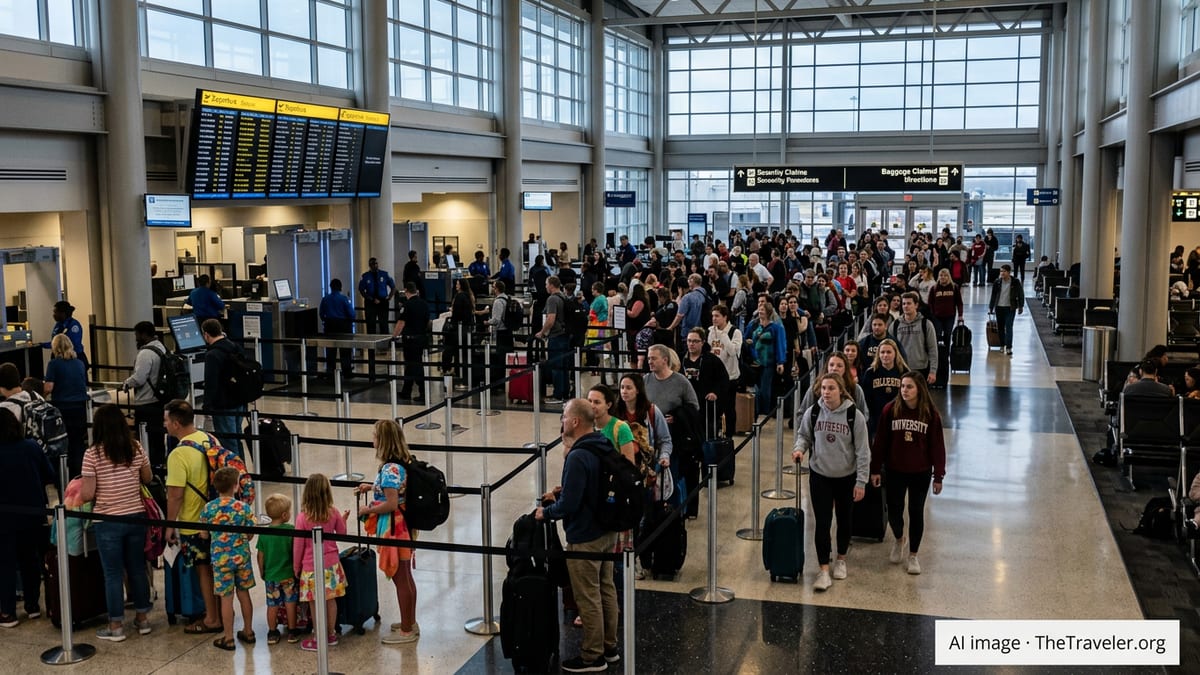
A deepening staffing crisis at Transportation Security Administration checkpoints during the ongoing U.S. government shutdown is rippling through airports nationwide, with reports of hours-long security lines, checkpoint closures and mounting flight disruptions as millions of spring break travelers crowd terminals.
Get the latest news straight to your inbox!
Shutdown Enters Second Month As TSA Strains To Keep Checkpoints Open
The latest partial federal government shutdown, which began in mid-February when funding for the Department of Homeland Security lapsed, has pushed roughly 50,000 TSA officers into unpaid status while still requiring most of them to report to work. Publicly available information indicates that as the weeks have stretched on, more staff are calling out or leaving the agency entirely, triggering noticeable gaps at airport checkpoints.
Recent coverage from national and local outlets describes TSA screening operations under sustained pressure as the shutdown enters its second month. Some airports have consolidated lanes, shortened checkpoint operating hours or redirected travelers between terminals to keep security lines moving. The TSA continues to process millions of passengers a day, but the margin for handling peak surges appears to be shrinking as the staffing pool thins.
Industry groups have warned for years that the agency’s workforce model is vulnerable during funding lapses, because screeners are classified as essential and must work without pay while they wait for Congress and the White House to resolve budget disputes. This year’s impasse is colliding directly with one of the busiest periods on the leisure travel calendar, amplifying its impact on the flying public.
Hours-Long Security Lines Reported At Major Hubs
Across the United States, travelers are reporting wait times that stretch well beyond 90 minutes and, in some cases, past the three-hour mark at standard screening lanes. Coverage from travel and local news outlets highlights severe backups at airports in New Orleans and Houston, where security lines have snaked through concourses and into terminal lobbies during peak periods.
Similar, though sometimes shorter, delays have been noted at other large hubs including Atlanta and Charlotte, according to regional reporting. Some mid-sized airports, such as those in Dallas and Richmond, have so far avoided the worst of the backups but are warning that conditions could deteriorate quickly if more officers fail to report for shifts.
Travel-focused publications also note that long lines are not confined to any single time of day. Early-morning departures, which typically see heavy business and leisure traffic, are running up against the limits of how early checkpoints can open when staffing levels are constrained. Afternoon and evening peaks are likewise testing the reduced number of open lanes, leaving many passengers facing unexpectedly long waits regardless of when they arrive.
Flight Delays, Missed Connections And A Strained Aviation System
While TSA officers do not control flight operations, bottlenecks at checkpoints are starting to ripple into airline schedules. When large numbers of passengers are still in security lines near departure time, airlines face a difficult choice between delaying flights or leaving seats empty. Recent national coverage describes thousands of delays and cancellations across the country, with severe weather compounding the effects of the shutdown-related staffing crunch.
Industry analysts note that even modest slowdowns at security can have outsized effects when terminals are already operating near capacity. Gate areas fill more slowly, boarding begins later and crews can run up against duty-time limits if flights are repeatedly held. At some airports, airlines are adjusting minimum connection times and advising travelers to build in extra buffer between flights, particularly when connecting between terminals that require rescreening.
Airline trade groups and travel associations are publicly pressing Congress to restore stable funding for Homeland Security, arguing that prolonged disruption at the front end of the travel experience undermines confidence in the broader aviation system. Economic estimates cited in recent analyses suggest that hours of cumulative delays across millions of passengers could translate into hundreds of millions of dollars in lost productivity and spending.
Spring Break Crowds Turn A System Under Stress Into A Travel Gauntlet
The timing of the shutdown is magnifying its effect. March and early April are peak months for spring break travel, with airports in Florida, Texas, Nevada and major coastal gateways all expecting record or near-record volumes. Local coverage from tourist hubs such as Orlando, Miami and Houston describes terminals bracing for surges of families, college students and international visitors on top of already heavy baseline traffic.
Several airport operators have issued advisories urging travelers to arrive at least three hours before domestic departures and up to four hours before international flights, citing both the shutdown and spring break crowds. In some cases, airports have warned that standard guidance based on historical averages may no longer apply, as checkpoint throughput has become less predictable from day to day.
Popular tools that travelers rely on to gauge real-time conditions are also less dependable during the shutdown. Travel reporting notes that TSA’s own wait-time data, including estimates available through the MyTSA mobile app, may not be consistently updated during the funding lapse. That uncertainty makes it harder for passengers to calibrate arrival times, leading many to overcompensate by arriving extremely early and further crowding check-in and security areas.
Uneven Impact Across Airports And A Growing Debate Over Resilience
The disruptions are not uniform nationwide. Some airports, particularly those with newer terminals, more flexible lane layouts or supplemental private security arrangements, are managing to keep wait times closer to typical levels even with fewer federal screeners on duty. Others, often older facilities with constrained checkpoints or rapidly growing passenger counts, are feeling the strain more acutely.
This uneven picture is fueling a broader policy debate about how resilient the U.S. aviation security system should be in the face of recurring funding standoffs. Travel industry groups and some policymakers are pointing to the current crisis as evidence that critical functions such as passenger screening should be insulated from political impasses, whether through alternative funding mechanisms, expanded use of private contractors under federal oversight, or statutory protections for key programs like TSA PreCheck and Global Entry.
For now, spring break travelers are bearing the brunt of the instability. Reports from across the country describe families camping on terminal floors after missed flights, students scrambling to rebook connections and business travelers abandoning trips rather than risk multi-hour waits. With no clear timeline for a political resolution, airports, airlines and passengers are being forced to adapt day by day to a security system stretched close to its limits.