

More news on this day
A deepening funding standoff in Washington is rippling across the United States air travel system, with transportation analysts warning that prolonged strain on Transportation Security Administration staffing could push some smaller commercial airports toward temporary closure just as the busy spring travel season accelerates.
Get the latest news straight to your inbox!
Funding Lapse Pushes TSA to the Breaking Point
The Department of Homeland Security funding lapse that began in mid-February has left tens of thousands of Transportation Security Administration employees working without pay while handling rising passenger volumes. Publicly available information shows that unscheduled absences, low morale and attrition among screeners are mounting as the shutdown drags into its second month.
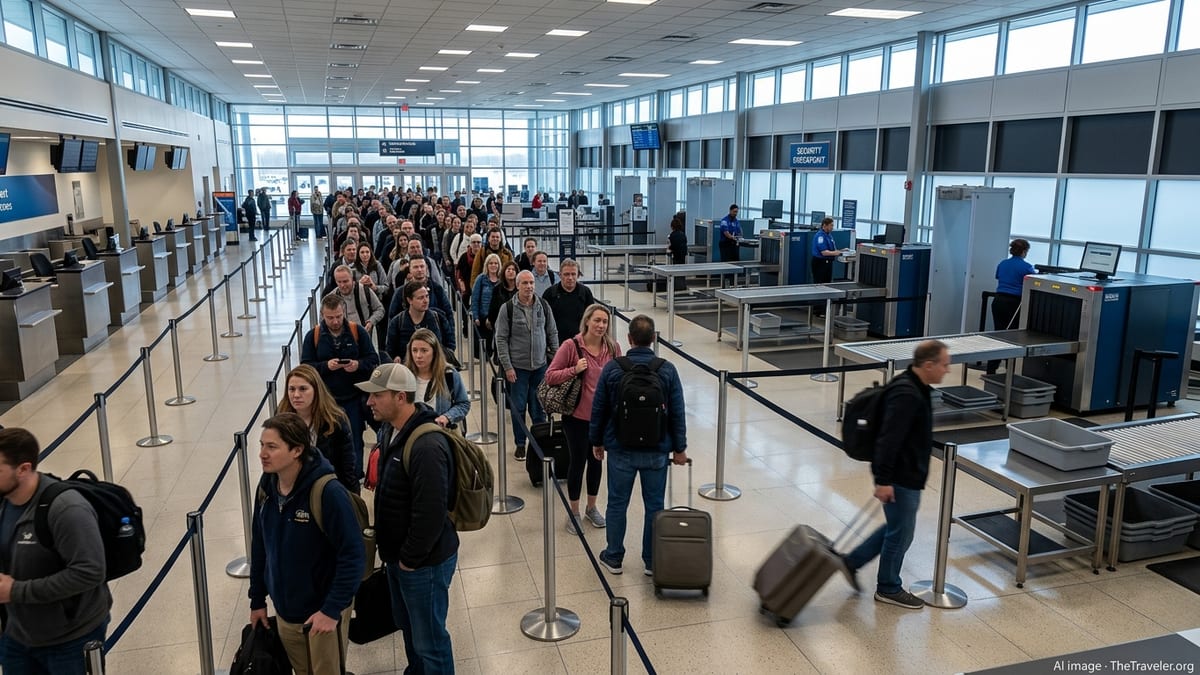
Coverage from national outlets indicates that TSA officers have been reporting sick in growing numbers at major hubs, leading to the consolidation of checkpoints and the closure of some screening lanes during peak periods. In several cases, travelers have reported standing in lines that stretch into parking structures, with waits of two to three hours becoming more common at the largest airports.
Operational updates from airports and industry groups describe a system under sustained stress but still functioning. Air traffic control remains funded separately, and airlines continue to operate full schedules. However, the constraint at the security checkpoint has become the choke point, threatening to transform a political stalemate in Washington into a nationwide customer service crisis just as spring break, March college basketball tournaments and early season leisure travel converge.
Aviation-focused analysis suggests that the longer TSA officers are unpaid, the more likely it becomes that additional staff will seek other employment, further weakening the agency’s ability to rebuild capacity even after Congress restores funding. That prospect is particularly worrying for the smallest commercial airports that have little redundancy in their security staffing models.
Small Airports Face Outsized Risks
While headlines have largely focused on marathon lines at the nation’s biggest hubs, experts warn that small and mid-sized airports could bear the brunt of a prolonged TSA disruption. Many regional facilities operate with only a handful of screening lanes and rely on a relatively small contingent of federal officers to process all departing passengers.
Industry commentary notes that if even a few TSA officers at a small airport are unable or unwilling to work without pay, management may have no practical way to keep checkpoints open at all hours. Unlike large hubs, regional airports cannot easily reassign staff from other terminals, and some lack the infrastructure to consolidate multiple checkpoints into a single screening area.
Recent warnings highlighted in policy and transportation coverage suggest that airport closures, while not yet widespread, are considered plausible at smaller fields if absenteeism climbs further. Analysts point out that these facilities typically serve communities with limited alternative transportation options, meaning any temporary shutdown of TSA operations could effectively halt all commercial service.
Travel organizations have been raising alarms about the economic consequences of such a scenario. Prior studies of earlier shutdowns estimated that each day of significant disruption to air travel could cost the broader U.S. travel economy hundreds of millions of dollars, with small communities disproportionately affected as visitors, business travelers and conference delegates are forced to reroute or cancel trips entirely.
Spring Travel and Event Season Amplify the Stakes
The timing of the TSA funding crisis is particularly damaging. Spring break travel is in full swing, NCAA basketball tournaments are drawing fans across the country, and the United States is preparing for a surge of international visitors ahead of major summer events, including the FIFA World Cup matches scheduled in multiple host cities.
Travel surveys conducted ahead of 2026 indicated that a large share of Americans planned at least one domestic flight this year, with many trips clustered in March and April. As these plans collide with reduced checkpoint capacity, travelers are being advised in various consumer reports to arrive far earlier than usual, in some cases three hours before domestic departures and four hours before international flights.
Weather-related disruptions and routine operational hiccups are compounding the pressure. Recent storms across the eastern half of the United States triggered thousands of delays and cancellations, leaving already stretched TSA teams to deal with rolling waves of rebooked passengers. When flight schedules are compressed into small operational windows after storms clear, the security bottleneck becomes even more acute.
Major airline executives, in open letters and public statements, have urged policymakers to restore predictable funding for Homeland Security and stabilize staffing at airport checkpoints. They argue that prolonged uncertainty threatens not only passenger convenience but also the reputation of the United States as a reliable gateway for global tourism and business travel.
Travel Industry and Local Leaders Search for Stopgaps
Within the travel sector, trade associations, airport operators and tourism boards are stepping up pressure on lawmakers while also exploring contingency measures. Some large airports and local charities have organized support drives for unpaid federal workers, including TSA officers, in an effort to ease immediate financial strain and discourage further resignations or sickouts.
Policy discussions reported by aviation and government affairs outlets suggest renewed interest in long-debated proposals to buffer critical aviation functions from future funding lapses. Ideas range from creating dedicated trust funds for aviation security and air traffic control to authorizing limited fee increases that would flow directly to essential staff payrolls during a shutdown.
At the local level, airport authorities are reviewing options that could preserve operations if TSA staffing thins further. A handful of airports that already use private contractors under federal oversight are being closely watched as potential models, although labor organizations and some security experts caution that broad privatization could create new challenges and inequities between large and small markets.
For smaller airports that lack the leverage of major hubs, the room to maneuver is far narrower. Many are dependent on a single daily route or a limited set of regional connections. If screening cannot be maintained to federal standards, even for a few days, those flights may be suspended, eroding passenger confidence and making it harder to restore traffic once normal operations resume.
What Travelers Can Expect in the Weeks Ahead
With no immediate resolution guaranteed, travelers heading into and through the United States in the coming weeks are being urged by consumer advocates and travel advisors to plan for disruption. That includes building in extra time for security, considering very early morning or late-night departures when lines may be shorter, and, where possible, choosing airports that have shown more resilience during the current funding crisis.
Reports from some secondary airports, for example in parts of the Mountain West, indicate that shorter lines and less congestion have so far kept operations relatively smooth, offering alternatives for travelers willing to drive farther to depart from a smaller field. However, analysts warn that if TSA staffing pressures intensify, these airports could quickly shift from welcome relief valves to the first casualties of forced closures.
For now, aviation safety standards remain unchanged, and there is no indication from public reporting that the security protocols themselves have been relaxed. The central question facing the industry is whether the system can maintain those standards without significant loss of capacity at the most vulnerable airports if the shutdown extends further into the spring and early summer.
As negotiations in Washington continue, travel industry leaders and local officials across the country are bracing for a pivotal period. The coming weeks will determine whether the current strain settles into a difficult but manageable status quo or tips smaller airports into the kind of forced shutdowns that would mark a new and more severe phase of the crisis.