

More news on this day
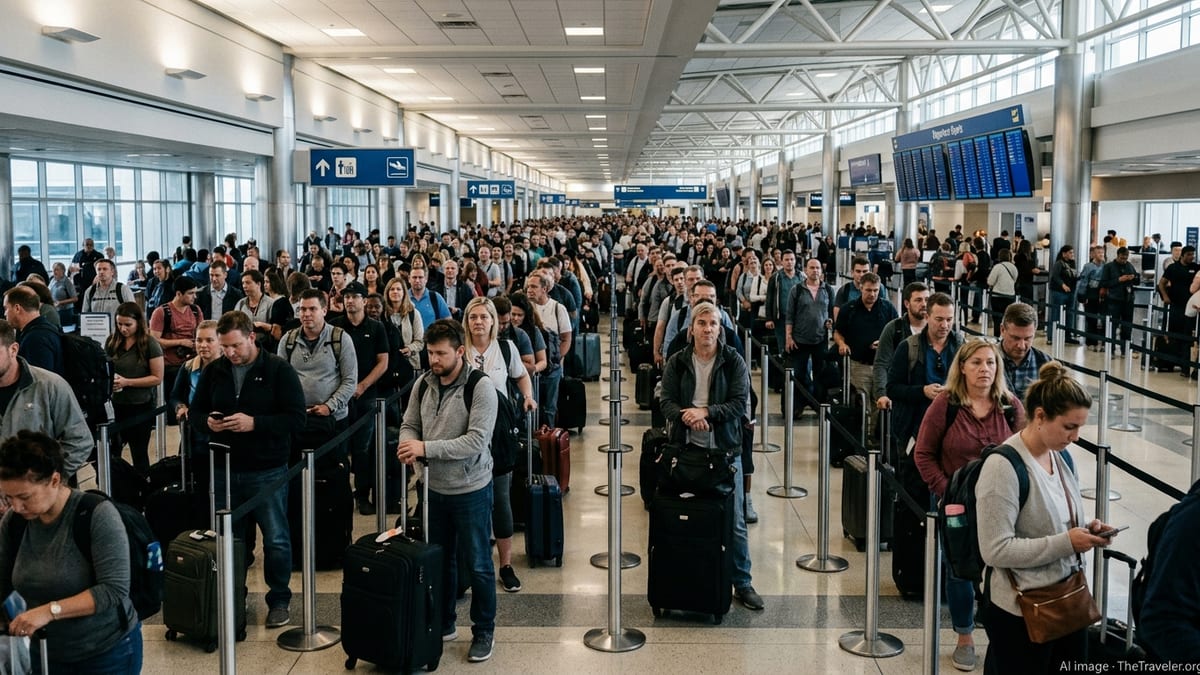
A deepening standoff in Washington over government funding has spilled dramatically into the nation’s airports, with a partial shutdown curbing Transportation Security Administration capacity, producing security lines stretching for hours, more than 1,300 delayed flights in a single day, and a mounting wave of fury from stranded travelers.
Get the latest news straight to your inbox!
Security Bottlenecks Stretch From Houston to Atlanta
Published coverage and traveler accounts indicate that some of the worst congestion is emerging at the country’s busiest hubs, where even modest staffing gaps at security checkpoints rapidly cascade into hours long queues. At Houston’s Bush Intercontinental Airport, travelers reported waits approaching two to three hours at peak periods this week as limited TSA lanes struggled to process heavy spring travel demand.
Similar patterns have appeared intermittently at airports serving Atlanta, New Orleans and other large metropolitan areas, where normal midweek traffic has collided with a reduced roster of screening officers. In some locations, lines have reportedly snaked into terminal curbside areas, forcing airport staff to redirect crowds and reconfigure stanchions simply to keep passengers inside secure zones.
While not every major airport is experiencing extreme delays at the same time, the shutdown has introduced a volatile new variable into trip planning. On certain mornings and evenings, travelers report breezing through checkpoints in under 20 minutes, only for the same checkpoints to devolve into multi hour logjams later in the day when staffing thins or sick calls spike.
The uneven conditions have turned once predictable security routines into guesswork, particularly at large hubs where connections hinge on tight schedules. Some passengers have begun arriving four hours early for domestic flights, only to find either near gridlock or surprisingly short lines, underscoring how fragile the system has become under shutdown pressures.
Flight Delays Mount as Gridlock Ripples Across the Network
As security lines lengthen, the impact is increasingly visible on departure boards. Flight tracking data cited in national coverage shows more than 1,300 delays nationwide on one recent day linked in part to staffing shortages in the aviation system, with the shutdown amplifying an already busy travel period.
When large numbers of passengers remain stuck in security while boarding times approach, airlines face a difficult choice: hold flights and risk downline disruptions, or depart partially empty and rebook late arriving travelers. In practice, carriers appear to be mixing both approaches, leading to rolling delays that can ripple across hubs for hours.
Those knock on effects are particularly acute at sprawling connecting hubs such as Atlanta and Houston, where a late arriving aircraft or crew can disrupt onward flights across the country. According to publicly available operational data, clusters of late departures have been most pronounced in the late morning and early evening banks, the times when connections are heaviest and security queues most likely to collide with tight schedules.
Weather has further complicated the picture. Recent storm systems in parts of the Midwest and East Coast have already thinned buffer times built into airline schedules. With the shutdown simultaneously constraining staffing for both security screening and air traffic functions, even routine disruptions can now tip entire regions into widespread delay.
Airlines and Airport Leaders Turn Up Pressure on Washington
Industry voices are increasingly framing the airport turmoil as a direct consequence of political stalemate in the capital. In an open letter circulated this week, chief executives of several major US passenger and cargo airlines urged Congress to restore full funding for the Department of Homeland Security and enact longer term protections for federal aviation workers who are currently expected to report to duty without pay.
The letter, highlighted in national business coverage, warned that treating TSA officers and air traffic controllers as “political footballs” in recurring funding battles is undermining reliability across the air travel system. The executives argued that predictable financing for aviation safety and security functions is essential not only for passenger confidence, but also for the broader US economy, which depends on stable air links for tourism, business travel and freight.
Airport operators are also sounding alarms. Trade groups representing airports have circulated analyses suggesting that prolonged shutdown conditions could drive up costs for terminal operations and concessionaires, who must cope with erratic passenger flows and extended operating hours. Some local airport authorities have begun deploying their own staff to assist with crowd management and wayfinding, particularly at checkpoints where lines spilled into ticketing and baggage claim halls.
The appeals underscore growing concern that the current episode could echo or exceed previous shutdown related aviation disruptions, which saw ground stops, chronic delays and reduced capacity at some of the nation’s busiest airports when staffing shortfalls became severe.
Travelers Caught in the Middle Weigh Tough Choices
For passengers, the shutdown has introduced a new layer of uncertainty atop the usual stresses of modern air travel. Social media posts and traveler forums have filled with images of crowded serpentine lines, missed flights and families camped out on terminal floors, alongside scattered reports from smaller airports where operations appear closer to normal.
Some travelers describe adjusting their plans by booking earlier departures, shifting from connections to nonstop flights where possible, or choosing alternative airports in the same region that appear to be handling the disruption more smoothly. Others are opting to avoid flying entirely for shorter trips, turning instead to long distance driving or intercity rail to sidestep the risk of being stranded in an overcrowded terminal.
Travel advisors are urging clients to build in additional buffer time for every stage of the journey. Recommendations commonly include arriving at the airport at least three hours before domestic departures and even earlier for international flights, especially at large hubs that have appeared in national coverage of shutdown related delays. Passengers are also being encouraged to keep carry on baggage as light and organized as possible to speed screening.
Yet these measures can only go so far. For many travelers, particularly those with fixed departure times, family obligations or nonrefundable reservations, there is little choice but to navigate the long lines and rolling delays, hoping that their particular airport and departure window avoids the worst of the staffing crunch.
What the Shutdown Means for the Weeks Ahead
Transportation analysts note that the longer the shutdown continues, the greater the risk that current disruptions will harden into more systemic problems. Extended periods without pay can push experienced TSA officers and other essential federal aviation workers to seek alternative employment, eroding a workforce that requires specialized training and security clearances.
That attrition risk is especially serious at the largest hubs, where the volume of passengers and complexity of operations demand high staffing levels. If even a modest fraction of trained screeners or controllers exit the system, rebuilding capacity could take months, potentially prolonging delays long after lawmakers resolve the immediate funding dispute.
At the same time, there are signs of resilience. Some airports continue to report relatively normal wait times despite the shutdown, suggesting that local staffing levels, scheduling strategies and passenger volumes can mitigate the worst impacts. Travel data shows that security wait times can vary dramatically not only from airport to airport, but also from hour to hour within the same facility.
For now, the outlook for US air travel remains closely tied to the pace of negotiations in Washington. Until a funding agreement emerges that restores stable pay and staffing for TSA and related agencies, passengers heading to the airport may need to pack additional patience along with their carry ons, and treat every trip as vulnerable to the kind of sudden, cascading disruption now visible on departure boards across the country.