

More news on this day
Long security lines, missed flights and frayed tempers are becoming a defining feature of air travel in the United States as the Department of Homeland Security shutdown stretches into its seventh week and Transportation Security Administration staffing remains under intense strain.
Get the latest news straight to your inbox!
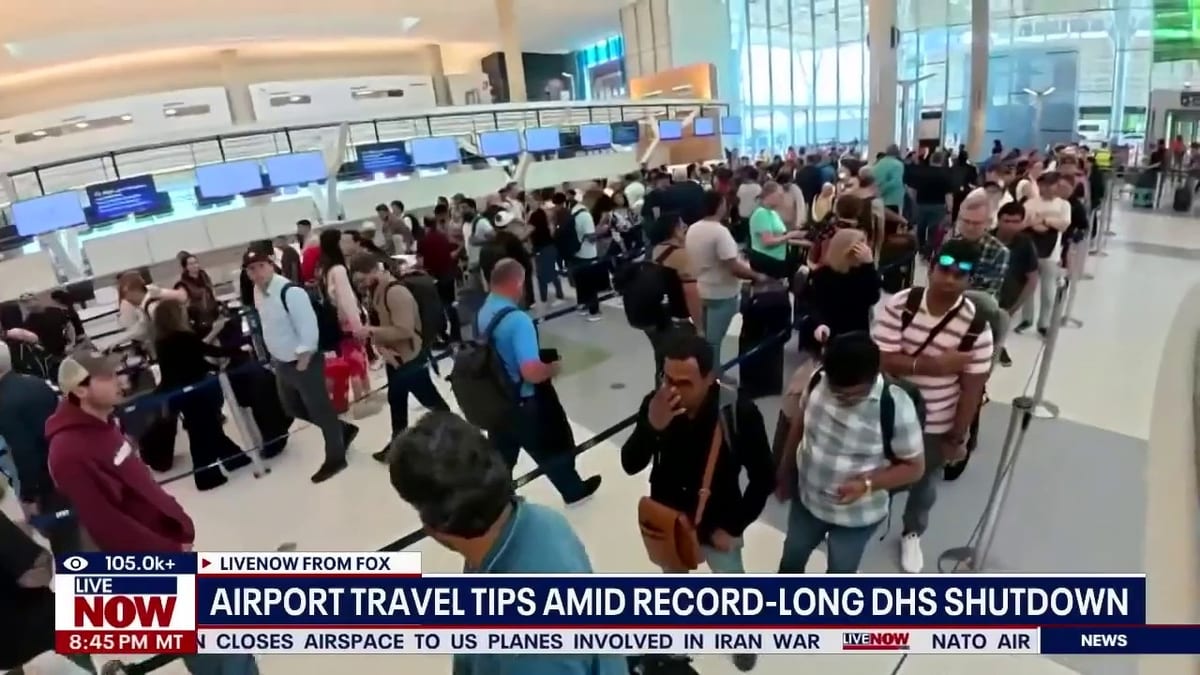
Image by livenowfox.com
Shutdown leaves TSA workforce unpaid and under pressure
The current Department of Homeland Security funding lapse began on February 14 and has forced tens of thousands of TSA officers to continue working without pay. Publicly available information indicates that this is the second federal funding disruption for many of these workers in less than a year, following the broader 2025 government shutdown. The prolonged uncertainty has intensified financial pressure on front line staff who are required to maintain airport security operations despite missing multiple paychecks.
According to published coverage, more than 400 TSA officers have resigned since the DHS shutdown began, and many more are calling out of work as they juggle unpaid bills, child care and transportation costs. Union statements and media interviews describe officers sleeping in cars, falling behind on rent and struggling to afford basic expenses, circumstances that are feeding higher absence rates and accelerating attrition.
In response to mounting hardship, President Donald Trump signed an executive action in late March to redirect DHS funds so that TSA employees could begin receiving pay again, even as the wider shutdown continues. Reports indicate that overdue paychecks may reach officers this week, but back pay alone is not expected to quickly reverse the exodus of experienced screeners or erase the impact of weeks of missed income.
Analysts note that TSA was already coping with the aftershocks of earlier federal workforce cuts, which reduced staffing levels across several agencies in 2025. The shutdown has collided with this leaner baseline, making it more difficult for airports to absorb callouts or resignations without visible effects on checkpoint capacity and passenger wait times.
Record wait times and uneven impacts across major airports
Travelers at some of the country’s busiest hubs are encountering what several outlets describe as the longest TSA wait times on record. At Houston’s George Bush Intercontinental Airport, lines in recent days have stretched outside terminal doors, with reports of passengers waiting three to four hours to clear security. Only a fraction of the usual checkpoints have been staffed during peak periods, forcing airlines to warn customers to arrive far earlier than normal.
Similar scenes have been documented at major gateways including Atlanta’s Hartsfield-Jackson, New York’s LaGuardia and airports around the Washington region. Published coverage describes serpentine queues snaking through concourses, with bottlenecks at document-check stations and standard screening lanes. Missed flights, cascading delays and gate changes are becoming more common as carriers attempt to rebook passengers who never make it past security in time for departure.
The impact is not uniform, however. Local reporting from Minneapolis-St. Paul, for example, indicates that the airport has so far avoided the worst congestion, with most travelers clearing security in under 30 minutes. Airport officials there credit a combination of staffing coordination with TSA, flexible lane configurations and lower-than-expected callout rates. These contrasts highlight how local management practices, passenger volumes and baseline staffing levels can either cushion or amplify the shock of a national-level disruption.
Industry groups warn that the timing of the shutdown is especially problematic for airlines and airports, coming just as the spring break travel period ramps up and ahead of a busy summer season. With more passengers funneled through fewer open lanes, even modest spikes in demand are producing outsized delays, and experts caution that chronic understaffing could ripple into flight schedules and crew duty-time limits well beyond the security checkpoint itself.
ICE deployment underscores political and operational tensions
As wait times climbed in mid-March, the White House directed Immigration and Customs Enforcement to send personnel to airports around the country to support stretched TSA operations. According to news coverage and advocacy group statements, ICE officers have been dispatched to at least a dozen large and mid-sized airports, including Houston, Phoenix Sky Harbor and others, where they have been spotted assisting with crowd control and identity checks in security lines.
Administration statements cast the move as a way to alleviate long lines created by shutdown-related callouts. However, current and former TSA officials quoted in multiple outlets question how much relief ICE can provide, noting that ICE personnel do not receive the same specialized training in passenger screening, x-ray analysis and explosives detection as TSA officers. Some experts characterize the deployment as largely symbolic, contending that the presence of ICE officers may help manage queues but does little to expand the number of fully qualified screeners available to staff checkpoints.
The decision has also stirred broader political controversy. Civil liberties advocates and some worker representatives argue that bringing additional immigration enforcement officers into security areas risks heightening anxiety among immigrant and mixed-status travelers, especially at a moment when tensions over immigration policy and DHS funding are central to the shutdown itself. They contend that the measure blurs the line between aviation security and immigration enforcement in ways that could deter some travelers from flying.
Despite these concerns, federal agencies have not laid out a clear timetable for when ICE personnel will withdraw from airports or how long the current level of augmentation will continue. As negotiations over DHS funding grind on, the temporary patchwork of ICE support has become another visible symbol of a system straining to keep air travel moving during a political standoff.
Partial pay fix unlikely to resolve long-term staffing challenges
Policy analysts and travel industry observers widely describe the executive action to resume TSA pay as an important but incomplete step. While back pay may reduce short-term financial stress for officers who have stayed on the job, reports emphasize that many who resigned during the shutdown are unlikely to return, and the agency faces a lengthy process to recruit, clear and train replacements.
Even before the current crisis, TSA had struggled with high turnover, relatively low pay compared with other federal law enforcement roles and demanding schedules that include pre-dawn and late-night shifts. The experience of working extended periods without pay during repeated shutdowns is expected to further erode morale and make it harder to attract new recruits, particularly in high-cost metropolitan areas where private-sector security jobs may offer more predictable income.
Experts point out that new hires typically require weeks of classroom and on-the-job training before they can fully staff checkpoints, meaning any hiring surge that follows a shutdown resolution will lag far behind immediate operational needs. Publicly available assessments from think tanks and aviation consultancies suggest that, even if Congress restores DHS funding in the near term, elevated wait times could persist into the peak summer travel months as airports adjust to thinner rosters and less experienced personnel.
The episode is also prompting renewed debate in Washington and within the aviation industry over whether TSA’s core screening function should be insulated more fully from future shutdowns. Proposals discussed in policy circles include creating automatic funding backstops for critical security roles, expanding the use of private screening contractors under federal oversight, and revisiting pay scales and career paths for TSA officers to reduce chronic turnover.
Travelers adapt as uncertainty clouds the months ahead
With no immediate resolution to the DHS shutdown in sight, airlines, airports and travelers are adjusting to a new normal of unpredictable security wait times. Carriers are issuing advisories urging passengers to arrive at airports even earlier than standard recommendations, particularly at large hubs that are reporting the highest rates of TSA callouts. Some airports are consolidating checkpoints, encouraging greater enrollment in expedited screening programs and reconfiguring queue layouts in an effort to squeeze more throughput out of limited staffing.
Travel trade groups note that while the United States aviation system remains safe, the reliability of the passenger experience has clearly deteriorated. Business travelers facing tight connections and families traveling with children are among those most affected by extended lines and last-minute gate changes. Tourism officials in affected cities warn that prolonged disruption could dampen demand for conferences and leisure trips if travelers begin to view U.S. airports as consistently chaotic.
For now, publicly available data and media reporting portray a system held together by workarounds and extraordinary efforts from unpaid or recently re-paid federal employees. How quickly conditions improve will depend not only on the eventual outcome of DHS funding negotiations, but also on whether policymakers move to address the deeper structural weaknesses in TSA staffing and pay that the shutdown has laid bare.