

More news on this day
U.S. air travelers are bracing for a difficult spring as the latest Department of Homeland Security funding lapse deepens a staffing crunch at Transportation Security Administration checkpoints, leaving tens of thousands of federal screeners working without full pay while lines lengthen and schedules fray at major airports nationwide.
Get the latest news straight to your inbox!
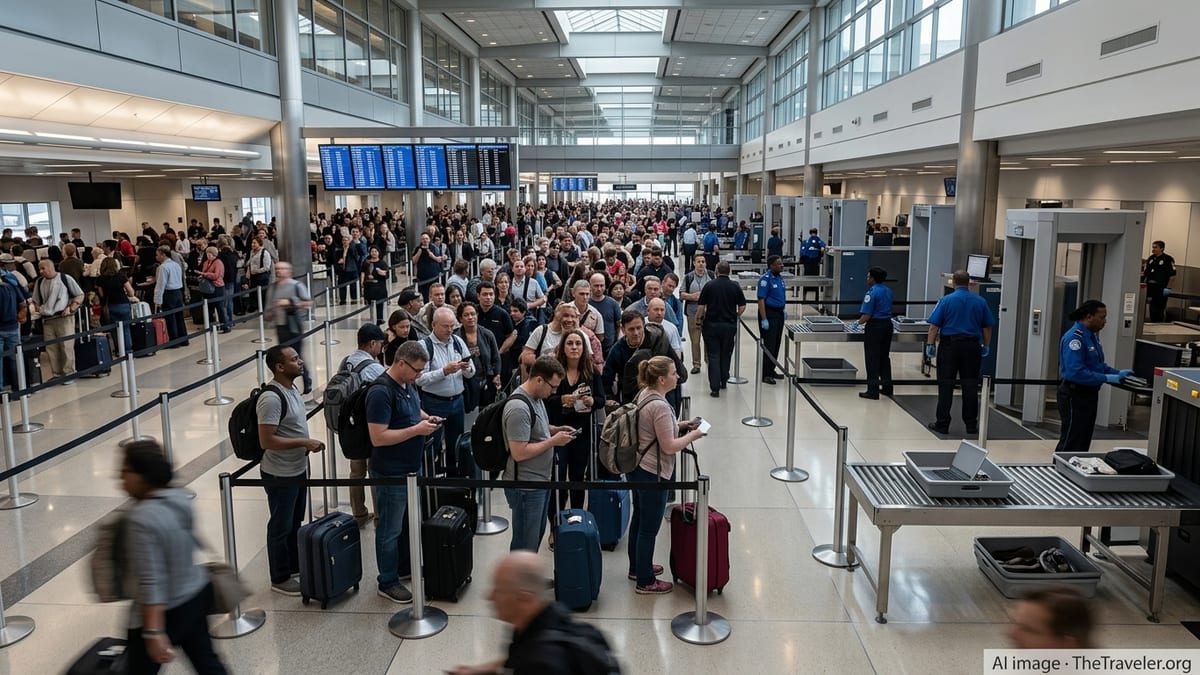
Shutdown Enters Second Month As TSA Workforce Frays
The current partial shutdown affecting the Department of Homeland Security, in place since mid-February 2026 after Congress failed to agree on new funding, is now colliding with the start of the spring break travel rush. Publicly available information shows that roughly 50,000 TSA employees have been classified as essential and ordered to keep working even as their paychecks are delayed, reviving memories of the 2018 to 2019 and 2025 funding standoffs that strained airport operations.
Published coverage indicates that the financial pressure on front line screeners is mounting. Reports from national outlets describe officers turning to food banks and community donation drives to cover basic expenses, while nonprofit groups and airport partners in cities such as San Diego are organizing regular distributions of groceries for TSA staff and other unpaid federal employees. Union leaders have warned in recent days that the combination of missed pay and high stress is fueling burnout.
The stress is already visible in attrition figures. According to recent reporting that cites Department of Homeland Security data, at least several hundred TSA officers have resigned since the shutdown began on February 14, with total quits since the start of the year surpassing 300 at one point this month. That is on top of historically high turnover at the agency, which has long struggled with comparatively low pay and demanding schedules.
While the majority of checkpoints remain open, the loss of experienced screeners and a rise in unscheduled absences are forcing managers to shuffle staff, consolidate lanes and rely more heavily on overtime. Travel analysts note that such measures can keep average wait times manageable on some days, but they leave the system more vulnerable to sudden spikes in passenger volume or weather disruptions.
Long Lines Hit Key Hubs As Spring Break Crowds Arrive
In the last week, travelers at several major airports have reported volatile and sometimes severe delays at security checkpoints. Recent coverage from national and local outlets describes hours long waits at Houston’s largest airport during the morning rush, with some passengers missing flights and others racing through terminals after sprinting from the end of snaking lines. At Atlanta, the world’s busiest hub by passenger volume, a mix of storms, checkpoint closures and staffing gaps has periodically slowed traffic to a crawl.
Other big gateways are also feeling the strain. Regional reporting from Denver and other Rocky Mountain airports notes that already tight staffing is being tested by heavy spring break demand, with travel planners advising passengers to arrive significantly earlier than usual. Travel industry commentary suggests that even modest increases in callouts can ripple quickly through larger facilities, where a handful of closed lanes can add 30 minutes or more to peak time waits.
Not every airport is seeing the same level of disruption. Medium sized facilities such as Colorado Springs have so far avoided the worst of the chaos, and some airports that rely on private contractors under TSA’s Screening Partnership Program, such as San Francisco International, have been less directly exposed to the federal pay freeze. Still, these outliers underscore how uneven the experience has become for travelers moving through different parts of the network.
Technology and data are offering only limited relief. TSA publishes historical and real time wait estimates for some hubs, and consumer technology outlets have pointed travelers toward third party apps and airline alerts as ways to spot emerging bottlenecks. Yet with staffing levels in flux and callout rates shifting from one day to the next, analysts caution that wait forecasts are less reliable during an extended shutdown.
ICE And Other Federal Personnel Shifted Into Airports
The White House is now taking the unusual step of redirecting other federal personnel to help stabilize airport screening. According to recent reporting from Axios and other outlets, President Donald Trump announced on Sunday, March 22, that Immigration and Customs Enforcement officers will be deployed to U.S. airports beginning Monday to assist TSA operations while negotiations over Homeland Security funding continue.
Publicly available details suggest that ICE officers will support non screening functions to free up trained TSA staff for front line security tasks. Homeland Security leaders have previously signaled that they are exploring cross agency support measures in order to keep checkpoints open and mitigate the worst delays, even as they emphasize that only certified officers can operate screening equipment or make certain security judgments.
Travel experts note that the arrival of additional federal agents may help relieve congestion at some high volume hubs, particularly during morning and evening peaks. However, they also point out that these stopgap measures do not address underlying attrition and morale problems at TSA, where officers have now experienced multiple shutdowns in less than a year. Some aviation analysts warn that relying on emergency staffing fixes can create logistical complexity inside terminals and confusion for passengers about who is in charge at checkpoints.
The visibility of more uniformed personnel in airports may also have mixed effects on traveler sentiment. While some passengers may feel reassured by a larger law enforcement presence, others could interpret the moves as a sign that the federal government is improvising its way through a prolonged funding crisis rather than restoring normal operations ahead of one of the busiest travel periods of the year.
Uneven Impact On Airlines, Routes And Regional Travelers
So far, there has been no nationwide wave of outright airport closures tied directly to TSA staffing, but the operational knock on effects of the shutdown are increasingly evident in airline schedules. Data highlighted by aviation trackers and local news outlets shows clusters of delays and cancellations at major hubs where weather, tight crew availability and stretched security lines intersect, particularly in the Southeast and Midwest.
Carriers are adjusting in real time, at times holding departures to allow more passengers to clear security, consolidating lightly booked flights and re timing some services to avoid the heaviest checkpoint congestion. Airline statements reviewed in recent coverage emphasize that most cancellations remain tied to weather and broader operational issues, but analysts say it is becoming harder to fully separate those factors from the chronic strain on federal airport staffing.
For travelers in smaller markets, the picture can be even more fragile. Industry commentary notes that short haul flights connecting through big hubs are particularly vulnerable when departure banks back up, since missed connections can strand passengers until the next available flight, which may not depart until the following day. Communities dependent on a single carrier or limited daily frequencies may therefore feel the fallout of TSA related slowdowns more acutely than travelers in large coastal cities.
There are also growing concerns north of the border and abroad. Canadian transportation observers have warned that prolonged delays at U.S. departure points could disrupt itineraries for passengers flying onward to Canadian destinations or transiting U.S. hubs on international journeys. Because many overseas flights rely on tight connection windows through American airports, even modest increases in security wait times can cascade through long haul networks.
What Spring 2026 Travelers Can Expect In The Weeks Ahead
With Congress still deadlocked over Homeland Security funding and no firm end date in sight for the shutdown as of March 22, 2026, travel analysts are increasingly blunt about the outlook for the coming weeks. Public guidance from aviation experts and travel industry groups suggests that passengers should be prepared for unpredictable security wait times, sporadic checkpoint closures and localized flare ups of delays as spring break peaks in late March and early April.
The impact is likely to vary widely by airport and even by time of day. Early morning and late afternoon banks at major hubs remain the most vulnerable to long lines, while some smaller or contractor staffed airports may continue to see relatively normal flows. Analysts recommend that travelers build in substantially more buffer time before departure, particularly if they are checking bags or connecting to international flights.
There is also fresh attention on the limits of popular expedited screening programs. Earlier this year, Homeland Security briefly announced a suspension of TSA PreCheck and Global Entry as part of its shutdown planning before reversing the move after political pushback. Even with those programs still operating, staffing shortages mean that dedicated lanes are not always open, and travelers who typically rely on faster screening are being urged to have backup plans.
For now, much depends on whether lawmakers can reach a funding compromise that restores full pay and staffing to TSA before the summer travel season. Until that happens, the combination of unpaid federal officers, high attrition and surging passenger demand is expected to keep pressure on airport security lines, raising the risk of missed flights, rolling delays and a bumpy start to the 2026 travel year.