

More news on this day
Spring 2026 air travel in the United States is colliding with a worsening Transportation Security Administration staffing crisis and a prolonged federal funding standoff, raising the likelihood of long security lines, missed flights, and widespread schedule disruptions just as millions of travelers head for airports.
Get the latest news straight to your inbox!
Shutdown Enters Second Month as TSA Agents Miss Paychecks
The current Homeland Security funding lapse, which has stretched beyond a month, is now directly hitting the front lines of airport security. Publicly available information shows that thousands of TSA officers are working without full pay, with many reporting financial strain and seeking temporary work elsewhere. The Department of Homeland Security is operating under a partial shutdown framework, requiring most security staff to report for duty even as regular pay cycles are disrupted.
Recent reporting indicates that hundreds of TSA officers have resigned since the shutdown began, while others are increasingly taking unpaid leave or calling out as they juggle rent, food, and childcare costs. Union statements and budget documents describe a workforce that has weathered multiple shutdowns and staffing cuts since late 2024, leaving little cushion for the current disruption. As the shutdown drags on with no immediate resolution, the staffing pipeline that normally backfills vacancies is struggling to keep up.
Earlier federal testimony and planning documents had warned that a lengthy lapse in Homeland Security funding could degrade checkpoint operations just as the spring travel rush began. Those scenarios are now materializing, with contingency plans focused on emergency “surge” staffing, overtime shifts, and reassignments from quieter airports. Aviation analysts say the tools available to TSA are increasingly constrained by the broader fiscal and political impasse in Washington.
Long Lines and Patchy Delays at Major Hubs
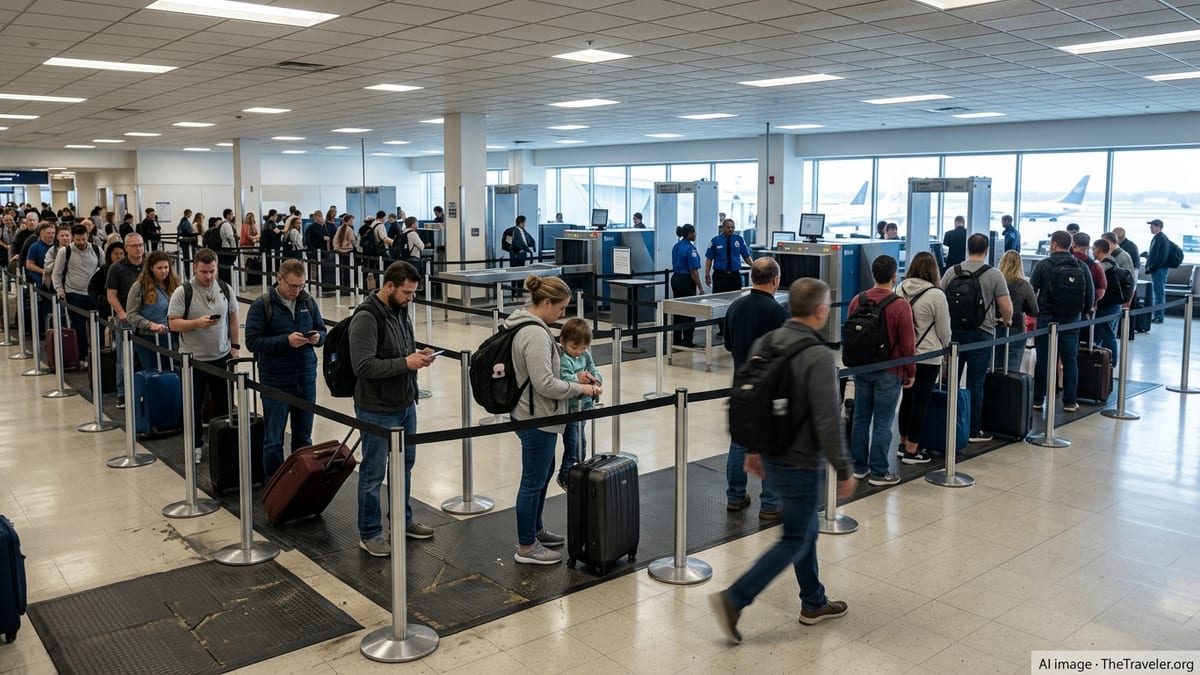
Travelers in recent days have reported widely varying experiences across the country, from near-normal screening times at smaller airports to severe congestion at the nation’s busiest hubs. Published coverage points to Atlanta, Houston, Denver, and other high-volume airports as frequent hot spots, with standard security wait times at some checkpoints stretching past two hours during peak periods. Social media posts and local news segments have shown lines snaking into parking garages and curbside areas at several large facilities.
Airport operations updates suggest that staffing shortages are forcing some security lanes and entire checkpoints to close intermittently, concentrating passengers into fewer open lanes. When compounded by weather issues or runway constraints, these bottlenecks are feeding into broader departure and arrival delays. Flight-tracking services have documented spikes in same-day cancellations and late departures at several major hubs since mid-March, with security-related slowdowns cited alongside storms and air traffic control constraints.
The impact is not uniform. Regional airports and secondary metropolitan fields, including some in Colorado, the Midwest, and the Southeast, are reporting shorter lines and fewer disruptions, in part because their volume is lower and staffing levels have held up better. That uneven picture is complicating travel planning, as historic data and typical “busy day” patterns are less reliable indicators than real-time conditions at individual airports.
Immigration and Other Federal Staff Redeployed to Checkpoints
As the shutdown drags on and TSA attrition grows, the federal government is turning to extraordinary stopgap measures. Recent national coverage describes how immigration officers and other Homeland Security personnel are being reassigned from traditional duties to help manage security lines and crowd control at some large airports. The White House has framed these moves as a way to keep security checkpoints functioning and relieve pressure on unpaid TSA screeners.
The expanded on-site presence of immigration personnel at passenger checkpoints has raised questions from civil liberties advocates and travel industry groups about traveler experience, consistency of procedures, and the potential for confusion over individual roles. Airport briefings and union statements emphasize that core security screening functions remain under TSA’s authority, with reassigned personnel primarily helping with non-screening tasks such as line management and document checks.
Operationally, however, the redeployments underscore the severity of the staffing gap. Budget analyses and workforce reports over the past year have documented both earlier mass layoffs and hiring slowdowns across federal transportation agencies, reducing the system’s ability to absorb another prolonged disruption. With the shutdown still unresolved, experts say these ad hoc measures may steady operations in the short term but cannot fully replace a dedicated, fully staffed TSA workforce.
Spring Break Demand Collides With Constrained Capacity
The timing of the crisis is particularly challenging. Historical travel data and airline schedules show that March and April are among the busiest months of the year for U.S. airports, with family vacations, college spring breaks, and early-season business conferences generating strong demand. Airlines had already upgauged aircraft and added frequencies on popular leisure routes before the funding impasse intensified.
Now, the combination of heavier passenger loads and thinner security staffing is amplifying the risk of missed flights, gate holds, and rolling delays. Aviation analysts note that security-induced chokepoints can ripple throughout the day: early morning slowdowns push departures behind schedule, which then cascade into later banked departures and arrivals. Once aircraft and crews fall out of position, airlines have fewer options to recover quickly, especially on high-demand days when standby capacity is limited.
Several carriers have begun issuing travel advisories that acknowledge the potential for longer security lines and have encouraged customers to arrive much earlier than usual. Policy documents and customer guidance suggest that limited fee waivers or flexible rebooking options may be available when airport security disruptions clearly contribute to missed flights or same-day changes. However, travelers are being cautioned that such waivers are not automatic and will vary by airline, route, and time period.
What Spring 2026 Travelers Should Expect in the Coming Weeks
For Americans planning to fly in late March and April 2026, the emerging picture is one of continued uncertainty rather than uniform chaos. Publicly available wait-time dashboards and airport statements show that some checkpoints are still processing passengers within 20 to 30 minutes outside peak hours, while others are periodically exceeding 90 minutes or more. The day-to-day situation remains highly dependent on local staffing levels, shift patterns, and the evolving course of the shutdown.
Travel technology coverage has highlighted a patchwork of tools travelers can use to track conditions, including official airport wait-time feeds, airline app alerts, and third-party services that aggregate crowd-sourced reports. These resources can help passengers make more informed decisions about when to leave for the airport and which terminal or checkpoint to use, but they cannot fully predict last-minute sickouts or resignations that may alter staffing on a given shift.
Industry watchers caution that if the shutdown extends deeper into the spring peak, more structural impacts could emerge. Possibilities include further reductions in TSA overtime, temporary pauses of some expedited screening lanes at select airports, and increased pressure on airport authorities to reconfigure terminal flows to accommodate overflow queues. In the most severe scenarios outlined in recent policy discussions, aviation leaders have warned that individual airports could face partial closures of checkpoints or periods of drastically reduced throughput if staffing falls below critical thresholds.
For now, the outlook for U.S. air travel heading into Spring 2026 is defined by a fragile balance: a stressed but still functioning system, heavily reliant on unpaid federal workers, temporary reassignments, and day-by-day improvisation at the checkpoint level. Until Congress and the White House agree on a Homeland Security funding solution, travelers are likely to continue encountering longer lines, sporadic delays, and an air travel experience shaped as much by politics as by passenger demand.