

More news on this day
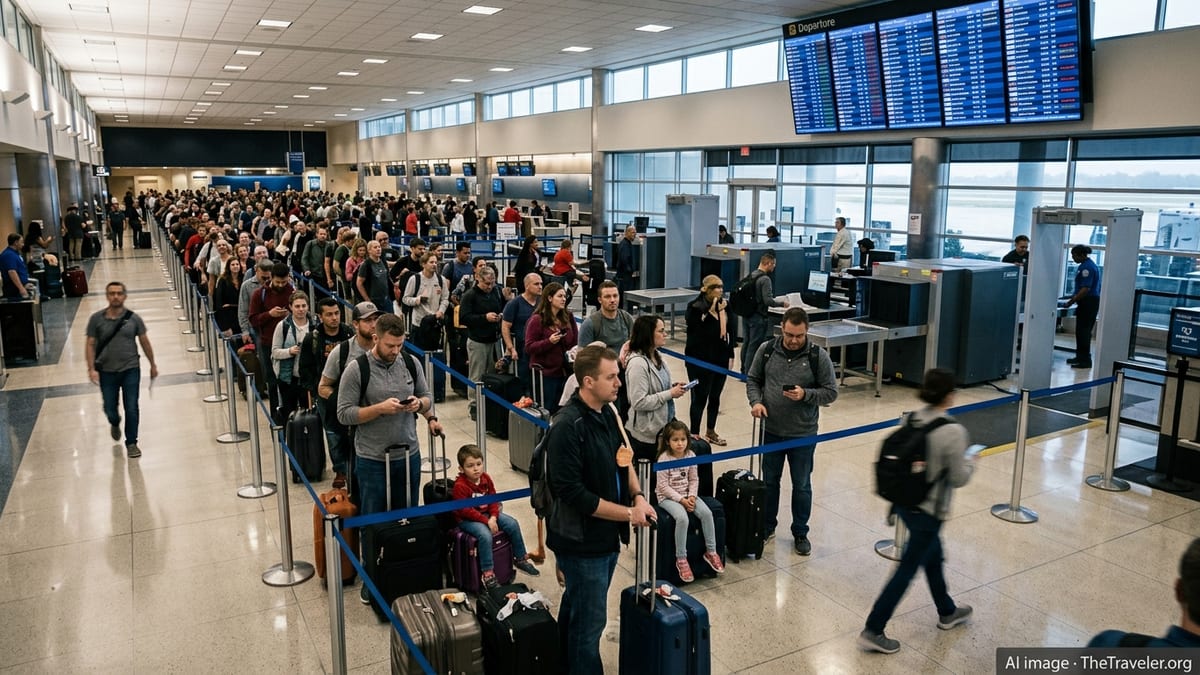
Security lines at several major U.S. airports have stretched for hours in recent days, as a funding lapse affecting the Transportation Security Administration combines with spring travel peaks to create what travelers describe as a cascading breakdown of the nation’s airport screening system.
Get the latest news straight to your inbox!
Houston’s Hobby and Bush Intercontinental at the Center of the Storm
Houston’s two primary airports, William P. Hobby Airport and George Bush Intercontinental Airport, have emerged as focal points of the current disruption. Published coverage and traveler accounts describe domestic security lines at Hobby in particular snaking deep into the terminal on multiple days, with some passengers arriving more than two hours before departure and still missing flights as they inched toward the checkpoint.
Reports indicate that the partial federal government shutdown that began on February 14 has left TSA officers working without pay, amplifying long-standing staffing challenges. Publicly available information from national outlets shows that hundreds of screening officers have resigned since mid-February, while others have taken time off or reduced their availability in order to make up lost income elsewhere. The result at certain airports has been fewer open lanes, inconsistent opening times and unpredictable surges in wait times tied to day-to-day staffing.
At Bush Intercontinental, the picture has been more mixed. Travelers have reported hours-long lines at peak times in some terminals, but substantially shorter waits only hours later as staffing and passenger volumes shift. Online message boards show passengers comparing real-world conditions against official airport wait-time dashboards and finding significant discrepancies, adding a layer of confusion for travelers trying to judge when to arrive.
Local factors have further intensified the strain in Houston. The city’s busy events calendar, including the Houston Livestock Show and Rodeo and spring break traffic, has driven unusually high passenger volumes through Hobby’s compact security area. With only a limited number of screening lanes available, any reduction in TSA staffing has had an outsized effect on throughput compared with larger hubs that have more checkpoint capacity.
Louis Armstrong New Orleans Joins a Growing List of Hotspots
Louis Armstrong New Orleans International Airport has faced similar scenes as the federal funding impasse drags on. Travelers returning from events and spring festivals in the New Orleans area have shared images and descriptions of security lines looping through the terminal and at times extending toward public areas normally used for circulation rather than queuing.
According to published coverage in U.S. media, the pattern in New Orleans resembles what is playing out elsewhere: a lean TSA workforce strained by the loss of paychecks at the same time that seasonal traffic is climbing. The airport serves as a key gateway for both tourism and conventions, and March traditionally brings a sharp uptick in domestic leisure travel that can quickly overwhelm checkpoints when even a small share of officers are absent.
Accounts from passengers arriving from heavily affected airports such as Houston describe a sense of déjà vu when they land in New Orleans and encounter similarly congested security areas for connecting or return flights. While not every day has seen extreme waits, the swings from relatively normal processing times to multi-hour backlogs within the span of a single morning have made planning difficult for both travelers and airlines.
The operational ripple effects are becoming more visible. Longer security queues have triggered delayed departures as crews and passengers struggle to reach gates on time, which in turn has contributed to missed connections at other hubs. Even when flights depart on schedule, the experience of passing through security at a handful of overburdened airports is shaping traveler perceptions of the overall stability of the U.S. air travel system this spring.
Shutdown, Storms and Spring Break Converge
The turmoil at TSA checkpoints is not unfolding in isolation. A powerful mid-March storm system that brought heavy snow to parts of the Midwest and severe weather to the eastern United States has already led to thousands of flight cancellations and delays at major hubs, according to national reporting. Those weather disruptions have collided with the staffing crunch at TSA just as spring break traffic surges through popular leisure gateways.
Data cited in recent coverage from aviation trackers show that hubs such as Atlanta, Chicago and New York experienced widespread delays during and after the storm, with some airports still working through residual disruptions days later. At the same time, the partial government shutdown has continued to pressure security operations in cities where passenger peaks were already expected to be challenging.
For travelers, the convergence of these factors has meant that a smooth experience at one end of a trip does not guarantee the same on the other. Some airports have managed to keep wait times relatively modest even with constrained TSA staffing, while others have lurched from manageable lines to what passengers describe as gridlock in a matter of hours. The unpredictability, rather than any single day’s disruption, is increasingly defining the current episode for frequent flyers.
Industry groups have warned in public statements that the combination of a prolonged shutdown and elevated seasonal demand could erode confidence in air travel if not resolved quickly. Airlines have limited control over checkpoint staffing, but they are bearing the operational costs of missed flights, rebookings and customer service backlogs when passengers cannot reach their gates in time.
Gaps Between Official Information and On-the-Ground Reality
One of the most striking themes emerging from traveler reports is the growing disconnect between official wait-time estimates and actual conditions at certain airports. In Houston and New Orleans, passengers have repeatedly noted that airport websites or app-based dashboards have shown moderate security delays at the same time that lines have stretched far beyond typical checkpoint boundaries.
Some travelers have documented differences of an hour or more between published wait times and their real experience in line. In other cases, information screens at one terminal have understated delays while another checkpoint at the same airport has been relatively empty, suggesting that local staffing adjustments and lane openings are changing too quickly for centralized systems to capture accurately.
According to publicly available commentary from aviation analysts, wait-time estimates often rely on a mix of historical data, staffing plans and sporadic manual updates, which can break down in fast-changing situations like the current one. When officers call out at short notice or when additional lanes are opened to relieve sudden pressure, those changes may not be reflected promptly in public-facing tools.
The resulting uncertainty has led many travelers to adopt a more conservative approach, arriving significantly earlier than usual even for routine domestic flights. While that strategy can help individual passengers reduce their risk of missing a departure, it also pushes more people into airport terminals earlier in the day, which can further swell lines during already busy periods and make forecasting even less reliable.
Airports and Travelers Adjust to a New Level of Risk
As the situation evolves, airports, airlines and passengers are all making short-term adjustments to cope with the heightened risk of delays at security checkpoints. Some carriers have issued broad advisories recommending that travelers arrive at least two to three hours before domestic flights at the most affected airports, citing the combination of spring break volumes, ongoing weather-related disruptions and the impact of the shutdown on TSA staffing.
Airport operators, based on published meeting materials and public briefings, are looking at both immediate and longer-term responses. Short-term measures include reconfiguring queue layouts to handle overflow lines more efficiently, redeploying non-security staff to assist with crowd management and signage, and coordinating with airlines on early check-in and baggage acceptance to spread passenger arrivals over a wider window.
For travelers, the sudden volatility has underscored the importance of building more flexibility into itineraries, particularly when connecting through airports that have emerged as pain points such as Houston and New Orleans. Travel advisers are encouraging passengers to monitor conditions on the day of travel through multiple sources, including airline notifications and real-time accounts from other flyers, rather than relying solely on official wait-time estimates.
With the federal funding impasse still unresolved as of March 21 and TSA attrition continuing to rise, the outlook for a rapid return to normal screening operations remains uncertain. Unless an agreement restores pay for screening officers and stabilizes staffing levels, the scenes playing out at William P. Hobby, George Bush Intercontinental and Louis Armstrong New Orleans are likely to remain emblematic of a U.S. travel system under exceptional strain.