

More news on this day
U.S. air travel faces a deepening threat as the partial shutdown of the Department of Homeland Security drags into its second month, with Transportation Security Administration officials warning that staffing shortfalls could force partial closures at some airports if the standoff in Washington continues.
Get the latest news straight to your inbox!
Mounting Pressure as TSA Works Without Full Pay
The current shutdown, triggered by a lapse in Homeland Security funding in mid-February, has left tens of thousands of TSA officers either working with reduced or delayed pay or facing furloughs. Publicly available information shows that many front-line screeners have already missed at least one full paycheck, while others report smaller pay deposits as back pay and premium shifts stall.
Reports from major hubs and regional airports indicate that sick calls and attrition are starting to rise, echoing patterns seen in earlier federal funding lapses. During previous shutdowns, prolonged uncertainty and missed paychecks led some security officers to seek other jobs, a trend aviation analysts warn could accelerate if the current impasse stretches deeper into the spring travel season.
Travel industry groups have repeatedly cautioned that the aviation system entered this year with tight staffing at security checkpoints and air traffic facilities. Any additional strain, they note, compounds existing shortages that became visible during the lengthy funding crisis in 2025, when the government’s longest shutdown on record forced schedule cuts and widespread delays.
While TSA operations are classified as essential and checkpoints are required to remain open as long as staffing allows, the agency’s capacity to maintain normal coverage on every lane and at every terminal is now under intense pressure.
Risk of Closures Highest at Smaller and Secondary Airports
According to recent coverage of the shutdown’s impact, TSA has warned that some smaller airports could face partial shutdowns if they are unable to staff enough lanes to screen passengers and crews safely. In practice, TSA does not formally close airports, but without certified officers to operate checkpoints, flights cannot legally depart with passengers on board.
Aviation experts note that large hub airports are better positioned to absorb staffing disruptions by consolidating checkpoints, reducing open lanes, or shifting officers between terminals. Regional and small-city airports, by contrast, often rely on lean teams and single checkpoints; even a modest spike in sick calls or resignations can quickly cross the threshold where screening cannot be conducted at all.
Scenario planning shared by airport operators suggests that the first visible impacts at vulnerable locations would likely include sharply reduced checkpoint hours, cancellations on early-morning or late-evening departures, and the consolidation of flights into narrower operating windows. In the most stressed cases, entire days without passenger screening could occur, effectively closing an airport to commercial traffic for limited periods.
Industry groups representing airports and airlines have urged lawmakers to prioritize stable funding for security operations, arguing that even short-lived closures at smaller airports reverberate across route networks, particularly in regions where travelers have few alternative gateways.
Long Lines, Delays and Flight Cancellations Already Emerging
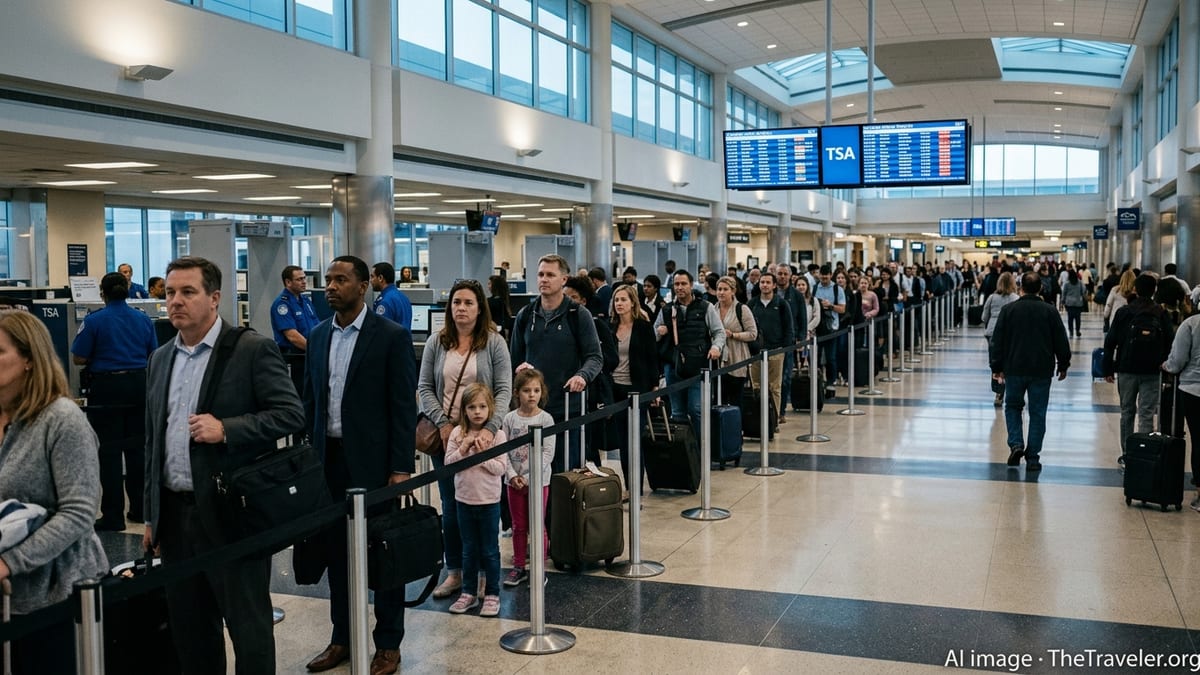
Across the country, travelers are already encountering early signs of stress as TSA struggles to keep checkpoints fully staffed. Social media posts and local news coverage in recent days have highlighted three-hour security waits at some large hubs and reports of early-morning queues spilling into terminal lobbies.
Airlines are beginning to adjust as well. Aviation analysts point to an uptick in same-day cancellations and schedule changes attributed to security bottlenecks, particularly at connecting airports where tight turnaround times leave little margin for extended screening delays. In several markets, carriers have proactively advised passengers to arrive significantly earlier than usual or to rebook away from peak morning and evening banks.
Published analyses of past shutdowns indicate that when security and air traffic staffing fall below critical thresholds, delays can spread quickly as missed departure slots cascade through already congested airspace. During the 43-day funding lapse of 2025, a combination of controller and TSA shortages led to reduced flight volumes at dozens of high-traffic airports, fueling thousands of delays and cancellations nationwide.
With the latest Homeland Security shutdown now stretching beyond the thirty-day mark, observers warn that a similar pattern could develop, particularly if the confrontation in Congress shows no sign of resolution before the busy late-spring travel period.
Travel Industry Braces for Broader Economic Fallout
The U.S. travel and tourism sector is closely tracking the situation, with trade associations warning of mounting economic costs if traveler confidence erodes. Prior studies by travel organizations have found that even the threat of a shutdown can prompt passengers to postpone or cancel trips, particularly discretionary leisure and business travel.
For gateway cities and tourism-dependent regions, reduced air capacity or temporary airport closures can translate into lost hotel bookings, restaurant revenue, and convention business. Some airport authorities are already revisiting contingency plans developed during previous shutdowns, including measures to support concession workers and other on-site staff whose hours may be cut if passenger volumes drop.
Economists who specialize in transportation policy note that aviation disruptions ripple far beyond the terminal. Missed cargo flights can impede supply chains, late-arriving crews can affect downstream routes for days, and disrupted connections can discourage international visitors who depend on smooth domestic links.
Business travel groups have urged employers to factor potential checkpoint delays and regional disruptions into upcoming meeting and conference planning, particularly for events that rely on attendees connecting through smaller U.S. airports.
What Travelers Can Do as Uncertainty Grows
While the duration of the Homeland Security funding lapse remains uncertain, travel planners are advising passengers to build in substantial extra time and flexibility. Many airlines are publishing guidance that encourages arriving at least three hours early for domestic flights at busy hubs and checking airport social media feeds or local news for reports of abnormal wait times.
Experts in aviation operations suggest that travelers consider booking nonstop flights when possible to minimize exposure to multiple checkpoints and potential chokepoints. For those who must connect through smaller regional airports, allowing longer layovers can provide a buffer against delayed departures from the origin airport.
Publicly available information from airport operators indicates that some facilities are adjusting checkpoint opening hours, relocating screening lanes, or temporarily closing less-used checkpoints to concentrate staff. Travelers are encouraged to verify which terminals and checkpoints will be open during their planned arrival window and to be prepared for last-minute changes.
As the shutdown continues, analysts warn that the risk of localized airport closures could increase, especially if TSA staffing levels continue to erode. Until Congress restores full funding for the Department of Homeland Security, the stability of the U.S. aviation system will depend heavily on the resilience of front-line security personnel and the willingness of travelers to adapt to rapidly changing conditions.