

More news on this day
Europe’s biggest holiday airlines are rapidly scaling back flights to Cyprus after a drone strike near a key British air base and the deployment of a UK Royal Navy warship heightened security fears in the eastern Mediterranean.
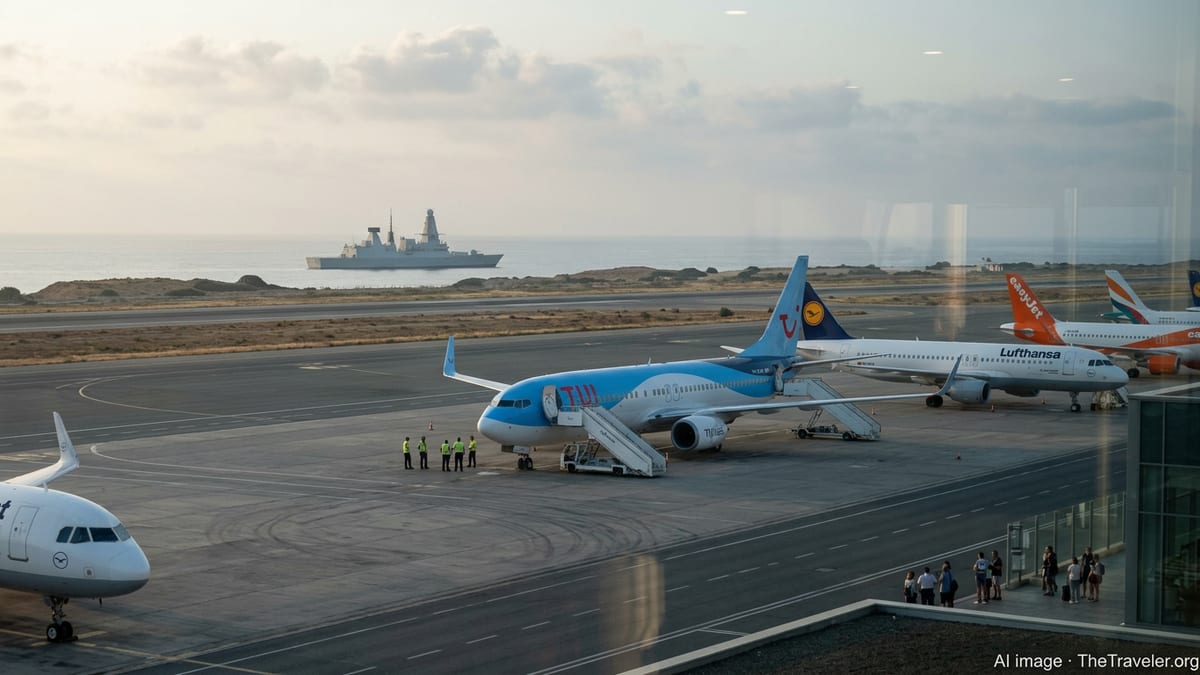
Wave of Flight Cancellations Hits Popular Holiday Island
TUI Airways has joined British Airways, easyJet, Ryanair, Turkish Airlines and several smaller carriers in cancelling or consolidating services to Cyprus, in the clearest sign yet that rising regional tensions are beginning to bite into one of Europe’s most dependable winter-sun markets. The latest adjustments affect flights into both Larnaca and Paphos, with airlines citing “operational reasons” and “evolving security conditions” in notifications sent to passengers.
The move follows disruption earlier in the week when a suspected Iranian-made drone struck the runway at RAF Akrotiri, the British military base on the island that serves as a launch pad for operations across the Middle East. While commercial airports remain open and Cypriot authorities insist that civilian areas are not under direct threat, airlines are increasingly wary of routing aircraft close to sensitive airspace as the situation develops.
Travel agents in the UK, Germany and Scandinavia reported a surge in calls from concerned holidaymakers overnight, many asking whether their Easter trips could still go ahead. Industry sources say more schedule cuts are now “highly likely” in the coming days, particularly on routes that primarily serve British and northern European leisure travellers.
Airline planners are also factoring in knock-on effects from wider instability across the region, including airspace restrictions and the possibility of further military activity that could affect standard flight corridors over the eastern Mediterranean.
Royal Navy Destroyer Heads to Cyprus After Drone Strike
The UK government has ordered the Type 45 air defence destroyer HMS Dragon to the waters off Cyprus following the drone attack on RAF Akrotiri, underscoring how seriously London views the evolving threat picture. The warship is being accompanied by Wildcat helicopters equipped with specialist counter-drone missiles, intended to bolster protection of British assets and improve early interception capability over the surrounding seas.
Officials in London describe the deployment as a defensive step aimed at reassuring both Cyprus and the thousands of British military personnel and dependants stationed on the island. It comes amid heightened concern that Iran or allied groups could target Western facilities in retaliation for US and Israeli strikes elsewhere in the region.
For the travel industry, the arrival of a front-line warship off one of the Mediterranean’s most tourism-dependent islands is a stark visual reminder of how quickly geopolitical shocks can spill into aviation and holiday planning. Analysts say that while the destroyer is not there to protect civilian aircraft directly, its presence reinforces airline risk assessments about potential escalation near key flight paths.
Military movements by France and Greece, which are also sending naval and air assets to the area, add a further layer of complexity to the already busy eastern Mediterranean air and sea corridors that commercial carriers routinely rely on.
Authorities Stress Calm as Airlines Act Cautiously
The government of the Republic of Cyprus has repeatedly stressed that the island’s airspace remains open and that there is no indication of a direct threat to commercial aviation. Officials in Nicosia say air defence systems are fully operational and that they are in constant contact with European and regional partners to monitor the situation.
Despite these assurances, airlines operate under strict internal safety protocols that frequently go beyond formal government advisories. In practice this means carriers can pare back or suspend flights when their own security teams judge the risk to be rising, even if national travel guidance has not changed.
The UK Foreign, Commonwealth and Development Office has not issued a formal warning against travel to Cyprus, but has updated its advice to highlight the drone incident, the heightened regional tension and the possibility of sudden disruption. Other European foreign ministries have adopted a similar tone, urging citizens already on the island to stay informed via local authorities and to maintain flexible travel plans.
Travel insurers, for now, continue to treat Cyprus as a standard European leisure destination, but some are starting to circulate technical briefings to corporate clients highlighting the potential for airport closures or last-minute schedule changes should the security environment deteriorate.
Holidaymakers Face Uncertainty Over Easter and Summer Plans
For many travellers, the immediate impact is practical rather than political. Families booked on TUI package holidays have been among the first to receive rebooking and refund offers, as the tour operator reshapes its programme in response to aircraft no longer operating into Cyprus on certain days. Some passengers have been rerouted via alternative Mediterranean destinations, while others are being asked to push departures later into the spring.
Independent travellers using low cost carriers are experiencing a patchwork of disruption, ranging from outright cancellations to merged services on busier days. Passengers whose flights are scrapped are generally being offered alternative dates or vouchers, but seat availability around peak Easter travel weeks is already tight across Europe, making like for like replacements harder to secure.
Irish and British travellers, traditionally among the largest source markets for Cyprus, have been advised by their governments to remain vigilant, monitor airline communications closely and allow extra time at airports in case of additional security checks. Travel agents report that while there has not yet been a wave of mass cancellations by consumers, new bookings for Cyprus have slowed markedly in recent days compared with rival destinations such as Spain and Portugal.
Hoteliers and local tourism businesses on the island are watching developments anxiously. Many had been counting on a strong late-winter and early-spring season to offset weaker demand during earlier phases of the Middle East crisis and now fear that even a short period of reduced airline capacity could hit revenues.
More Cancellations Likely as Airlines Monitor Security Risks
Industry experts warn that further cancellations and schedule reductions are increasingly probable in the short term, particularly if additional drone incidents or military deployments occur in or around Cyprus. Airlines are conducting daily security reviews with specialist risk advisers, weighing the safety of flight paths, the resilience of local infrastructure and the availability of diversion airports should an incident occur mid-flight.
Carriers also have to consider the positioning of aircraft and crews, with some now opting to avoid overnighting planes on the island until the threat environment is clearer. This operational choice can lead to chains of cancellations and timetable reshuffles affecting passengers far beyond Cyprus itself, especially on multi-sector rotations across Europe and the Middle East.
For travellers with imminent departures, the most important step is to keep contact details up to date with airlines and tour operators, as most changes are being communicated by text and email rather than through public announcements alone. Flexible tickets and package holidays booked through established operators are currently offering the greatest protection, as they typically include clearer rights to rerouting or refunds when flights are cancelled for security reasons.
If the security situation stabilises and warship deployments succeed in deterring further attacks, airlines may begin to restore capacity relatively quickly. For now, however, Cyprus finds itself on the front line of how Europe’s travel industry responds to fast-moving geopolitical tension, with both carriers and holidaymakers braced for more turbulence in the days ahead.