

More news on this day
TUI Cruises has canceled multiple Arabian Gulf sailings of its Mein Schiff 4 vessel as rising geopolitical tensions and airspace closures across the Middle East continue to disrupt cruise operations and unsettle global travel demand.
Get the latest news straight to your inbox!
Popular Gulf Itineraries Abruptly Cut Short
Recent schedule updates from industry reports show that TUI Cruises has withdrawn several planned departures of Mein Schiff 4 from its winter program in the Arabian Gulf following a sharp escalation in regional tensions at the end of February 2026. The ship had been operating weeklong cruises from hubs such as Abu Dhabi and Dubai, visiting ports in the United Arab Emirates, Oman, Qatar and Saudi Arabia that had become key pillars of the brand’s Middle East deployment.
Cruise-focused publications indicate that at least four Mein Schiff 4 sailings scheduled for early March, including departures on March 1, 2, 8 and 9, were canceled after conflict-related disruptions led to widespread airspace restrictions and concerns about safe passage through key maritime chokepoints. In parallel, sister ship Mein Schiff 5 also saw voyages in the Gulf suspended, compounding the scale of the disruption for TUI’s German-speaking customer base.
Earlier planning had positioned Mein Schiff 4 as a central player in TUI Cruises’ 2025–26 Middle East strategy, following a previous decision to abandon Red Sea itineraries in response to security and shipping risks. The latest cancellations underline how quickly conditions in the region have deteriorated for cruise operators and how vulnerable long-term deployment plans remain in today’s geopolitical climate.
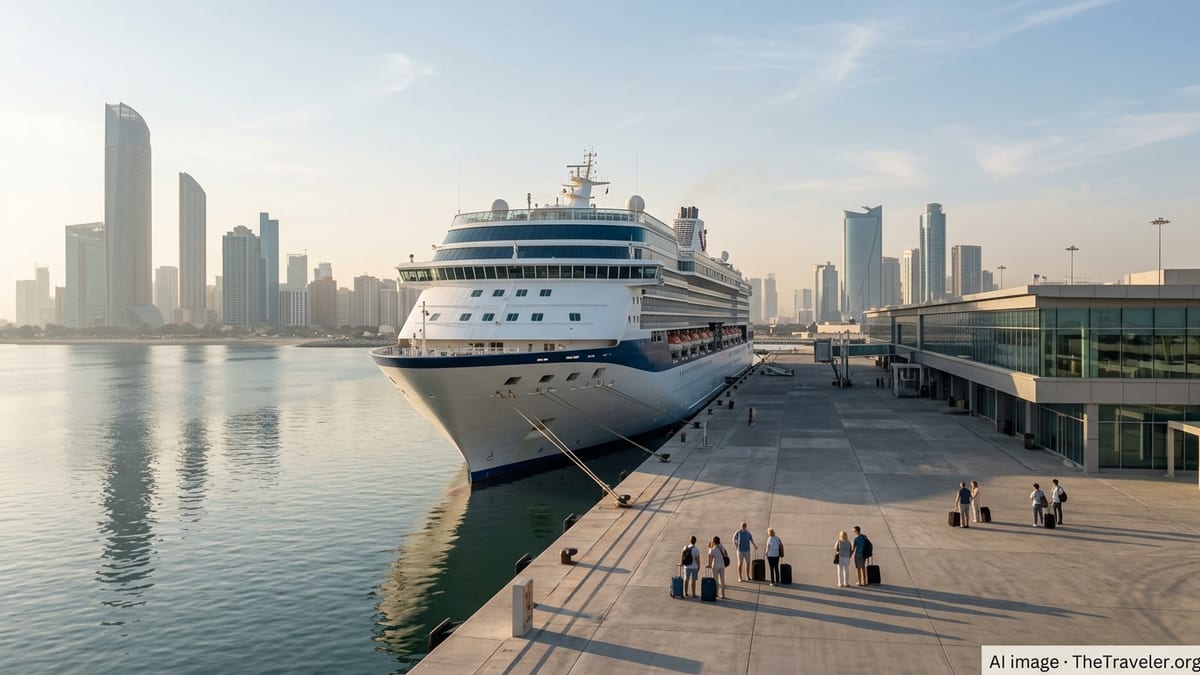
Reports from cruise news outlets describe Mein Schiff 4 remaining alongside in Abu Dhabi for an extended period while TUI worked through alternative arrangements for guests, including additional nights on board and rebooked journeys home, as flight schedules across the Gulf were repeatedly altered or suspended.
Security Warnings and Airspace Closures Drive Decisions
Publicly available information from German-language and international coverage shows that TUI Cruises framed its cancellations in direct connection with formal travel and safety advisories issued by Germany’s Federal Foreign Office for several Gulf destinations. Those advisories, together with temporary airspace closures and restrictions on overflights in multiple Middle Eastern states, effectively undermined the logistical foundations required to operate turnaround cruises safely and reliably.
Analyses of the broader security environment point to a confluence of risks, including heightened military activity around the Strait of Hormuz and ongoing missile and drone incidents in parts of the region. Maritime and insurance briefings published in early March highlight a pronounced reduction in cruise and commercial vessel traffic in the Gulf, as many operators chose to pause sailings or reroute assets away from higher-risk areas until the situation stabilizes.
For TUI Cruises, these developments left limited room to adapt itineraries locally. With port calls concentrated in countries subject to travel warnings and with key embarkation airports facing disruptions, canceling entire voyages became a more viable option than attempting piecemeal changes. Industry commentary notes that cruise lines are increasingly leaning on this approach when the combination of security risk, regulatory guidance and operational complexity crosses a certain threshold.
The episode also illustrates how quickly consumer-facing travel plans can be reshaped by decisions taken far upstream in government and military circles, with cruise brands sometimes given only narrow windows to respond before itineraries become untenable.
Passengers Face Sudden Itinerary Changes and Repatriation Efforts
The cancellation of Mein Schiff 4 sailings has directly affected thousands of passengers who had planned winter sun holidays in the Gulf, many of them booking months in advance under the assumption that the region would remain open to tourism. Coverage in cruise trade media and general news outlets describes a wave of short-notice communications to guests, with some passengers informed while still at home and others already on board when subsequent legs of their trip were withdrawn.
Reports indicate that TUI Cruises focused first on ensuring that those already at sea or in port were accommodated and then repatriated, coordinating with airlines and local partners where commercial flight options remained available. In several cases, guests were offered additional overnights on board while alternative flights were secured, reflecting the knock-on effect that regional airspace closures had on both scheduled and charter services.
Consumer-focused analyses suggest that affected travelers may be entitled to a mix of refunds, rebookings and future cruise credits, depending on when and how their individual voyages were changed. Previous policy decisions by the line, including enhanced credits for earlier itinerary cancellations in the Red Sea region, are seen as a reference point for what customers might expect in the current situation, though specific arrangements vary by booking.
Online forums and social media posts from cruise passengers also reveal a broader sense of uncertainty, with some travelers expressing concern about upcoming departures in nearby regions and others actively shifting their plans to itineraries perceived as safer, such as the Canary Islands, the western Mediterranean or Northern Europe.
Middle East Conflict Ripples Across the Global Cruise Map
The suspension of Mein Schiff 4’s Gulf program is part of a wider retrenchment by major cruise brands from Middle Eastern waters as tensions rise. Industry roundups show MSC Cruises, Celestyal Cruises and other operators also curtailing or canceling voyages in the Arabian Gulf and eastern Mediterranean, often at short notice, to keep ships and guests clear of conflict-affected zones.
These decisions are layered on top of earlier route adjustments triggered by security threats in the Red Sea, where attacks on commercial shipping pushed many lines to divert vessels around the Cape of Good Hope instead of transiting the Suez Canal. Analysts note that the combined effect has been to redraw global deployment patterns, concentrating more capacity in relatively stable regions while leaving Middle Eastern cruise tourism in a holding pattern.
For destination ports in the Gulf, the loss of scheduled calls from Mein Schiff 4 and other ships presents an immediate economic challenge. Cruise tourism has become an increasingly important pillar of diversification strategies in countries such as the United Arab Emirates, Qatar and Saudi Arabia, where new terminals and waterfront attractions have been developed specifically to attract international lines. Reduced ship traffic means softer revenues for local tour operators, port-side retailers and hospitality businesses that had geared up for a strong winter season.
At a global level, financial disclosures and regulatory filings from large travel groups have long flagged geopolitical risk and conflict-related itinerary changes as material factors that can weigh on cruise earnings. The current wave of cancellations in the Middle East is likely to reinforce those warnings, underscoring how cruise lines must constantly balance growing demand for exotic itineraries with the need to protect guests, crews and assets in volatile regions.
Travelers Pivot to Alternative Winter Sun Destinations
The disruption to Mein Schiff 4’s popular Gulf cruises is also reshaping traveler behavior as guests reassess their comfort levels with itineraries near active conflict zones. Travel agents and cruise specialists quoted across European media report increased interest in alternative warm-weather routes, ranging from Caribbean fly-cruises to Canary Islands circuits and extended Mediterranean sailings that avoid higher-risk chokepoints.
This shift builds on trends that began when security issues in the Red Sea first pushed cruise lines to step back from that corridor, prompting a reallocation of ships to western basins. The latest cancellations in the Arabian Gulf add another layer to that pattern, suggesting that winter cruise demand is not disappearing so much as rerouting toward destinations perceived as more predictable from a safety and logistics standpoint.
Experts in the sector note that traveler perceptions often lag behind fast-moving political developments, which can make demand swings uneven and difficult to forecast. While some guests are now deliberately avoiding any itineraries that include Middle Eastern ports, others continue to book cruises in nearby areas but with closer attention to flexible cancellation policies and insurance coverage.
For TUI Cruises, the coming months will likely involve fine-tuning deployment plans for Mein Schiff 4 and its fleetmates to capture demand in alternative markets while monitoring the security picture in the Gulf. The line’s recent history of adjusting or abandoning itineraries in both the Red Sea and Arabian Gulf illustrates how quickly strategic priorities can be reordered when global travel meets regional instability.