

More news on this day
TUI Cruises has completed the evacuation of around 2,500 guests from Mein Schiff 5 in Qatar following a sudden escalation of regional conflict that has disrupted shipping lanes and air travel across the Gulf, with new cancellations and further itinerary changes now expected across the cruise sector.
Get the latest news straight to your inbox!
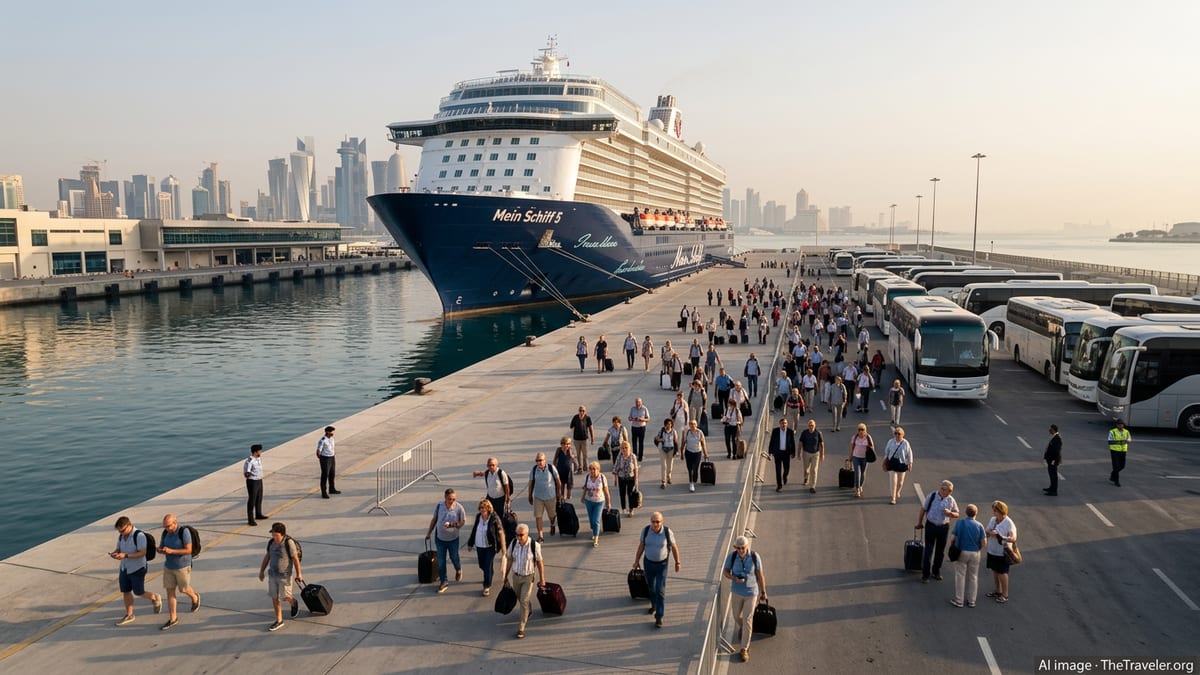
Evacuation Operation Concludes in Doha
Publicly available information indicates that Mein Schiff 5 remained in Doha for days after missile activity and airspace restrictions effectively froze cruise operations in parts of the Gulf at the beginning of March 2026. The ship, which normally sails week-long itineraries in the region during the winter season, was forced to suspend its schedule while operators assessed security risks and the status of nearby ports.
Reports from regional media and passenger accounts on social platforms describe a large-scale effort to move approximately two and a half thousand guests off the vessel and out of Qatar once limited air corridors and charter capacity became available. Travel industry analysis suggests that the process involved staggered disembarkations, ground transfers to airports in and beyond Doha, and a mix of special flights and rebooked commercial services as carriers gradually restarted evacuation and repatriation operations.
While specific routing details differ by source, the overall picture is of a carefully sequenced evacuation that prioritized getting guests out of the immediate conflict zone rather than returning them directly to original cruise endpoints. The operation appears to have concluded in recent days, with Mein Schiff 5 guests either back in their home countries or continuing onward journeys from safer transit hubs.
TUI Cruises has not yet published a detailed public breakdown of the evacuation timeline, but financial and industry commentary portrays the repatriation as largely successful under challenging conditions, carried out against a backdrop of intermittent airspace openings and continuing concerns about missile activity around key Gulf ports.
Conflict Fallout Hits Gulf Cruise Season
The evacuation of Mein Schiff 5 is part of a wider disruption to cruising in the Middle East triggered by the latest escalation around the Strait of Hormuz and neighboring Gulf states. According to recent analyses of the situation, joint military actions and subsequent missile strikes in late February and early March led to parts of the region being classified as a high-risk zone, with war-risk insurance restrictions and airspace closures heavily constraining commercial travel.
Market research on TUI Group shows that itineraries for both Mein Schiff 4 and Mein Schiff 5 in the Gulf were among the earliest large-scale cruise cancellations in response to the conflict. Sailings out of Abu Dhabi and Doha scheduled for early March were withdrawn as operators judged that continuing normal operations was no longer viable, especially after reports of missile activity close to port areas.
The cruise industry impact has extended beyond the TUI Cruises fleet. Coverage of the unfolding crisis notes that several international lines either cancelled calls, repositioned ships away from the Gulf, or allowed passengers to disembark early to return home by air. With major choke points affected and maritime traffic patterns shifting rapidly, cruise brands have had to weigh passenger safety, logistical feasibility, and contractual obligations in real time.
For the Gulf states that have invested heavily in cruise infrastructure and winter tourism, the setback comes at a sensitive moment. Doha, Abu Dhabi, and Dubai have been working to position themselves as major regional cruise hubs, and the sudden curtailment of sailings highlights the vulnerability of that strategy to geopolitical shocks and transport corridor closures.
New Cancellations and Itinerary Changes Expected
Industry commentary now points to a second wave of schedule changes as operators reassess the viability of Gulf deployments for the remainder of the season. Financial research focusing on TUI indicates that initial cancellations in early March may be followed by broader redeployments if conflict conditions or insurance constraints persist into April and beyond.
For TUI Cruises, this could mean further adjustments not only for Mein Schiff 5 but also for other ships that had planned shoulder-season calls in the region before heading to summer programs in Europe. Analysts suggest that, where possible, capacity is likely to be shifted to Western Mediterranean and Northern European routes, which currently face fewer security concerns and continue to see solid demand from core source markets.
Travel agents and tour operators serving the German-speaking cruise market are advising customers to expect increased use of replacement itineraries, overnight port swaps, and shortened or lengthened repositioning voyages as cruise lines realign their fleets. While some guests may opt to change travel dates or move to alternative destinations, others are being rebooked automatically onto substitute routes with added port calls in Spain, Italy, or the Canary Islands.
The pattern is similar across the wider sector, with other major lines already canceling or modifying Middle East sailings for the coming weeks. Decisions are being driven by a combination of safety assessments, port access, flight availability for embarkation and disembarkation, and the escalating cost and complexity of operating in or near a conflict zone.
Traveler Impact: Refunds, Vouchers and Insurance Questions
For passengers, the immediate concern has been returning home safely, but attention is now turning to financial and practical fallout from the abrupt changes. According to published coverage of airline and cruise responses to the conflict, many carriers operating in and out of Qatar and neighboring states have introduced temporary flexible booking policies, allowing date changes and, in some cases, refunds or travel credits for affected journeys.
The detailed conditions vary by company, but travel industry advisories highlight that cruise guests whose voyages were curtailed or cancelled are generally being offered a mix of pro-rated refunds, rebooking options, and future cruise credits. In some instances, additional goodwill measures such as onboard credit for future sailings or assistance with independently booked flights are being reported.
The situation has also reignited debate about travel insurance coverage in conflict zones. Policy documents commonly include exclusions related to acts of war or armed conflict, and consumer advocates note that some travelers may find their claims partially or fully denied if their plans were impacted directly by hostilities. At the same time, many airlines and cruise lines are choosing to go beyond strict contractual obligations in order to protect brand reputation and maintain customer loyalty.
With conditions still fluid, experts recommend that travelers booked on future Gulf cruises closely monitor operator updates and review the fine print of both cruise contracts and insurance policies. Those considering new bookings in the region for late 2026 and beyond are being encouraged to weigh the potential for renewed instability against the often-attractive pricing and itineraries on offer.
Outlook for Gulf Cruising After the Crisis
Looking ahead, analysts are divided on how quickly Gulf cruising can recover from the current shock. Some industry reports argue that, if the conflict remains relatively contained and key maritime routes reopen under stable security arrangements, cruise lines may cautiously return to the region within one or two winter seasons. The Gulf’s modern terminals, warm-weather appeal, and proximity to major air hubs remain compelling assets for itinerary planners.
Others are more cautious, pointing out that repeated disruptions in a relatively short period can reshape consumer perceptions of a destination’s safety for years. For brands like TUI Cruises that serve a risk-aware customer base in Central Europe, rebuilding confidence may require clear evidence of lasting stability, along with transparent communication about contingency planning and safety protocols on board.
The experience of Mein Schiff 5 and its evacuated guests is likely to inform those future plans. Observers note that the ship’s rapid shift from holiday vessel to temporary shelter and then to the focal point of a complex repatriation effort underscores the growing importance of crisis management capabilities in modern cruising. From coordination with local authorities to logistics of mass airlift, such operations are now a critical part of operational risk planning.
For the moment, the focus remains on winding down emergency measures and supporting guests whose journeys ended very differently from what they had expected when they boarded Mein Schiff 5 in the Gulf. As cruise lines digest the lessons of this latest crisis, travelers and industry stakeholders alike will be watching closely to see how and when large-scale leisure sailings return to Qatar and its neighbors.