

More news on this day
Turkey and Uzbekistan have entered a new phase in their relationship, elevating 34 years of diplomatic ties into a comprehensive strategic partnership that puts travel, tourism and economic connectivity at the heart of their future cooperation.
Comprehensive Strategic Partnership Sealed After 34 Years
The two countries formally marked the 34th anniversary of their diplomatic relations this week by announcing that ties have been upgraded to a comprehensive strategic partnership, a status that reflects both the breadth and depth of cooperation achieved since the early 1990s. Turkey was the first country to recognize Uzbekistan’s independence in 1991, and diplomatic relations were established in 1992, laying the groundwork for what officials now describe as a “mature, multidimensional” relationship.
Recent discussions between foreign ministers and senior officials in Ankara and Tashkent have focused on consolidating this progress within an institutional framework, including a High-Level Strategic Cooperation Council and a Joint Strategic Planning Group that meet regularly to set priorities and review implementation. The latest round of talks in early 2026 reaffirmed the two sides’ intention to coordinate more closely on regional issues, energy security and connectivity projects across Central Asia.
Officials on both sides say the new phase reflects a deliberate shift from symbolic political support to practical, long-term alignment. With both governments pursuing ambitious economic reforms and infrastructure agendas, the partnership is designed to create predictable conditions for investors and travelers, while positioning Turkey and Uzbekistan as key hubs on emerging east-west trade and transport corridors.
Surging Trade, Investment and Transport Connectivity
Economic cooperation has been one of the fastest-growing pillars of the relationship. Bilateral trade, which stood around 1.2 billion dollars in the mid-2010s, has more than doubled and is reported to have surpassed 3 billion dollars in 2025, with both governments publicly backing a medium-term goal of expanding this figure to 5 billion dollars. Turkey has emerged as one of Uzbekistan’s top four trading partners, after Russia, China and Kazakhstan, reflecting a broadening mix of manufactured goods, textiles, machinery and food products moving in both directions.
Investment ties have deepened in parallel. Uzbek authorities report that the number of companies with Turkish capital active in the country has risen sharply in recent years, reaching well over 5,000 firms involved in energy, construction, textiles, tourism, pharmaceuticals, healthcare and agriculture. Turkish investors have been particularly active in industrial zones and special economic areas, as well as in regional development projects, such as new tourism and agribusiness initiatives in the Ferghana Valley.
Transport connectivity has become another strategic focus. Both governments are backing the development of the Trans-Caspian East-West Middle Corridor and associated rail links, which would allow goods and passengers to move between Central Asia and Europe via the South Caucasus and Turkey. Ankara and Tashkent view these corridors as essential to reducing transit times, diversifying export routes and linking Uzbek producers more directly with Mediterranean, Black Sea and European markets.
Expanding Air Links and Visa Facilitation to Boost Travel
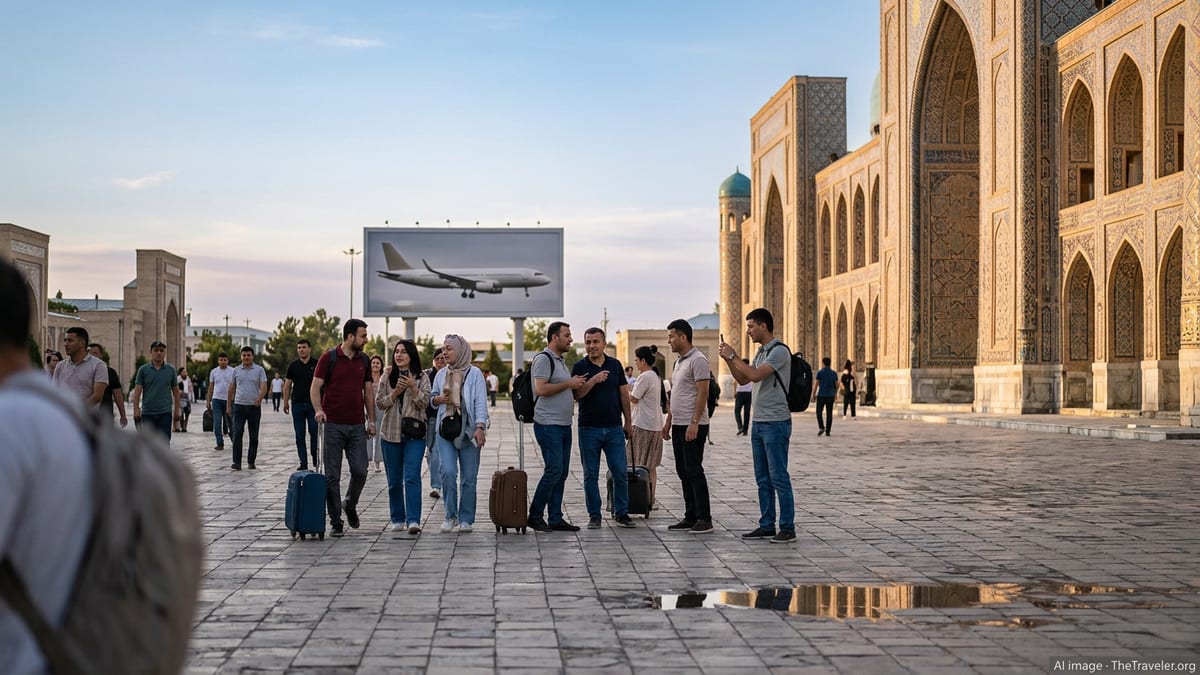
One of the most visible results of the closer partnership is in the skies. Weekly flights between Turkey and Uzbekistan, once limited to just a handful of connections, have expanded dramatically to around 100 frequencies per week, linking major hubs such as Istanbul, Ankara, Tashkent and Samarkand, as well as growing regional destinations. Flag carriers and low-cost airlines alike are targeting rising demand from tourists, business travelers and members of the Uzbek diaspora.
This rapid expansion in air services has been underpinned by a series of visa facilitation steps and tourism agreements put in place since 2018. Easier entry rules have contributed to a sharp increase in mutual visits, with officials in both countries speaking of a shared target of reaching one million visitors per year in the coming period. Travel industry analysts say this could place the Turkey–Uzbekistan corridor among the busiest intra-Turkic tourism routes.
Travel operators are responding by developing new multi-stop itineraries that combine Turkish coastal and cultural destinations with Uzbekistan’s Silk Road cities. Istanbul and Antalya are increasingly marketed in Central Asia as gateways to Mediterranean holidays, while Tashkent, Samarkand, Bukhara and Khiva are drawing more Turkish travelers seeking history-focused trips and pilgrimage routes. Direct flights are shortening journey times, turning once-complex itineraries into straightforward weekend or long-weekend options.
Tourism and Cultural Ties Revitalize the Silk Road
Tourism has become both a driver and a symbol of the new strategic partnership. Uzbekistan has invested heavily in restoring historic sites along the ancient Silk Road, improving visitor infrastructure and upgrading airports in key cities, while Turkey’s mature tourism industry is sharing expertise in destination marketing, hospitality management and training. Joint projects range from hotel developments and theme parks to cultural festivals designed to spotlight shared Turkic heritage.
Regional authorities in Uzbekistan, particularly in the Ferghana region and other historically rich provinces, have been courting Turkish investors to co-develop eco-tourism, wellness resorts and agritourism complexes. These ventures aim not only to attract international visitors, but also to generate jobs, promote sustainable land use and create new opportunities for young entrepreneurs in rural areas.
Cultural and educational exchanges are expanding alongside holiday travel. Universities and vocational schools in both countries are signing new cooperation agreements, boosting student and academic mobility in fields such as tourism management, information technology and engineering. Turkish television, music and digital platforms enjoy strong followings in Uzbekistan, while Uzbek arts, crafts and cuisine are gaining higher visibility at cultural events in Istanbul, Ankara and other Turkish cities.
Regional Ambitions and the Future of the Partnership
The upgraded strategic partnership also carries wider regional implications. Both Turkey and Uzbekistan play active roles in the Organization of Turkic States and other multilateral formats, where they advocate deeper economic integration, smoother cross-border travel and harmonized standards in sectors such as transport, tourism and digital services. Officials say closer coordination between Ankara and Tashkent can help accelerate broader initiatives within the Turkic world.
For Uzbekistan, the relationship with Turkey offers a bridge to European, Mediterranean and Middle Eastern markets, complementing its ties with neighboring Central Asian states, China and the European Union. For Turkey, deeper engagement with Uzbekistan enhances its position as a hub for east-west trade and as a key player in the evolving geopolitics of Central Asia, energy transit and supply-chain diversification.
As the two countries enter their 35th year of diplomatic relations, the focus is shifting from headline agreements to implementation. Infrastructure projects along the Middle Corridor, new tourism clusters, joint industrial ventures and digital economy initiatives will test how far the partnership can translate into tangible gains for businesses and travelers. Yet both governments insist that the combination of shared language, cultural affinity and converging economic interests gives their comprehensive strategic partnership an enduring foundation.