

More news on this day
Turkey is grappling with a fresh wave of air travel disruption as Emirates, Turkish Airlines, flydubai and other major carriers cancel scores of services at Istanbul Airport, leaving passengers stranded and sharply curtailing vital links to Dubai, Doha, Bahrain and other Gulf hubs.
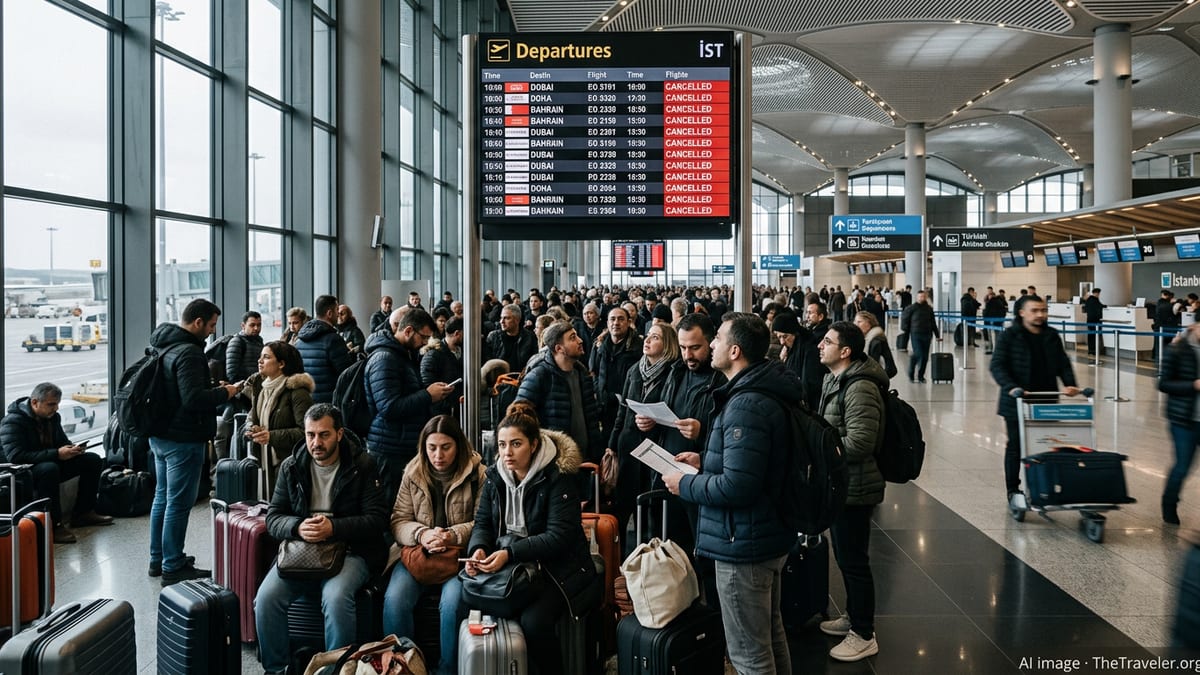
Latest Wave of Cancellations Hits Istanbul Airport
Flight schedules at Istanbul Airport were heavily disrupted on March 2 and 3 as regional airspace closures across the Middle East forced airlines to halt or reroute services. Aviation data and local reports indicate that more than 20 departures and arrivals operated by Emirates, Turkish Airlines, flydubai, Qatar Airways and Gulf carriers were cancelled or severely delayed, with additional knock-on disruption rippling through the day.
The cancellations are part of a broader suspension that has seen Turkey extend its halt on most flights to Iran, Iraq, Syria, Lebanon and Jordan through March 6, while all planned services to Qatar, Kuwait, Bahrain and the United Arab Emirates are cancelled through March 3. Although Turkish airspace remains open and Istanbul’s airports are technically operational, regional closures have made it impossible for many services to reach Gulf destinations or safely overfly neighboring states.
At Istanbul Airport, departure boards on Tuesday morning showed multiple flights to Dubai, Doha and Manama marked cancelled, with others listed as delayed without clear estimates. Ground staff said many services were being reassessed on a rolling basis depending on evolving airspace notices and operational decisions from Gulf aviation authorities.
Airlines warned that more cancellations remain likely if security conditions and airspace restrictions do not ease. The fluid situation means that some flights still visible in booking systems may never depart, adding to confusion for travelers who have already arrived at the airport.
Passengers Left Isolated From Gulf Hubs
The sudden halt to traffic between Turkey and the Gulf has left many travelers effectively isolated, unable to reach key connection points such as Dubai and Doha that normally serve as gateways to Asia, Africa and Australasia. With Emirates and flydubai grounding services to and from Dubai and Turkish Airlines cancelling flights to Qatar and Bahrain, passengers who planned to transit through these hubs are finding their journeys abruptly cut short in Istanbul.
Scenes at Istanbul Airport on Tuesday reflected mounting frustration. Families returning from Europe to homes in the Gulf, business travelers heading to conferences in Dubai and Doha, and tourists bound for winter sun breaks in the United Arab Emirates all found themselves stuck in terminal halls as airlines worked through queues of stranded customers.
Many passengers reported difficulty securing alternative routes. With Dubai, Abu Dhabi and Doha largely closed to commercial traffic and other regional airports coping with heavy rerouting, options for rebooking have become scarce. Some customers were offered itineraries involving lengthy detours via European capitals or cities such as Muscat and Riyadh where limited services continue, often adding a full day or more to total travel time.
Travel agents in Istanbul said demand for seats on remaining long haul departures, particularly to European and Asian hubs, had surged since the weekend. Fares on some last minute routes climbed sharply, while hotel bookings near the airport spiked as travelers resigned themselves to overnight stays and uncertain departure dates.
Government Extends Bans as Airlines Await Next Update
Turkey’s Ministry of Transport and Infrastructure confirmed on March 2 that national carriers Turkish Airlines, AJet, Pegasus and SunExpress have extended cancellations to Iran, Iraq, Syria, Lebanon and Jordan until at least March 6, in line with ongoing regional risk assessments. Flights to Qatar, Kuwait, Bahrain and the United Arab Emirates were formally cancelled through March 3, with officials signaling that further extensions are possible if airspace remains closed or restricted.
Transport and Infrastructure Minister Abdulkadir Uraloğlu stressed that the government is monitoring the situation in real time and coordinating closely with aviation authorities and airlines. He noted that crews based in Bahrain, Qatar and the UAE remain safe, but added that carrier operations will not resume until risk levels are deemed acceptable and neighboring states reopen their skies.
Gulf airlines have issued similar rolling updates rather than firm restart dates. Emirates and flydubai have both extended suspension of most regional operations until at least March 3, promising further guidance once regulators provide clarity on airspace availability. Qatar Airways, Etihad and other regional carriers are operating with limited or no schedules on many routes, with regular bulletins advising passengers to check flight status frequently.
Aviation analysts say the cautious approach reflects both security concerns and the operational complexity of restarting networks that rely heavily on tightly choreographed hub schedules. Any partial reopening of airspace is likely to be followed by a phased return of flights rather than an immediate restoration of normal timetables.
Knock-on Impact Across Turkish and Global Networks
The disruption radiating from Istanbul Airport is being felt well beyond Turkey’s borders. Istanbul typically functions as a crucial transfer point for travelers moving between Europe and the Gulf, and onward to destinations in South and Southeast Asia, as well as East Africa. With flights to Dubai, Doha and Bahrain curtailed, many of those itineraries have effectively broken mid route.
Turkish Airlines has been forced to reshuffle aircraft and crews across its global network, prioritizing routes that can operate via alternative corridors while avoiding closed or high risk airspaces. This has led to additional delays and occasional last minute aircraft swaps on long haul flights, even on services that do not touch the Gulf region directly.
International carriers that rely on Istanbul as a feeder hub are also feeling the strain. European, Asian and North American airlines with codeshare agreements on Turkish routes to the Gulf have had to rebook customers or offer refunds, further adding to the strain on call centers and customer service channels already inundated by regional disruption.
Industry groups warn that if airspace closures around the Gulf persist, the cumulative impact on global connectivity could be significant. Freight flows linking Europe, Turkey and the Gulf are already being rerouted or delayed, while business travelers and tourism flows into the region face prolonged uncertainty.
What Travelers Through Istanbul Should Do Now
Travel experts urge passengers scheduled to transit Istanbul on their way to Dubai, Doha, Bahrain or other Gulf destinations in the coming days to treat their bookings as highly provisional. With airlines revising timetables in short cycles and regional authorities adjusting airspace notices at short notice, same day changes are becoming the norm rather than the exception.
Passengers are advised to stay in direct contact with their airline via official apps and call centers, and to avoid heading to the airport until their flight is confirmed as operating. Many carriers, including Emirates, Turkish Airlines and flydubai, are waiving certain change and rebooking fees for affected routes, but processing times can be slow due to heavy demand.
Those already stranded in Istanbul are being encouraged to secure accommodation early, either through airline provided hotel vouchers or independently, as local availability tightens. Travel insurance policies that cover disruption caused by airspace closures or security incidents may provide some reimbursement, though coverage terms vary widely.
With no guaranteed timeline for a full restoration of services, both airlines and officials in Turkey are signaling that travelers should prepare for continued volatility. For now, Istanbul remains connected to much of the world, but its critical bridge to Gulf mega hubs is sharply reduced, leaving thousands of journeys shortened, diverted or indefinitely on hold.