

More news on this day
Turkey has secured preliminary international financing worth $6.75 billion for a new Bosphorus-spanning railway across northern Istanbul, an ambitious corridor poised to transform both daily travel in the city and long-distance trade between Asia and Europe.
Largest Foreign-Funded Rail Project in Turkey’s History
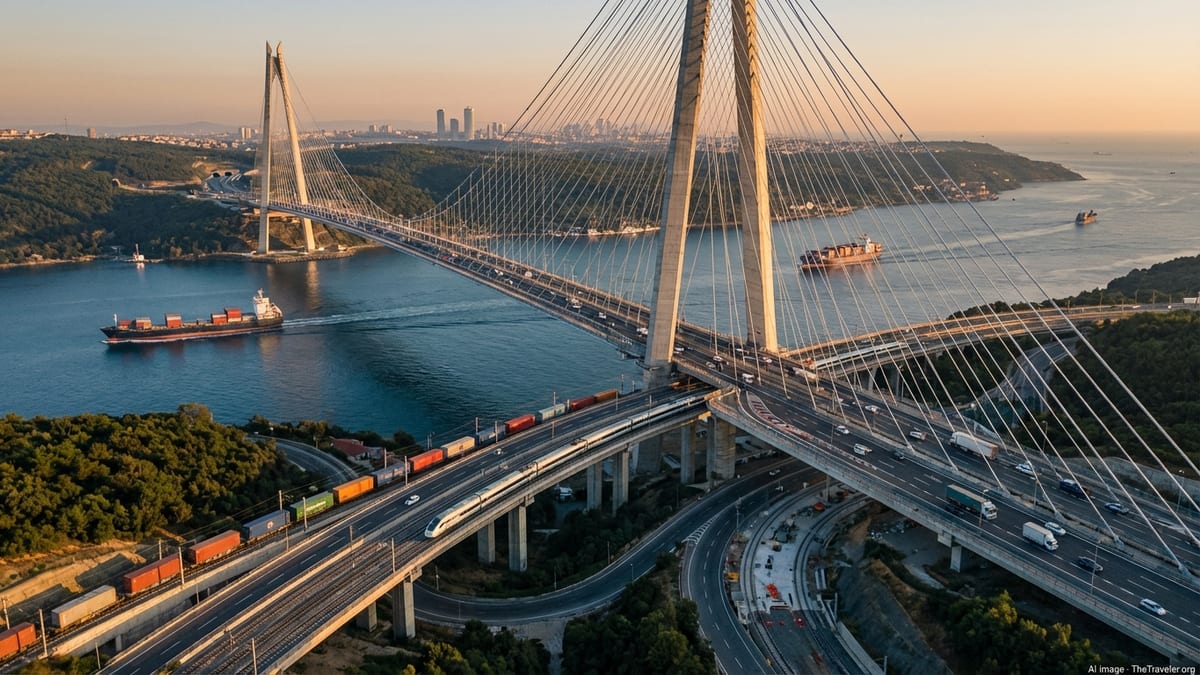
Transport and Infrastructure Minister Abdulkadir Uraloglu announced on February 24 that Ankara has reached preliminary agreements with six major international lenders for the Northern Ring Railway Project, a 125-kilometer line that will arc across the northern edge of Istanbul and cross the Bosphorus via the Yavuz Sultan Selim Bridge.
The package, valued at $6.75 billion, represents Turkey’s largest foreign-financed railway investment to date. Officials describe the strong response from multilateral lenders as a pivotal endorsement of the country’s long-term rail strategy and its bid to cement Istanbul’s role as a key junction on east–west transport corridors.
Once completed, the line is expected to carry around 33 million passengers and 30 million tons of freight annually, significantly expanding rail capacity between the Asian and European sides of the metropolis. Authorities say the project will usher in what they call a new era in logistics for the wider region.
Global Lenders Line Up Behind Bosphorus Corridor
The financing framework brings together some of the world’s most influential development institutions. Preliminary deals have been struck with the World Bank, the Asian Infrastructure Investment Bank, the Asian Development Bank, the Islamic Development Bank, the European Bank for Reconstruction and Development, and the OPEC Fund for International Development.
For these lenders, the railway is framed as both a trade and climate project: shifting freight from road to rail, cutting journey times between continents and helping reduce emissions along one of the busiest transport axes between Asia and Europe. Their participation signals confidence not only in Turkey’s sovereign risk profile but also in the long-term demand for rail-based logistics across the Bosphorus.
According to Turkish officials, work is now focused on finalizing the tender documentation. The government aims to complete the bidding process and hand over the construction site within this year, setting the stage for physical works to begin soon after contracts are awarded.
Route to Link Istanbul’s Airports and Ease Urban Congestion
The Northern Ring Railway will run from the industrial hub of Gebze on the Asian side to Halkali on the European side, effectively creating a high-capacity outer rail belt across Istanbul’s northern districts. Crucially, the line will directly connect Istanbul Airport and Sabiha Gokcen Airport, offering the first dedicated rail link between the city’s two main aviation gateways.
By routing both passenger and freight traffic over the Yavuz Sultan Selim Bridge, the corridor is designed to take pressure off the Marmaray rail tunnel, currently the primary cross-Bosphorus rail artery and already operating under tight time windows for freight services. Officials say the new line will help rebalance flows across the wider network, freeing up slots and easing bottlenecks that affect both commuters and cargo operators.
For travelers, the project promises shorter transfer times between airports and new rail alternatives to some of Istanbul’s most congested highway routes. For logistics operators, the promise is an uninterrupted, higher-capacity route that can bypass inner-city congestion while still tapping into key freight terminals on both continents.
Engineering a New Continental Rail Spine
Beyond its financial scale, the Northern Ring Railway stands out for its engineering complexity. Plans call for 44 tunnels with a combined length of just over 59 kilometers and 42 bridges totaling around 22 kilometers along the corridor, reflecting the rugged topography of northern Istanbul and the need to minimize surface disruption in sensitive areas.
The line’s Bosphorus crossing via the Yavuz Sultan Selim Bridge will add a new rail function to a structure already recognized as one of the tallest and widest suspension bridges in the world. Incorporating rail on the bridge allows the project to avoid a second sub-sea tunnel while still delivering a continuous, high-capacity connection between continents.
Transport planners say the corridor has been designed to interface with existing and planned high-speed and freight lines, turning the northern belt into a backbone for future services stretching deeper into Anatolia as well as toward European rail hubs. In the medium term, the line is expected to support heavier freight trains and longer-distance passenger services alongside regional and airport-linked operations.
Strategic Boost to Asia–Europe Trade and Regional Rail Ambitions
The new Bosphorus railway comes as Turkey accelerates its ambitions to position itself as a central node in Asia–Europe supply chains. By offering an additional high-capacity rail crossing and a dedicated freight-friendly route, the project is intended to complement existing corridors and make rail a more attractive option for long-haul shippers moving goods between the two continents.
Government officials argue that improved cross-Bosphorus connectivity will support emerging transcontinental freight initiatives and allow Turkey to capture a larger share of value-added logistics activity, from intermodal terminals to warehousing and distribution centers clustered around the new line.
For Istanbul’s residents and visitors, the project is equally framed as a mobility upgrade, giving the city a second major rail spine that could, over time, underpin new commuter patterns, airport access options and regional rail links. With the financing framework in place and tender preparations advancing, the Northern Ring Railway has moved from vision to near-term implementation, setting up Istanbul and Turkey for a reshaped rail map that reaches far beyond the Bosphorus shores.