

For many travelers, the word “exotic” conjures images of minarets and marketplaces, spice-scented alleyways, and landscapes that look nothing like home. Few destinations embody that dream more vividly than Turkey and Morocco, two gateway countries where Europe, Africa, and the Middle East intersect. Both promise maze-like old cities, richly layered history, and cuisine built on centuries of trade. Yet the kind of “exotic” you experience in Turkey versus Morocco can feel very different once you land. Choosing between them comes down to what kind of intensity, comfort level, and cultural mix you are really looking for.
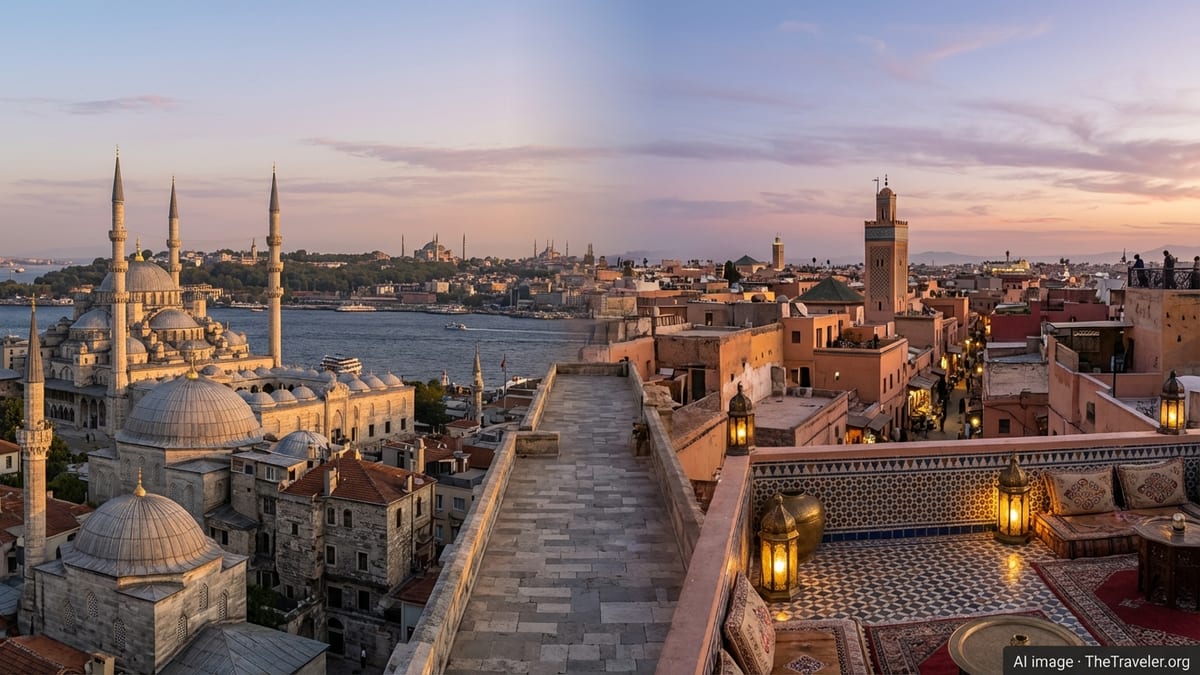
First Impressions: How Each Country Feels on Arrival
Touching down in Turkey, especially in Istanbul, many visitors sense a blend of the familiar and the foreign. Sleek new airport terminals, an efficient metro and tram system, and wide boulevards ease you in before you step into the historic quarters of Sultanahmet or Beyoğlu. The city’s skyline of domes and minarets is striking, but it sits alongside modern high-rises and shopping streets that would not look out of place in Southern Europe. For some travelers, that balance makes Turkey feel comfortably exotic rather than overwhelming.
Morocco, by contrast, tends to feel more immediately “other.” Leaving the airport in Marrakech or Fes, you move quickly from palm-fringed boulevards into heaving medinas where donkey carts, scooters, and pedestrians all battle for inches of space. The scents of leather, cumin, and charcoal smoke hit at once. While there are modern districts in every major Moroccan city, the daily life most travelers encounter is concentrated in older quarters that have changed slowly over centuries. That intensity is exactly what many people are seeking when they picture an exotic North African escape.
For first-time travelers beyond Europe and North America, Turkey often feels like a gentler introduction. Morocco, with its denser medinas and more persistent street hustle in tourist zones, can feel more adventurous. Neither is objectively more exotic; it is a question of how much cultural immersion you want in your first hours on the ground.
Architecture, History, and Sense of Place
Turkey’s exotic appeal is rooted in its role as the hinge of empires. Istanbul alone layers Byzantine churches, Ottoman mosques, and 19th-century European-style avenues in a compact area. Icons such as Hagia Sophia and the Blue Mosque dominate the historic peninsula, while the Grand Bazaar showcases centuries of merchant life under one vast roof. Beyond Istanbul, Cappadocia’s fairy chimney rock formations and rock-hewn chapels inside Göreme Historical National Park, a UNESCO World Heritage Site, create a landscape and built environment that feels closer to a fantasy novel than a typical city break.
Western and central Turkey add further depth. At Ephesus, travelers walk marble streets once trodden by Roman citizens. In Konya, the city of the Whirling Dervishes, Sufi heritage shapes everything from museum spaces to evening performances. Natural wonders such as the white travertine terraces of Pamukkale introduce yet another visual layer, so the country’s sense of place is constantly shifting even on a short itinerary.
Morocco’s architecture leans more consistently toward the Maghreb and Arab-Andalusian traditions. Imperial cities such as Marrakech, Fes, Meknes, and Rabat blend towering gates, intricately tiled madrasas, and central squares where life still revolves around markets and public gatherings. Within the medinas, homes hide behind plain walls, but inside many lie carved cedar ceilings, zellij tilework, and central courtyards cooled by fountains. Even everyday streetscapes can feel deeply exotic to visitors used to glass-and-steel skylines.
Outside the cities, Morocco’s kasbahs and fortified villages on the fringes of the Atlas Mountains and Sahara echo caravan days, while blue-painted towns like Chefchaouen add a dreamlike visual twist. Compared with Turkey’s wider range of styles, Morocco offers a more concentrated and traditional architectural vocabulary, which some travelers find more intensely “exotic,” especially on their first trip.
Landscapes and Natural Drama
Both countries offer dramatic, photogenic landscapes, but the feel of those landscapes is very different. Turkey stretches from the Aegean and Mediterranean coasts across Central Anatolia to the rugged mountains along the Black Sea and the borders with Georgia, Armenia, Iran, and Iraq. This geographic breadth means your idea of “exotic Turkey” could be sunlit bays with pine-covered slopes, the eroded volcanic valleys of Cappadocia, or the stark plateaus of eastern Anatolia. Hot-air balloons drifting over Cappadocia’s canyons at sunrise have become one of the country’s defining travel images and contribute strongly to its otherworldly reputation.
Morocco’s landscapes are more concentrated but no less striking. The High Atlas Mountains slice the country from southwest to northeast, with Berber villages clinging to hillsides and winding passes connecting lush valleys. South of the mountains, travelers reach semi-desert and, further east, the sand dunes that are often marketed as “the Sahara” on multi-day tours. Sunrise over the dunes, reached by camel or 4x4, delivers that classic desert-silhouette moment that many travelers equate with exotic adventure.
Along the coasts, contrasts continue. Turkey’s Aegean and Mediterranean shores are dotted with resort towns, yacht harbors, and ancient ruins perched above turquoise seas. The experience can feel closer to a Greek island holiday, though Ottoman and Anatolian elements keep it from blurring entirely into European beach culture. Morocco’s Atlantic coast, from Essaouira to Asilah, is windier and wilder, with fortified walls, fishing fleets, and long sandy beaches where surfing culture mixes with North African daily life.
If you dream of surreal rock formations, lush valleys, and historical ruins in different climates within a single trip, Turkey may feel more varied. If your idea of exotic centers on the desert, mountain villages, and ancient caravan routes, Morocco will likely match your mental image more closely.
Culinary Adventures and Everyday Eating
Food often defines how exotic a place feels, and both countries deliver richly. Turkish cuisine combines influences from the Ottoman court, Central Asia, the Balkans, and the eastern Mediterranean. Travelers quickly encounter meze spreads of small plates, grilled meats, stuffed vegetables, and pastries soaked in syrup. Street food is approachable and varied, from simit bread rings to stuffed mussels and döner sandwiches. For many visitors, the familiarity of ingredients like eggplant, yogurt, lamb, and tomatoes, presented in new combinations, makes Turkish food feel exciting yet accessible.
Regional diversity adds further depth. In the southeast, dishes become spicier, with rich kebabs and pistachio-laden baklava. On the Black Sea coast, anchovies and corn feature prominently, while central Anatolia favors hearty stews. Tea houses and coffee spots anchor daily life, and it is easy to sit for long stretches sipping strong black tea or Turkish coffee while watching the city go by.
Moroccan cuisine leans more heavily on spice blends such as ras el hanout, preserved lemons, olives, and slow-cooked tagines. The combination of sweet and savory flavors, as in lamb with prunes or chicken with apricots, can feel more unusual to palates unused to North African food. Couscous, often served on specific days of the week, is still a staple in many homes. In medinas, travelers snack on grilled brochettes, fresh-squeezed orange juice, snail soup, and endless varieties of bread.
For some visitors, Moroccan food feels more exotic because of its stronger spice profiles and less familiar flavor pairings. For others, the heavy use of slow-cooked dishes and bread-based meals can feel repetitive on a long trip. Turkey wins on sheer variety and ease of ordering for newcomers, while Morocco can deliver a more distinctive flavor memory if you are open to experimentation and willing to seek out smaller local eateries instead of tourist-focused rooftop restaurants.
Cultural Norms, Religion, and Local Interaction
Both Turkey and Morocco are majority Muslim countries, and the call to prayer structures daily rhythms in cities and villages alike. In Turkey, especially in Istanbul and on the coasts, secular lifestyles and conservative religious practice often coexist side by side. You will see women in full hijab next to others without head coverings, couples holding hands in busy districts, and nightlife neighborhoods that stay open late. The result can feel like a bridge between Western Europe and the Middle East, particularly in cosmopolitan centers.
In Morocco, everyday life tends to present as more overtly conservative, particularly in smaller cities and rural areas. Travelers quickly notice local modest dress, more gender-segregated spaces in some neighborhoods, and expectations around public displays of affection. None of this is necessarily restrictive for respectful visitors, but it does contribute to a sense of stepping further from Western social norms. Many travelers appreciate the warmth and hospitality that come with that social fabric, especially when invited into homes or guesthouses that operate more like family stays than anonymous hotels.
Street interaction varies too. In Turkish cities, vendors can certainly be persistent in tourist zones, but many visitors find it relatively easy to window-shop or wander without constant engagement after a polite refusal. In parts of Morocco, particularly in the most touristed medinas, some travelers report more frequent approaches from touts, unofficial guides, and salespeople. For confident travelers, these interactions become part of the story; for others, they contribute to a feeling of sensory overload.
On balance, Turkey may feel culturally exotic but socially easier for those new to the region, while Morocco can feel more immersive and, at times, more demanding. Your comfort with bargaining, saying no, and navigating crowded markets should play a role in deciding which version of exotic you prefer.
Practicalities: Costs, Transport, and Safety
From a practical standpoint, both countries are relatively budget-friendly compared with many European destinations, though prices fluctuate with currency shifts and local inflation. In Turkey, long-distance buses, domestic flights, and intercity trains connect major sights efficiently, while urban public transport in Istanbul and other large cities is modern and expanding. This infrastructure makes it easier to combine multiple regions in a single trip without relying heavily on private drivers.
Morocco’s transport network offers a mix of intercity trains on main routes, buses, and organized tours. Rail links between cities like Tangier, Rabat, Casablanca, and Marrakech provide a comfortable backbone for itineraries, and the country is expanding high-speed rail to further shorten travel times between key hubs. Away from those corridors, many travelers join group tours or hire private drivers, particularly to reach desert camps or mountain villages where public options are limited.
Safety is a common concern for travelers weighing exotic destinations. Both Turkey and Morocco see millions of visitors each year and are generally considered safe for tourism, though advisories from Western governments frequently recommend a degree of caution. In both countries, petty crime such as pickpocketing and minor scams occurs in busy markets and transit hubs, and travelers are advised to keep valuables secure and be wary of unsolicited offers of help. Political events or protests can occasionally flare in larger Turkish cities, while in Morocco, authorities advise against travel to remote border areas not on typical tourist routes.
Solo travelers, especially women, often report nuanced experiences. Many feel comfortable in both countries with basic precautions, though some note more frequent street harassment or unwanted attention in certain Moroccan medinas. In Turkey’s major tourist centers, experiences are mixed but often moderated by more visible police presence and a significant domestic tourism market. Ultimately, both destinations reward situational awareness and respect for local customs; neither should be approached with fear, but neither should be treated casually.
Seasonality and Crowd Patterns
Turkey and Morocco are year-round destinations, but when you go strongly shapes how exotic they feel. In Turkey, coastal resorts on the Aegean and Mediterranean are at their busiest in summer, with hot temperatures and a distinctly holiday atmosphere that can feel more international than local. Spring and autumn are often ideal for Istanbul, Cappadocia, and archaeological sites, offering mild weather and fewer tour groups. Winter brings snow to central and eastern Anatolia and a moody, atmospheric Istanbul, where historic mosques and cafes feel especially evocative.
Morocco’s summer heat, especially inland, can be intense, pushing daytime exploration into early mornings and late evenings. Coastal towns like Essaouira benefit from cooling Atlantic breezes, making them appealing in the hotter months. Many travelers find late autumn through spring the most comfortable time to visit cities and desert regions, with cooler nights in the Sahara adding to the romance of camp stays. Mountain areas, however, can be cold and snowy in winter, affecting hiking plans.
In both destinations, peak tourist seasons bring crowds and higher prices to marquee sights. Istanbul’s main attractions, Cappadocia’s balloon flights, and Morocco’s busiest squares can feel more international than local in those months. Traveling slightly off-peak can restore some of the exotic sense of discovery, as you share spaces with more residents than tour groups. If your idea of exotic includes a touch of solitude, shoulder seasons are worth targeting in both countries.
The Takeaway
When travelers ask which country feels more exotic, they are often really asking which destination will shake them furthest out of their comfort zone without tipping into distress. On that spectrum, Morocco typically offers a more intense first impression: denser old cities, more traditional social norms on display, and a daily street life that looks and feels markedly different from Western urban experience. For many, that is the very definition of exotic.
Turkey, by contrast, surrounds you with a remarkable blend of East and West. Istanbul’s skyline of domes and minarets, Cappadocia’s dreamlike valleys, and central Anatolia’s spiritual centers all deliver a powerful sense of elsewhere, yet the underlying infrastructure and social mix often feel more familiar. Travelers who want exotic architecture, food, and history, but also value easier logistics and a slightly softer landing, tend to gravitate toward Turkey.
If you relish crowded markets, do not mind occasional hard bargaining, and dream specifically of desert nights and walled medinas, Morocco may be your best match. If you prefer a wider variety of landscapes, a more diverse architectural story, and a smoother balance between the foreign and the familiar, Turkey likely offers the version of exotic that will leave you inspired rather than exhausted. In the end, both countries reward curiosity and respect, and either one can deliver the kind of transformative journey that lingers long after your flight home.
FAQ
Q1. Which country feels more culturally different from Western Europe and North America, Turkey or Morocco?
Morocco generally feels more culturally different day to day, especially inside traditional medinas and rural areas, while Turkey often blends European and Middle Eastern influences in a more familiar way.
Q2. Is Turkey or Morocco better for a first-time traveler outside Europe and North America?
Turkey is often easier for a first big trip, thanks to extensive transport, a wide variety of accommodations, and cities that are used to hosting both regional and long-haul visitors.
Q3. Which destination offers more dramatic landscapes in a single itinerary?
Turkey usually offers greater variety in one trip, from coastal resorts and ancient ruins to Cappadocia’s volcanic valleys and high plateaus in the interior.
Q4. Where will I find more intense market and street life?
Moroccan medinas in cities like Marrakech and Fes tend to feel more intense, with narrow lanes, dense crowds, and a higher level of street hustle around visitors.
Q5. Is one country noticeably cheaper than the other?
Both are generally good value compared with many European destinations, but actual costs depend on exchange rates and travel style. Budget travelers can keep expenses moderate in either country.
Q6. Which destination is better if I am particularly interested in ancient history?
Turkey is stronger for ancient sites from multiple eras, including Greco-Roman cities, Byzantine landmarks, and Ottoman architecture layered across a wide geographic area.
Q7. Where will I find more distinctive local cuisine?
Both countries have memorable food, but Morocco’s heavier use of spice blends, preserved ingredients, and sweet-savory tagines often feels more unusual to first-time visitors.
Q8. Is one destination clearly safer than the other for solo travelers?
Both Turkey and Morocco see large numbers of solo travelers. Experiences vary, but many visitors find Turkey somewhat easier, while Morocco can require more assertiveness in crowded tourist areas.
Q9. Which country is better for a short five to seven day trip?
Morocco works well for a focused city-and-desert itinerary, while Turkey is ideal if you want one major city like Istanbul paired with a single region such as Cappadocia.
Q10. If I love desert scenery, should I prioritize Turkey or Morocco?
Morocco is the stronger choice for classic desert experiences, including sand dunes, camel rides, and overnight stays in tented camps on the edge of the Sahara.