

More news on this day
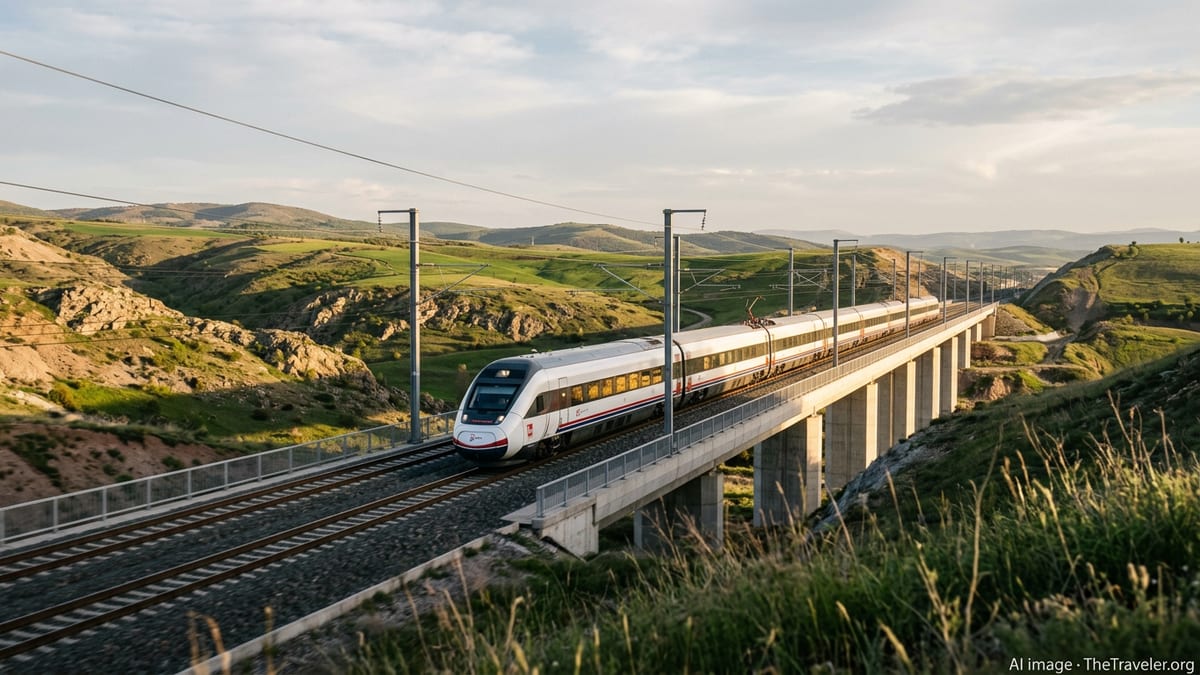
Turkey is entering a new era of rail travel as its first domestically designed 225 km/h high-speed train begins dynamic testing, laying the groundwork for faster, more frequent services and a transformed national network by 2026.
A 225 km/h Milestone for Turkey’s Rail Ambitions
After years of investment in high-speed infrastructure, Turkey is now putting a fully domestic train at the heart of its network. The new electric high-speed train set, engineered by state-owned manufacturer TÜRASAŞ with a maximum operating speed of 225 km/h, has moved from design and prototyping into on-track testing in early 2026. Transport officials say this marks a turning point in the country’s long-running push to become a regional rail powerhouse.
The train, configured as an eight-car set with capacity for around 580 passengers, is designed specifically for Turkey’s growing high-speed corridors, including the busy Ankara to Istanbul axis and emerging links to Sivas, Izmir and the country’s southeastern provinces. It will join and gradually complement the existing imported high-speed fleet, but with the critical distinction that key systems, components and final assembly are based in Turkey.
According to government statements and recent industry briefings, initial pre-series sets are expected to enter limited commercial service from 2026, following a structured test program that runs through 2025 and into next year. Full series production is planned through the second half of the decade, allowing the national operator TCDD Taşımacılık to roll out more frequent and longer high-speed services as new infrastructure opens.
Domestic Design, Local Supply Chains and Industrial Impact
The 225 km/h program is central to Turkey’s strategy of building a self-reliant rail industry. TÜRASAŞ has developed the high-speed sets using an upgraded platform derived from earlier 160 km/h electric multiple units, adding more powerful traction equipment, refined aerodynamics and enhanced crashworthiness to meet high-speed standards. A dedicated manufacturing and test complex in Sakarya has been established to support the project, with an annual capacity of up to a dozen high-speed trains once production ramps up.
Officials highlight that the localization rate for the new train is targeted at more than half of total value, with Turkish firms providing bodies, bogies, interiors and a growing share of traction and control systems. Major technology partners from the defense and electronics sectors are also involved, supplying power electronics, signalling interfaces and passenger information systems. This ecosystem is intended to reduce Turkey’s reliance on imported rolling stock while nurturing design and engineering expertise that could be exported in the future.
The industrial impact is already visible in the order books. The government has commissioned an initial batch of national high-speed sets to be delivered between 2026 and 2028, with options for further units if demand grows as projected. For regional suppliers, the program offers multi-year visibility and the chance to qualify for high-specification rail contracts, which could open doors to international projects as Turkey positions itself as a competitive player in global rolling stock markets.
Faster Links on an Expanding High-Speed Network
The new 225 km/h train is being introduced just as Turkey’s high-speed infrastructure enters its next growth phase. The existing Yüksek Hızlı Tren network already knits together Ankara with Istanbul, Konya and Sivas, and new lines such as the Ankara to Izmir corridor, the Istanbul to Kapıkule route toward the European Union border, and upgraded connections across central Anatolia and the southeast are under construction or in advanced planning.
On fully built high-speed lines, the national train is expected to cut journey times significantly compared with conventional services. Industry projections suggest that Ankara to Izmir trip times could be reduced to around three and a half hours once both infrastructure and rolling stock are in place, while links from Ankara to Sivas and further east will become more competitive with domestic air travel. The 225 km/h design speed aligns with the current geometry and signalling of most new Turkish high-speed routes, aiming for a balance between performance, energy efficiency and maintenance costs.
Beyond raw speed, the new trains are designed to improve reliability and capacity. Each set offers wide doors, level boarding at high platforms and rapid acceleration suited to corridors with multiple intermediate stops. Paired operation of two eight-car sets will enable operators to handle peak flows between major cities, particularly at holiday times and weekends when air and road capacity can be strained. Officials argue that this combination of speed and capacity is essential if rail is to capture a significantly larger share of Turkey’s intercity travel by 2030.
Passenger Experience: From Comfort to Connectivity
The national high-speed train is also being promoted as a step up in passenger comfort. Renderings and early interior mock-ups showcase a mix of economy and business-class seating, with ergonomic seats, individual power outlets, onboard Wi-Fi and large panoramic windows as standard. Noise and vibration levels are being tightly controlled through advanced bogie design and sound insulation, a priority for long-distance journeys across the Anatolian plateau.
Accessibility has been built into the specification from the outset, with dedicated spaces for wheelchair users, tactile signage, and accessible toilets. Catering cars, family areas and quiet zones are planned, allowing operators to tailor the onboard offer to different routes and markets. Digital ticketing and real-time occupancy information are expected to help manage demand, with passengers able to choose seats and monitor crowding through mobile apps.
For tourists, the improved rail product could reshape classic itineraries. Faster links between Istanbul, Cappadocia gateways, the Aegean coast and emerging destinations such as the Black Sea region will make multi-city trips more practical without domestic flights. Travel agencies are already exploring new high-speed rail packages that combine city breaks with coastal stays, leveraging the reliability and comfort of the new trains to appeal to visitors who prefer to avoid short-haul flights.
How 2026 Could Redefine Rail Travel in Turkey
By late 2026, if testing and certification proceed as planned, Turkey’s national high-speed train is expected to be in regular passenger service on at least one major corridor, with additional sets following quickly. This will coincide with the staged opening of new and upgraded lines, meaning that much of the added capacity will be delivered using domestically built equipment. Transport planners see this as the start of a virtuous cycle in which higher service quality attracts new riders, supports more frequent schedules and justifies further infrastructure spending.
The implications extend beyond passenger numbers. Shifting more long-distance journeys from roads and short-haul flights to electric high-speed trains will help Turkey meet climate and air-quality objectives, especially on congested intercity axes. Freight may also benefit indirectly as passenger services move to dedicated high-speed tracks, freeing paths on conventional lines for logistics operators.
With testing underway and the first 225 km/h trainsets preparing for commercial deployment, 2026 is shaping up as a defining year for Turkish rail. If the program succeeds, it will not only shorten travel times between the country’s largest cities but also demonstrate that a middle-income economy can design, build and operate its own modern high-speed fleet, reshaping both domestic mobility and industrial capabilities in the process.